

How does the powder coating process enhance the longevity and appearance of black metal products compared to other finishing methods?
Black powder coating enhances longevity by bonding a cured, protective layer to prepared metal, helping resist corrosion, abrasion, chipping and everyday wear. Compared with conventional liquid paint, it generally provides a more uniform, durable finish with strong colour consistency and a clean black appearance, provided the metal is correctly prepared and the coating is properly applied and cured.
Black powder coating can extend the service life of metal products and maintain a consistent visual finish because the process combines controlled surface preparation, electrostatic application and oven curing. Its main advantage over many conventional finishing methods is that the finished surface is engineered as part of a repeatable production process, rather than relying solely on a liquid film drying in ambient conditions. The result depends on the metal, coating specification, preparation standard and curing schedule, so powder coating is not automatically the best choice for every application.
Why the preparation stage matters
Durability begins before the black powder is applied. Oil, mill scale, rust, welding residue and other contaminants must be removed so the coating can adhere consistently. Depending on the component and its intended environment, preparation may include degreasing, abrasive blasting or chemical pre-treatment. Poor preparation can lead to localised lifting, blistering or premature deterioration regardless of the coating material used.
Preparation also affects appearance. A blasted surface may produce a different visual character from a finely prepared smooth surface, while welds, sharp edges, pits and surface repairs can remain visible beneath a dark coating. Identifying these features before coating allows the specification and preparation method to be matched to the required finish.
How the powder application affects service life
Powder particles are applied to the electrically prepared metal and then heated until they flow and cure into a continuous film. Correct control of the coating thickness and oven conditions is important. Insufficient curing can leave the film with reduced performance, while excessive heat or an unsuitable schedule can affect colour and finish. Components must also be arranged so that recessed areas, internal corners and difficult-to-reach faces receive adequate coverage.
This controlled application can offer practical advantages over conventional wet paint. Liquid paint may be more vulnerable to runs, sags, solvent-related defects and variations caused by application conditions. Powder coating avoids the use of a wet solvent-based film during application and can provide a more repeatable result when the equipment and process are properly controlled. However, intricate components still require careful racking, masking and inspection.
Appearance advantages of black powder coating
Black powder coating is available in different levels of gloss, surface textures and visual effects. A smooth high-gloss finish can create a clean, modern appearance, whereas a fine-textured or matt finish can reduce the visibility of minor handling marks and provide a less reflective surface. The appropriate choice depends on the product design, surrounding materials, lighting and expected handling.
Compared with brush or spray-applied paint, a properly specified powder finish can give a more even appearance across batches, with fewer visible application marks. Black also provides a strong visual contrast against lighter components and can make a product appear more uniform where several metal parts are assembled together. Colour consistency still requires control of the powder type, film build, curing conditions and batch compatibility; different black formulations are not necessarily visually identical.
Appearance can change if the product is exposed to ultraviolet light, heat, chemicals, moisture or repeated cleaning. For external applications, the coating specification should therefore be selected for the exposure conditions rather than by colour alone. A black finish may also show dust, fingerprints, scratches or uneven preparation more readily than some lighter or textured finishes, particularly where a high-gloss appearance is required.
Comparison with other finishing methods
- Wet paint: useful where on-site application, very large assembled structures or low-temperature substrates make oven curing impractical. It can also simplify local touch-up. Powder coating is often preferable for repeatable factory finishing of removable metal components, but it requires the component to tolerate the curing process and fit within the available equipment.
- Electroplating: can provide a thin metallic or protective layer and may suit parts requiring particular electrical, dimensional or surface properties. Powder coating generally provides a different visual and protective system, with more choice of opaque black textures and gloss levels. The two methods should be selected according to the substrate, tolerances and exposure rather than appearance alone.
- Anodising: is primarily associated with aluminium and changes the surface of that metal rather than adding a conventional polymer film. It can be durable and dimensionally controlled, but its colour range and visual character differ from an opaque black powder finish. Powder coating may be more suitable where a consistent solid black appearance is required across compatible metal components.
- Galvanising: is mainly selected for sacrificial protection of steel in demanding outdoor conditions. Its characteristic appearance and surface profile are different from a decorative black finish. A powder topcoat can be considered as part of a duplex system where the specification and preparation are suitable, but it should not be treated as a simple replacement for galvanising in every environment.
Factors that determine actual longevity
The expected service life is governed by more than the black colour or the powder brand. Relevant factors include the base metal, edge design, weld quality, pre-treatment, coating chemistry, film thickness, curing accuracy and the level of exposure. Coastal salt, industrial pollutants, standing water, abrasive contact and aggressive cleaning products can all place greater demands on the finish.
Product design can either support or undermine the coating. Drainage holes, accessible surfaces and rounded edges help preparation and coverage, while narrow crevices and sharp edges may create weak points or retain moisture. Parts should be handled and packaged in a way that avoids damaging the finish before installation. Once in service, removing deposits with suitable cleaning methods helps preserve the appearance; harsh abrasives and unsuitable chemicals can mark or dull the surface.
When powder coating is the appropriate choice
Black powder coating is well suited to manufactured metal parts, fabricated components, frames, panels and batch-produced products where a consistent opaque finish and controlled factory process are required. It is less suitable where the item cannot tolerate curing heat, cannot be transported to the coating facility, requires frequent field repairs or has unusually tight assembled tolerances.
For an informed comparison, the coating specification should state the substrate, preparation standard, black finish and gloss or texture requirement, exposure conditions, masking points and inspection expectations. Discussing these details with a specialist coating provider helps establish whether powder coating offers the right balance of appearance, durability, process control and maintainability for the product.
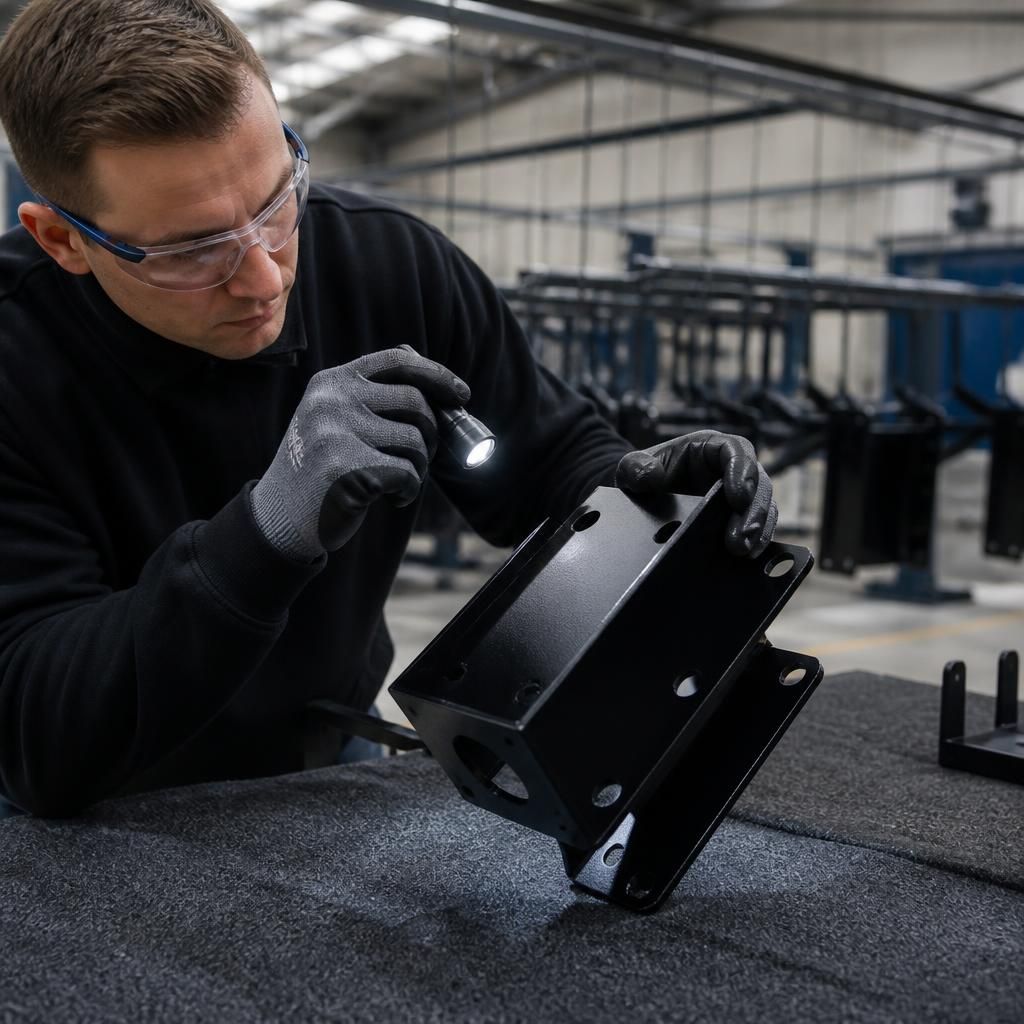
A controlled black powder finish makes pre-installation quality inspection more straightforward. Under consistent lighting, inspectors can look for visible discontinuities such as bare areas, pinholes, inclusions or uneven coverage before a component is assembled or put into service. This connects appearance with longevity: a uniform-looking film is not, by itself, proof of complete protection, but obvious defects can indicate areas where moisture or contaminants may reach the underlying metal.
Inspection should assess the whole component rather than only its broad faces. Edges, apertures, mounting points and areas affected by handling deserve particular attention because a small coating defect in a vulnerable location can have greater practical significance than a minor variation on a sheltered surface. Recording these checks as part of a repeatable finishing process helps distinguish an attractive black appearance from a coating that has also been applied consistently enough for its intended use.