

How does the thickness of the powder coating on black metal sheets affect their performance in harsh environments?
Powder coating thickness directly affects how well black metal sheets resist corrosion, abrasion, impact and moisture in harsh environments: an insufficient film may leave weak coverage, while a correctly specified film provides a more consistent protective barrier. Excessive thickness is not automatically better, as it can affect finish quality, adhesion and curing, so the required coating thickness should be matched to the substrate, powder system and service conditions.
Powder coating thickness affects the way a black metal sheet withstands environmental exposure by determining the depth and continuity of its protective film. In harsh conditions, the most suitable thickness is the one specified for the powder system, metal substrate and exposure category—not simply the greatest thickness that can be applied. A correctly controlled film helps maintain the sheet’s protective performance during wet, chemically exposed, abrasive or temperature-variable service.
Thickness is particularly important where moisture or contaminants may remain on the surface. A continuous film reduces the number of routes by which water, salts and industrial residues can reach the metal. If the coating is locally thin, variation between parts or missed areas may become the first point at which deterioration starts. This is why a nominal specification should be considered alongside the minimum film thickness achieved across the component, rather than relying only on an average reading.
Harsh environments rarely affect a flat sheet uniformly. Edges, corners, apertures, folds and fixing points are more difficult to coat consistently than broad faces. These areas may experience greater handling damage, concentrated wear or water retention. The selected coating system and application method therefore need to account for the sheet’s geometry. A thicker specification may be appropriate in some situations, but it will not correct poor edge preparation, inaccessible areas or a design that traps moisture.
External exposure also introduces ultraviolet radiation, rain, condensation and repeated heating and cooling. Black finishes can absorb more solar energy than lighter colours, so the coated sheet may experience greater surface temperature changes in direct sunlight. Repeated expansion and contraction can place stress on the coating and its interface with the substrate. Thickness must therefore be compatible with the powder formulation and curing requirements; adding material without confirming that compatibility can produce an inferior result rather than a stronger one.
Chemical exposure changes the assessment further. Industrial fumes, cleaning agents, salt deposits and process chemicals differ in concentration and frequency of contact. A coating that performs well in ordinary outdoor conditions may not be suitable for prolonged contact with a particular chemical. The chemical resistance of the powder system, the expected exposure and the required film specification should be reviewed together. Thickness supports barrier performance, but it does not make an unsuitable coating chemistry appropriate for the application.
Mechanical conditions should also be considered. A thicker film can provide more material for limited surface wear, but performance depends on the coating’s hardness, flexibility and resistance to the type of impact or abrasion involved. Sharp contact, repeated rubbing and movement at fixings can damage any finish if the design or handling method creates concentrated forces. For sheets used in demanding environments, the coating requirement should be based on the actual source of wear rather than thickness alone.
Film thickness is normally checked with a suitable gauge at representative locations over the sheet. Readings should include areas likely to vary, such as edges, corners and formed sections, while avoiding reliance on a single convenient measurement. The results can then be compared with the agreed specification for the coating system. Consistent readings are useful because excessive variation may indicate an application issue even when one area appears to meet the target.
- Environmental exposure: assess moisture, salt, chemicals, ultraviolet radiation and pollution.
- Temperature: consider direct sunlight, thermal cycling and the operating temperature of the finished sheet.
- Mechanical service: identify abrasion, impact, handling and movement at joints or fixings.
- Component design: review edges, bends, recesses and areas where water or debris may collect.
- Coating system: confirm that the powder type, specified film and curing requirements suit the intended service.
- Quality control: use documented thickness checks across representative parts rather than judging the finish visually.
For a black metal sheet intended for a harsh environment, the practical objective is an even, fully cured coating within the system’s specified range, supported by suitable substrate preparation and application control. The thickness should be agreed before production with reference to the exposure conditions and the sheet design. This approach gives a more reliable indication of long-term performance than treating coating thickness as an isolated measure of quality.
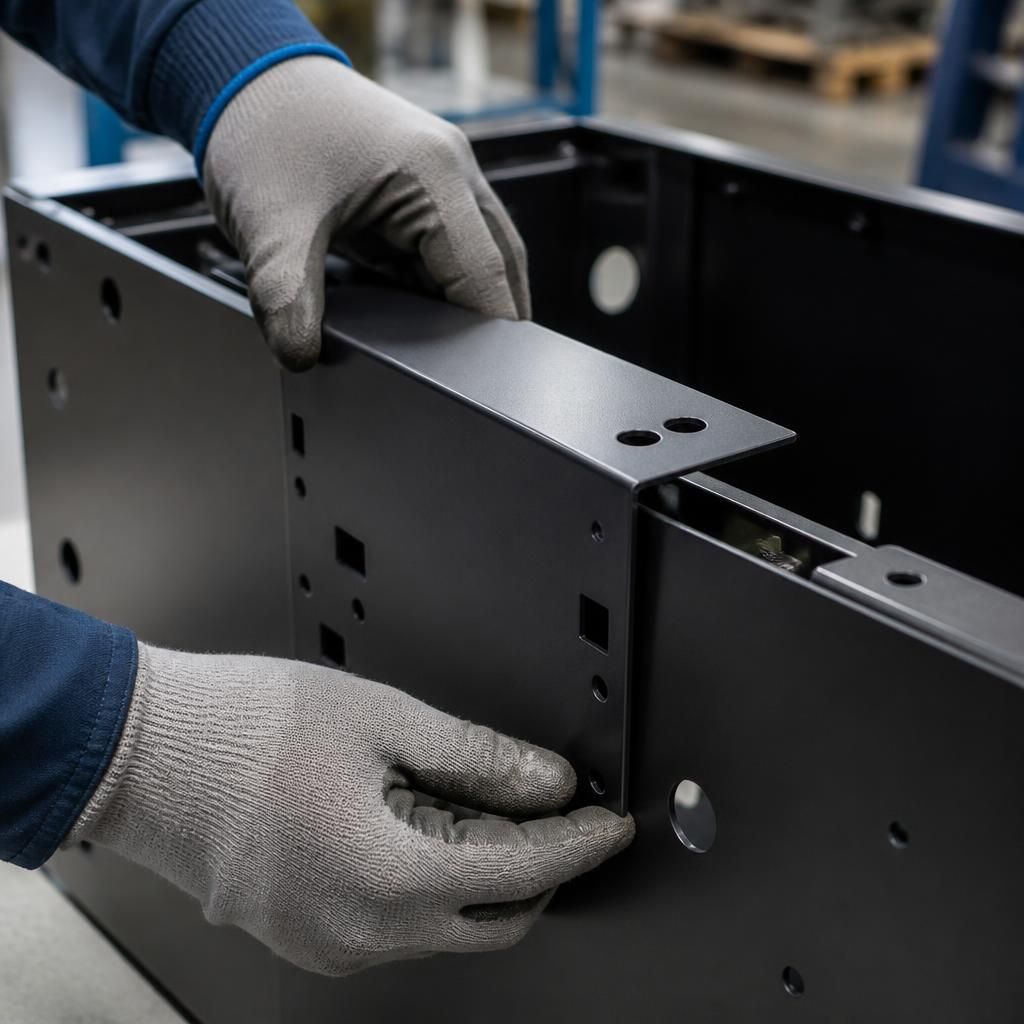
On black metal sheets used in assemblies, powder coating thickness can affect dimensional fit as well as surface protection. Excess coating around holes, folded returns, mating faces and fixing points may reduce clearances or interfere with accurate assembly. When parts are forced together or fasteners are tightened against an uneven film, the coating can be scraped or compressed, creating local damage that exposes the substrate to moisture and contaminants.
Thickness should therefore be specified with the sheet’s finished dimensions and method of assembly in mind. Areas that must remain electrically conductive, accept a close-fitting component or drain water effectively may require defined coating limits rather than simply the highest achievable film build. Controlling the coating in these functional areas helps preserve both assembly accuracy and the protective performance of the black finish.