

How do black protective powder coatings contribute to the energy efficiency of industrial operations?
Black protective powder coatings can support industrial energy efficiency by extending the service life of metal components, reducing the energy and resources associated with frequent stripping, repainting and replacement. Their dark finish can also absorb and retain heat, which may assist thermal management in suitably designed equipment, although the effect depends on the component, operating conditions and coating specification.
Black protective powder coatings can contribute to industrial energy efficiency mainly by supporting efficient thermal management and reducing the energy burden associated with coating manufacture, maintenance and replacement. They do not automatically reduce the electricity or fuel consumed by a machine, however. The result depends on the component design, the coating formulation, the operating temperature and whether the finished surface is intended to absorb, retain, radiate or resist heat.
Thermal behaviour of the finished surface
Colour and surface finish influence how a metal component interacts with heat. A black surface generally absorbs more radiant energy than a lighter surface, which can be useful where controlled solar or radiant heat absorption forms part of the equipment design. This may assist enclosures, housings or components that need to reach and maintain a working temperature, but it can be counterproductive where the aim is to limit heat gain.
Black coatings can also have relatively high thermal emissivity, particularly where the formulation and surface finish are designed for that purpose. High emissivity allows a surface to radiate heat effectively. In equipment designed to reject heat, this may support passive heat dissipation; in equipment that must retain heat, insulation and component geometry are usually more significant than colour. The coating should therefore be selected as part of the wider thermal design rather than treated as an insulation layer.
Lower resource demand during coating operations
Powder coating is applied as a dry powder and cured to form a continuous film. Unlike solvent-based liquid paint, it does not rely on the evaporation of large volumes of liquid carrier during application. Powder that does not adhere to the component may also be recoverable in suitably designed systems, although recovery performance depends on the equipment, colour management and contamination control.
These characteristics can reduce material waste and the energy associated with handling and processing coating materials. They do not remove energy consumption: the curing oven remains a significant part of the process, and its demand depends on part mass, oven loading, cure schedule, airflow and insulation. Efficient production planning is therefore important. Grouping compatible batches, avoiding unnecessarily long cure cycles and ensuring that the oven is correctly loaded can prevent avoidable energy use without compromising the specified finish.
Protection of thermal and mechanical performance
A correctly specified protective coating helps maintain the condition of metal surfaces exposed to moisture, chemicals, abrasion and outdoor conditions. For industrial equipment, preserving the designed surface condition can help components continue to operate within their intended tolerances. This is relevant to energy efficiency where corrosion, contamination or surface deterioration would otherwise increase heat-transfer resistance, interfere with moving parts or require additional cleaning and processing.
The effect is application-specific. A coated frame, guard or enclosure may gain its principal benefit from corrosion control, while a heat-producing housing may require a coating with carefully assessed emissivity and temperature resistance. A coating should not be expected to compensate for inadequate insulation, poor ventilation, an undersized heat exchanger or inefficient motors and drives.
Factors that determine the outcome
- Substrate and component design: the metal type, thickness, geometry and contact with other parts affect heat flow more than colour alone.
- Coating formulation: resins, pigments, additives and protective properties determine temperature resistance, emissivity, chemical resistance and long-term performance.
- Surface preparation and film thickness: inadequate preparation or an inconsistent film can lead to premature defects, while excessive thickness may affect fit, heat transfer or curing requirements.
- Surface texture and gloss: these can alter reflectance, radiative behaviour and cleanability, so the visual specification should be considered alongside the operating function.
- Operating environment: sunlight, process heat, wash-down chemicals, humidity and cyclic temperatures may change the coating’s practical performance.
For an industrial project, the most reliable approach is to define the component’s thermal role first, then specify the powder system, colour, finish, thickness and curing conditions around that requirement. Testing representative parts under their intended operating conditions can help establish whether the black finish provides useful heat absorption or heat rejection, and whether the complete coating process is compatible with the site’s energy objectives.
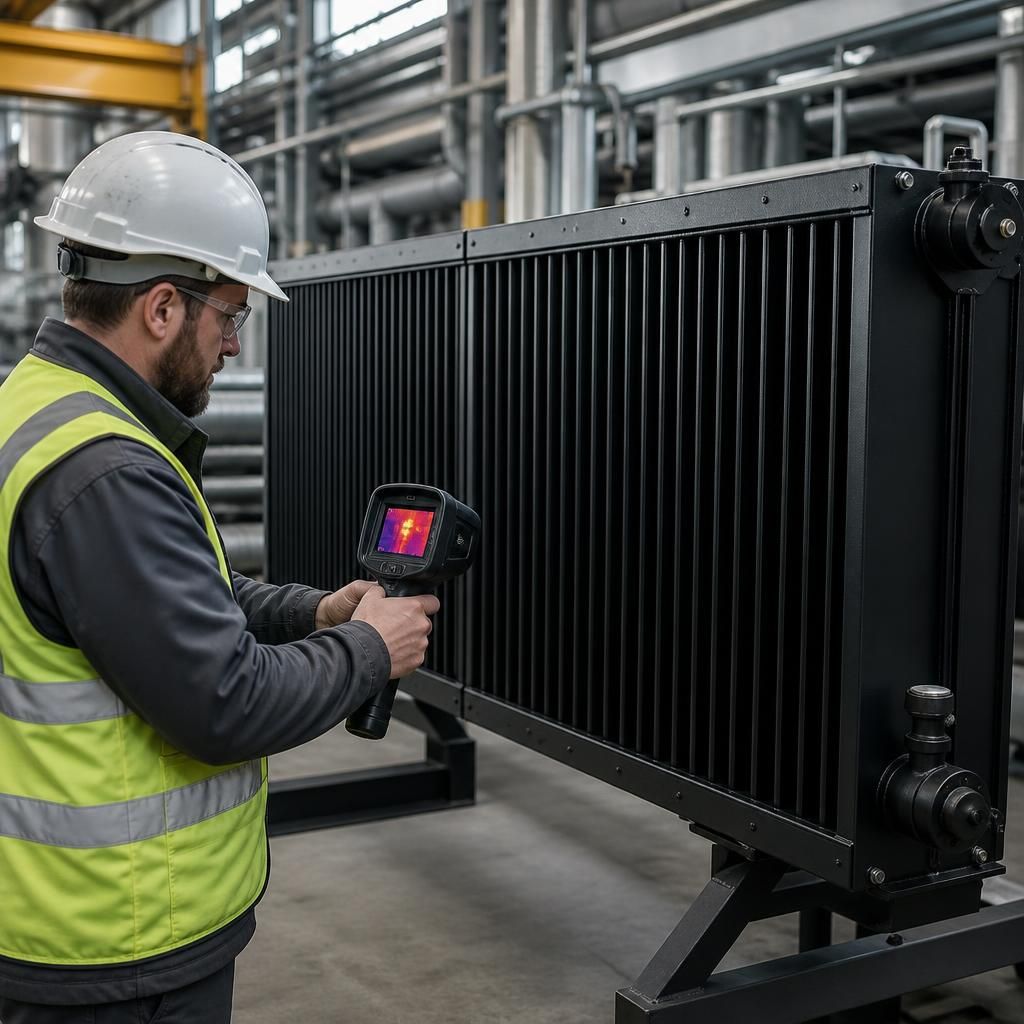
Black protective powder coatings support energy efficiency most effectively when their thermal properties are matched to the component’s operating duty. A black appearance alone does not show whether a surface will absorb or release heat efficiently; the specified formulation, gloss level and emissivity are more relevant than colour in isolation.
For equipment exposed to sunlight or process heat, assess the coating alongside ventilation, insulation, shielding and heat-transfer requirements. This prevents a finish selected for corrosion protection from unintentionally increasing heat gain or restricting the component’s intended thermal performance. Where heat rejection is important, the coating specification should be checked against the operating temperature and the manufacturer’s technical data before production.
Discuss Your Black Protective Powder Coating Requirements
Discuss your component’s operating temperature, thermal duty and required finish with the powder-coating team to identify a suitable black protective coating specification. Providing details of the substrate, application and environment will support a more informed assessment before production.