

How do different electrostatic finishes affect the longevity and maintenance of industrial components?
Different electrostatic finishes affect component longevity by changing resistance to abrasion, corrosion, chemicals, UV exposure and impact, while the coating’s texture and defect tolerance influence cleaning and inspection. Selecting a finish to match the component’s operating environment can extend protective performance and reduce maintenance requirements, provided the surface is prepared correctly and cleaned using suitable methods.
Different electrostatic finishes influence longevity and maintenance mainly through their surface profile, coating formulation, film build and suitability for the component’s duty. A finish that performs well on a machine guard may be unsuitable for a sliding part, a regularly handled enclosure or a component exposed to process chemicals. The visible level of gloss or texture is therefore only one part of the specification; the powder chemistry, curing requirements, substrate and application conditions also determine service performance.
Smooth finishes provide a relatively even surface that is straightforward to wipe and visually assess. They are often useful where cleanliness, clear identification of surface defects or close contact with seals and mating parts matters. Their uniform appearance can, however, make local marks, handling damage and inconsistent film build easier to see. This can be advantageous for inspection, as small defects are less likely to be overlooked.
Matt and textured finishes can reduce the visual prominence of minor scuffs and provide a different grip or tactile quality. Their surface profile may also affect how dirt, process residue and moisture are retained, particularly where the texture is pronounced. Maintenance procedures should account for this profile rather than assuming that a textured coating can be treated in exactly the same way as a smooth one. Excessively aggressive brushes or abrasive pads may gradually alter the appearance and expose high points of the coating.
Gloss level and appearance finishes also affect maintenance decisions. High-gloss surfaces make changes in uniformity and contamination more apparent, while low-gloss surfaces may conceal early visual changes but still require inspection for lifting, cracking or local damage. Metallic and other effect finishes can be more difficult to blend during repair because the final appearance may depend on spray direction, film distribution and the orientation of effect particles. Components requiring frequent local repair may therefore benefit from a finish with a simpler and more reproducible appearance.
Specialist nylon coatings are selected for applications where the coating must provide a particular combination of surface behaviour, such as reduced friction, impact tolerance or resistance to repeated contact. Their suitability depends on the operating temperature, mating material, movement, loads and any substances encountered in service. A nylon finish should not be chosen solely because it feels tough; the complete operating cycle and dimensional requirements need to be considered, since coating thickness can affect clearances, fits and threaded features.
Other protective finishes may be specified for a defined industrial duty rather than for appearance alone. These can be appropriate where components experience repeated handling, contact with process materials or a demanding combination of mechanical and environmental conditions. The key maintenance benefit comes from matching the coating system to the actual failure mechanism. For example, a finish intended for sliding contact should be assessed differently from one applied to a static enclosure, even if both components are made from the same metal.
To preserve service life, the maintenance plan should be agreed at the specification stage. It should identify:
- the areas most likely to receive repeated contact, impact or rubbing;
- any edges, apertures, welds, joints or fixing points requiring closer inspection;
- the permitted cleaning products and tools for the selected finish;
- dimensional surfaces where coating build must remain within an agreed tolerance;
- the visual and functional criteria that indicate a repair or recoating assessment is needed.
Inspection should distinguish between a change in appearance and a loss of protective function. A superficial mark may be cosmetic, whereas cracking, flaking, lifting or exposure of the underlying metal can indicate that the coating system is no longer providing the required protection. Early assessment is particularly important around edges, interfaces and areas subject to movement, because localised damage can develop differently from the main coated surface.
Cleaning should use methods compatible with the powder system and the finish profile. Non-abrasive equipment and controlled pressure are generally preferable to methods that can polish, score or erode the surface. Strong solvents, unapproved chemicals and concentrated mechanical cleaning can change the appearance or weaken the coating, even where there is no immediate visible failure. The appropriate method should be confirmed against the coating specification and the substances present in the operating environment.
Repairability is another factor in whole-life maintenance. A small isolated defect may be suitable for a local repair after the cause has been removed, but a repaired area may not exactly match the original gloss, texture or colour. Where damage is widespread, where adhesion has failed, or where the component has exceeded its intended duty, stripping and recoating may be more appropriate than repeated touch-up work. Any decision should also consider masking requirements, tolerances and whether the substrate needs additional preparation.
For industrial components, the most durable choice is consequently not always the hardest-looking or most decorative finish. The better selection is the one whose coating formulation, surface profile and repair requirements correspond with the component’s use, inspection regime and maintenance resources. A coating specialist can help translate those operating conditions into a finish specification, including the required appearance, film build, cure and areas that must remain uncoated.
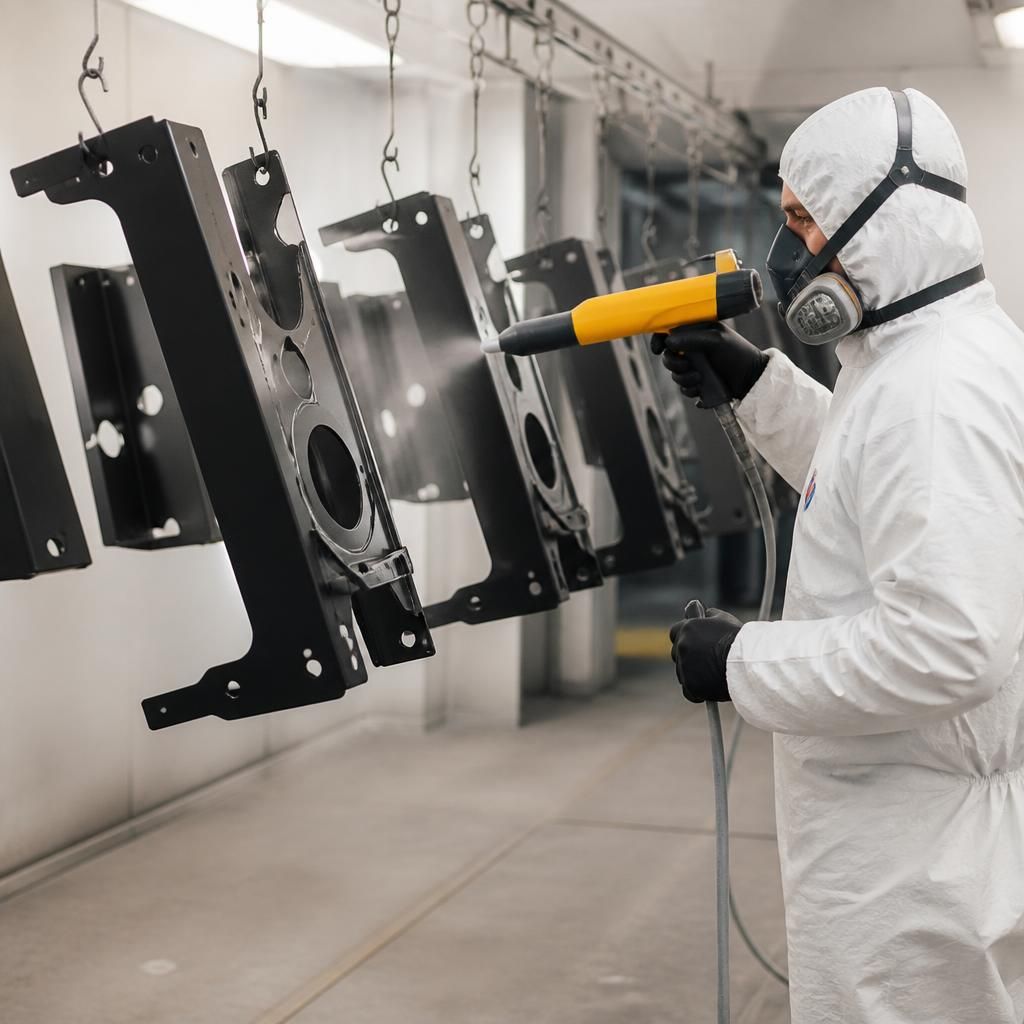
For complex industrial components, coating longevity is also affected by how evenly the powder reaches recessed areas, internal corners and screened sections. The electrostatic field can concentrate powder on exposed edges while reducing deposition inside deep recesses, a phenomenon commonly associated with the Faraday cage effect. If these areas are not addressed during application, they may have less protective coverage and become earlier points of corrosion or wear.
Component design and coating preparation should therefore be considered together. Application access, part orientation, earthing, powder-gun settings and any required pre-coating inspection can help improve coverage across difficult geometry. Drawings should identify surfaces that require full protection, controlled film thickness or masking, allowing the finish to be assessed against functional requirements rather than appearance on easily visible faces alone.
Discuss the right electrostatic finish for your components
Discuss your component’s operating conditions, contact points and maintenance requirements with a coating specialist to identify a suitable electrostatic finish. Providing drawings, material details and expected service conditions will help establish the appropriate coating specification.