

What are the specific benefits of choosing electrostatic coating for stainless steel components compared to other coating methods?
Electrostatic coating applies charged powder to stainless steel so it is attracted to the grounded component, helping produce a consistent, well-adhered finish across complex surfaces. Compared with methods such as conventional liquid painting or non-electrostatic application, it can reduce overspray, avoid solvent-based application and provide a durable finish with efficient powder transfer.
Electrostatic coating gives stainless steel components a cured polymer film that can add controlled colour, texture, chemical resistance and surface protection without changing the underlying metal significantly. Its main advantages over other methods are the range of finish options, consistent film control, suitability for repeat industrial production and the ability to specify a coating system around the component’s operating environment.
It provides more than stainless steel’s bare-metal finish. Brushing, polishing and other mechanical treatments alter the appearance of the surface but do not create a separate protective film. Passivation can support stainless steel’s corrosion resistance, but it does not normally provide colour, texture, impact protection or an electrically insulating surface. Electrostatic powder coating can therefore be useful where the component needs a defined appearance or additional surface properties rather than simply retaining its natural finish.
- Controlled appearance: Powder systems are available in different colours, gloss levels and textures, allowing components to be matched to equipment, plant layouts or identification schemes.
- Surface consistency: A specified powder and controlled curing process can help standardise the appearance of repeated components, which is useful for manufactured assemblies and visible architectural or engineering parts.
- Additional functional properties: The selected powder can be formulated for resistance to abrasion, impact, chemicals, moisture or particular industrial conditions. These properties depend on the resin system, film thickness, preparation and curing, so the coating should be selected against the actual service environment.
- Potential electrical insulation: Unlike bare stainless steel or many metallic treatments, a cured powder film can separate the metal surface from adjacent parts. Where insulation is important, the coating specification must address dielectric performance, thickness, edges and any areas that must remain conductive.
Compared with liquid paint, powder coating can offer a more robust finished film for many industrial applications. Liquid systems may be preferred where components cannot tolerate curing temperatures or where a particular thin-film, repair or specialist chemistry is required. Powder coating is often considered where a hard, formed film and repeatable production process are more important than applying the coating at ambient temperature. The correct comparison is between complete systems, not simply between powder and liquid materials: stainless steel grade, pre-treatment, powder chemistry, film thickness and curing all affect the result.
Compared with plating, electrostatic powder coating generally avoids adding a metallic layer to the component. That can make it appropriate where the required result is a coloured or textured protective surface rather than a conductive, metallic or decorative plated finish. Plating may be necessary for specific electrical, dimensional or wear requirements, while powder coating is usually selected for broader surface coverage and appearance control. Components with tight fits, threaded areas or close tolerances still require masking and specification of permitted coating build-up.
The method can also support practical design and production requirements. Stainless steel parts may be supplied in batches, assembled into larger fabrications or contain bends, apertures and formed sections. Powder coating can be specified with masking for mating faces, threads, earth points, bearing surfaces and other areas that must remain uncoated. This allows the visible and exposed areas to receive the required finish without treating every surface identically.
Another benefit is the ability to select a coating system for the component’s location rather than treating all stainless steel as equivalent. Indoor machinery, external fabrications, washdown areas, automotive parts and components exposed to industrial chemicals may require different powder chemistries and pre-treatment arrangements. Stainless steel itself varies by grade and surface condition, and contamination, oils or embedded iron can affect coating performance. Proper cleaning and preparation are therefore essential to achieving the advantages of the coating method.
Electrostatic coating is not automatically the best choice for every stainless steel component. The part must normally tolerate the curing cycle, and the design should allow reliable grounding, access for application and suitable masking. Heat-sensitive seals, electronics, lubricants or assembled components may need to be removed before coating. Areas subject to severe heat, prolonged immersion, aggressive chemicals or highly specialised electrical demands may require a different coating system or an alternative surface treatment.
For a sound comparison, assess the component against five criteria:
- the required appearance, including colour, gloss and texture;
- exposure to moisture, chemicals, abrasion, impact and temperature;
- dimensional tolerances, masking points and conductive contact areas;
- the stainless steel grade and condition of the surface;
- the powder chemistry, pre-treatment and curing requirements.
In summary, the specific benefit of electrostatic coating for stainless steel is not simply that it adds a finish. It provides a configurable, non-metallic surface system that can improve appearance control and add selected functional properties while remaining suitable for repeat industrial manufacture. Its performance depends on matching the complete coating process to the stainless steel substrate and the conditions in which the finished component will be used.
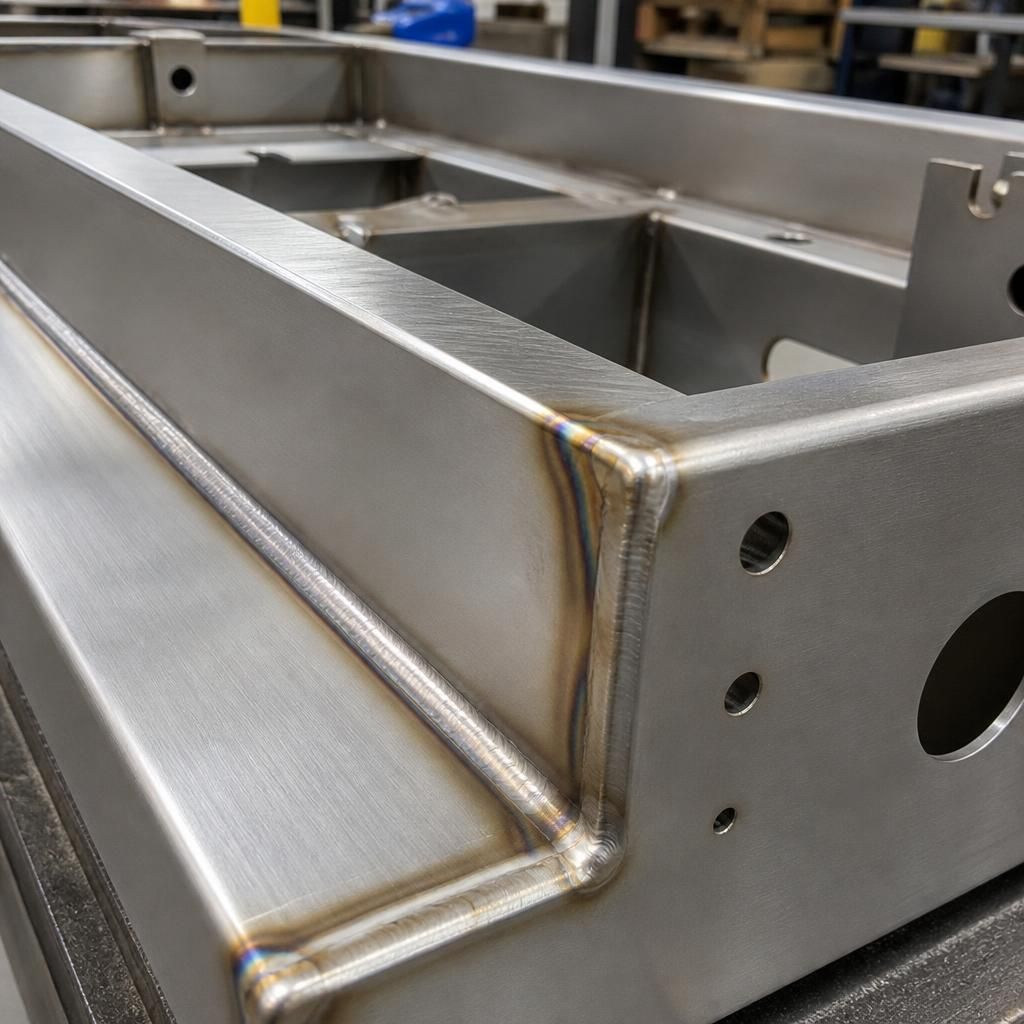
A specific benefit of electrostatic coating is the ability to give welded and fabricated stainless steel areas a consistent protective finish. Welds, heat-affected zones, corners and transitions can have a different appearance and surface condition from the surrounding stainless, even after cleaning or passivation. A correctly prepared powder coating can cover these variations with a continuous barrier, rather than leaving the component reliant on the natural finish of each individual area.
This can be useful for fabricated housings, brackets and assemblies where visual consistency and protection are required across both the original sheet or tube and the joined sections. The coating does not remove weld defects or replace essential cleaning: heat tint, oxides, grease and contamination must be addressed before application. Its benefit is that, once the substrate is properly prepared, the finished surface need not expose every change created during fabrication.
Discuss Electrostatic Coating for Your Stainless Steel Components
Discuss your stainless steel components with the Powder-coatings.co.uk team to review the required finish, service conditions, masking points and curing considerations. This will help establish whether electrostatic coating is suitable and identify the appropriate coating specification.