

How does the choice of powder coating material impact the durability and finish of metal components?
The powder coating material determines how well a metal component resists corrosion, abrasion, chemicals, weathering and heat, while also influencing colour stability, gloss level and texture. Selecting the resin and formulation for the component’s substrate, service environment and required appearance is therefore essential for achieving a durable, consistent finish.
The powder coating material affects both the service life and appearance of a metal component because its resin, additives, pigments and intended film properties determine how the coating forms a protective surface. The correct choice depends on the metal substrate, exposure conditions, mechanical demands and required appearance; selecting a material solely by colour or gloss can result in an unsuitable finish.
Resin type is the main starting point. Different resin families provide different balances of flexibility, chemical resistance, weathering performance and appearance:
- Polyester powders are widely used where components face outdoor exposure. They can provide good resistance to sunlight and weathering, helping the colour and gloss remain stable when the correct grade is selected for the environment.
- Epoxy powders are valued for adhesion, hardness and resistance to many chemicals. They are often suitable for components used indoors or where chemical and corrosion protection are more important than long-term exposure to direct sunlight. Prolonged ultraviolet exposure can cause surface chalking and loss of appearance, so an epoxy is not automatically the best choice for external decorative work.
- Epoxy-polyester hybrid powders combine characteristics from both resin types. They may be appropriate for general-purpose indoor components where a balance of finish, hardness and resistance is required, but the exact formulation still needs to match the operating conditions.
- Nylon and other thermoplastic powders can provide a different performance profile, including useful resistance to impact, abrasion and certain chemicals. They are considered where the component needs a more resilient or protective surface rather than simply a decorative finish.
These categories are broad. Two powders within the same resin family can behave differently because their formulation, intended use and quality requirements are not identical. A coating specified for sheltered internal equipment should not be treated as interchangeable with one designed for exposed structural components, even if both are polyester-based.
Exposure conditions should guide the material choice. External components may encounter ultraviolet radiation, rain, condensation, road contaminants, temperature changes and pollutants. Industrial parts may instead be affected by oils, solvents, cleaning agents, impact, friction or abrasive contact. A coating material that performs well in one environment may soften, become brittle, chalk or lose adhesion in another. Consider the full service environment, including intermittent exposure and cleaning methods, rather than assessing the component only under normal conditions.
Temperature is also relevant. Repeated heating and cooling can place stress on the coating and the metal beneath it because the two materials expand and contract. A formulation with suitable flexibility and adhesion is more likely to tolerate this movement than a coating selected only for high surface hardness. Where components operate near elevated temperatures, the powder’s recommended service range and curing requirements should be checked before specification.
The formulation affects the mechanical behaviour of the finished film. Harder coatings can resist scratching and indentation, while tougher or more flexible coatings may cope better with impact, vibration and handling. These properties are not always identical: a very hard film is not necessarily the most impact-resistant, and a flexible coating may not provide the best resistance to abrasion. For brackets, housings, frames and fabricated parts, the likely damage mechanism should influence the choice.
Material selection also affects the finish that can be achieved. The resin and powder particle characteristics influence:
- Gloss: the formulation determines whether the surface can produce a high-gloss, semi-gloss or matt appearance. Gloss can change if the coating is exposed to weathering or unsuitable heat treatment.
- Texture: textured and fine-textured powders can help create a particular visual effect and may reduce the visibility of minor surface irregularities. Texture also changes how easily dirt can be removed and how the component reflects light.
- Colour stability: pigments and the resin system influence resistance to fading, particularly where the component is exposed to sunlight or heat.
- Film smoothness: the powder must melt and flow appropriately during curing. The material, applied thickness and cure profile all affect whether the final surface is smooth, textured or visibly uneven.
Pigments and additives have a practical role beyond colour. They can contribute to light stability, corrosion protection, slip characteristics, conductivity, heat resistance or other specialised requirements. However, an additive intended to improve one property may affect another. For example, a formulation designed for a highly textured surface will not produce the same visual result as a smooth decorative grade, even when the colour reference is the same.
The chosen material must also be compatible with the substrate and component design. Steel, galvanised steel and aluminium can present different adhesion and preparation requirements. Welds, sharp edges, recesses, threaded areas and joined materials may require particular attention because the coating has to form a continuous film without interfering with assembly. A technically suitable powder can still produce a poor result if the substrate preparation, application method or film build is inappropriate.
For a reliable specification, identify the substrate, internal or external use, likely exposure to chemicals and moisture, temperature range, impact or abrasion risk, cleaning regime, required colour and gloss, and any electrical or hygiene requirements. It is also useful to distinguish between the appearance required at installation and the appearance that must be retained throughout service. This information allows the coating material to be selected for its complete performance profile rather than its initial appearance alone.
In practice, the material is one part of the result. Surface preparation, even application, suitable film thickness and correct curing are essential for the powder to develop its intended properties. A premium formulation cannot compensate for contamination, inadequate preparation or an unsuitable cure. For industrial components, the powder specification should therefore be considered together with the metal, component geometry and process controls before production coating begins.
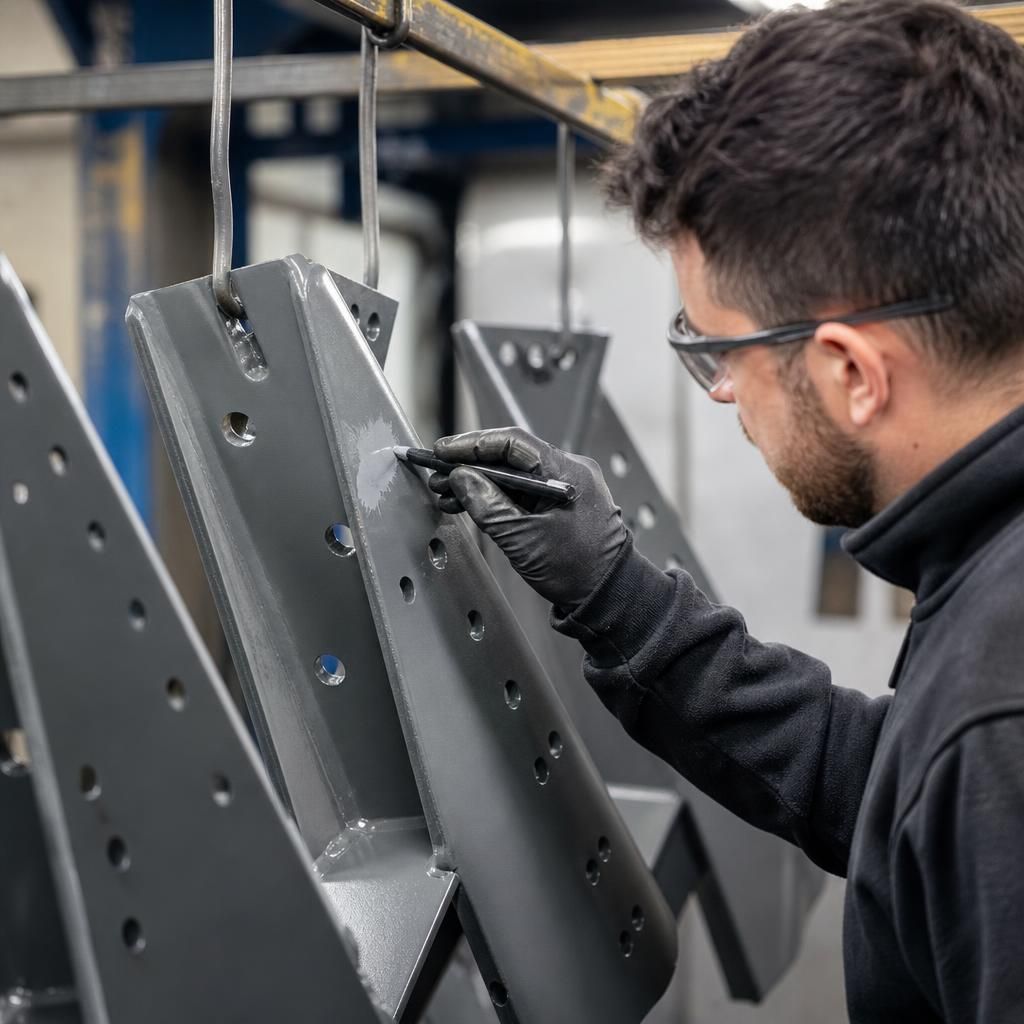
The powder coating material also affects how a component can be repaired or refinished later. Thermosetting powders form a cross-linked film during curing, so the coating cannot simply be melted and reapplied if a section is damaged. Local repairs may require careful preparation and a compatible touch-up system, while extensive damage may call for stripping and recoating.
This is important where components are installed in assemblies or specified in controlled colour schemes. A repair material with a different resin, gloss level or texture can be visible even when the colour reference is the same. Recording the original coating specification helps future work achieve a closer match and avoids treating every powder-coated finish as interchangeable.
Discuss the right powder coating material for your components
Discuss your component’s substrate, operating environment and required finish with the powder-coating team to identify a suitable material specification. Provide details of the coating performance and appearance needed so the proposed finish can be assessed against the application.