

How does the choice of abrasive media impact the effectiveness of wrought iron sandblasting preparation?
The abrasive media selected for wrought iron sandblasting affects how effectively corrosion, old coatings and contamination are removed without unnecessarily damaging the metal. Media type, particle size and hardness must suit the iron and the required surface profile, because these factors influence coating adhesion, appearance and the risk of distortion or excessive roughness.
The choice of abrasive media determines how efficiently wrought iron can be cleaned, how much surface texture is created and how suitable the prepared metal is for its next finish. The most effective selection balances cleaning power with control: it must remove rust, mill scale, previous coatings and embedded dirt while preserving the shape, detail and soundness of the wrought iron.
Media hardness and cutting action are central to this balance. Hard, angular abrasives cut into corrosion and firmly bonded coatings, making them useful where the surface has heavy oxidation or several old finish layers. They can also create a more pronounced anchor profile. Softer or less aggressive media remove loose contamination and weak coatings with less risk of marking the underlying metal, but may be inefficient against dense rust or resilient paint.
- Garnet and other mineral abrasives: angular particles provide effective cutting action and are often suitable for general corrosion and coating removal where a controlled profile is required.
- Aluminium oxide: a hard, sharp abrasive for demanding preparation. It can remove tenacious coatings and corrosion, although pressure, nozzle distance and particle size need careful control on detailed sections.
- Crushed glass: angular particles can clean rust and existing finishes while offering a useful balance between cutting action and surface control.
- Glass bead: rounded particles tend to peen and clean rather than cut aggressively. They may suit light contamination or situations where a relatively smooth appearance is preferred, but they are not normally the first choice for heavy corrosion or thick coatings.
- Steel grit or shot: metallic media can provide strong cleaning action and are more commonly associated with controlled, enclosed blasting systems. Their suitability depends on the component, equipment and recovery arrangements.
Particle shape changes the nature of the prepared surface. Angular media create small peaks and valleys that increase mechanical keying for a subsequent coating. Rounded media are more likely to compact or smooth the surface, which can be useful for limited cleaning purposes but may provide less effective mechanical adhesion where a coating relies on a defined profile. Excessive peening can also close surface openings rather than remove contamination from them.
Particle size affects both reach and texture. Finer abrasive can enter narrow recesses, decorative scrolls, joints and perforations found on wrought ironwork. It generally produces a finer texture and is easier to control around delicate details. Coarser abrasive removes heavy deposits more quickly from broad, robust areas, but can leave an unnecessarily rough profile and may be difficult to direct evenly into intricate sections. A single component may therefore require adjustments in media size or blasting technique between open faces and detailed areas.
Wrought iron is often irregular rather than uniformly flat. It may contain forged edges, welds, joints, pits and areas of differing thickness. A highly aggressive abrasive, excessive air pressure or prolonged blasting in one location can erode sharp details, enlarge existing pits or cause local distortion in thinner sections. The risk is not determined by the abrasive alone: nozzle angle, stand-off distance, dwell time and the operator’s control are equally important.
Surface contamination also influences media selection. Grease, oil and wax should be dealt with before abrasive blasting because blasting can spread contamination across the surface or drive it into recesses. Abrasive blasting is intended to remove solid corrosion and coatings; it is not a substitute for suitable degreasing. If the media becomes contaminated, it can transfer residue back onto otherwise clean metal and reduce the reliability of the subsequent finish.
For coating preparation, the required result is a clean, suitably keyed surface rather than the roughest possible surface. An overly deep profile can consume more coating, leave peaks insufficiently covered and make the finished appearance uneven. An insufficient profile, remaining rust or firmly attached coating can reduce adhesion. The correct media therefore depends on the condition of the individual component and the specification for its next coating, not simply on whether the item is described as wrought iron.
A controlled selection process normally includes:
- Assessing the metal’s thickness, geometry, condition and existing finish.
- Identifying whether the main task is light cleaning, coating removal, corrosion removal or a combination of these.
- Selecting a suitable abrasive type and particle size for the most vulnerable details as well as the broadest areas.
- Testing the chosen combination on a representative, less visible section where practical.
- Checking cleanliness and surface texture after blasting, then adjusting the method if the surface is either under-prepared or unnecessarily damaged.
Inspection should look beyond visual colour. The surface should be checked for remaining rust, coating edges, embedded abrasive, dust, oil and areas that were shielded by overlapping features. A surface can appear uniformly dull while still containing residues in pits, welds or internal corners. The prepared metal should also be protected from renewed contamination and flash rust before the specified coating system is applied.
For complex wrought iron components, the best result usually comes from matching media and operating conditions to each part of the item rather than using maximum blasting force throughout. A measured approach preserves decorative detail, produces a consistent preparation standard and gives the following coating a sound, appropriately textured surface.
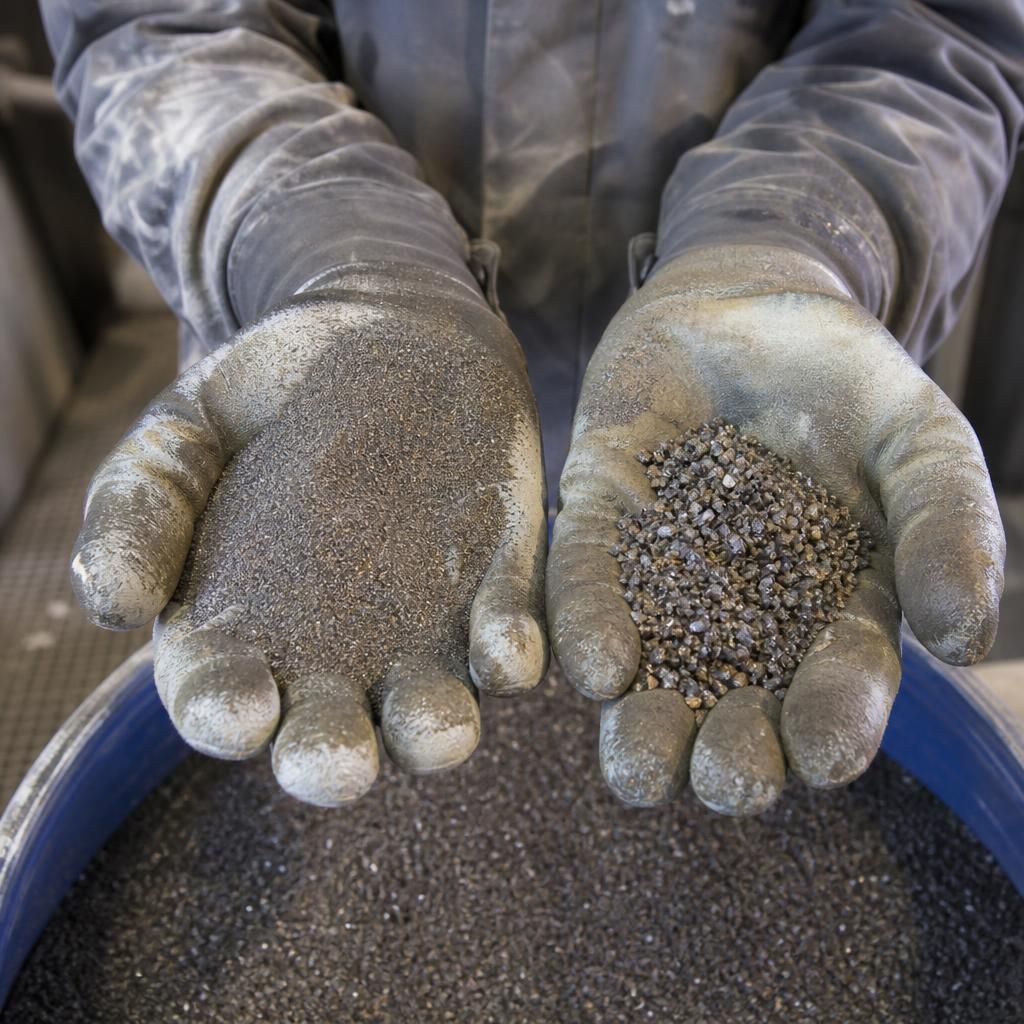
The condition of the abrasive during blasting can affect results as much as its original specification. Some media fracture into finer particles as they are used, gradually reducing cutting action and changing the texture produced on the wrought iron. Durable media maintain more consistent performance but may require suitable recovery and separation equipment. For batch work, monitoring the media condition helps prevent variation between components and ensures that the final parts receive a comparable level of preparation.
Discuss Your Wrought Iron Sandblasting Media Requirements
Share details of your wrought iron components, existing finish and intended coating with the powder-coating team to discuss a suitable abrasive media specification. This allows the preparation method to be considered against the component’s geometry and finish requirements before processing.