

How does metal shot blasting improve the performance and longevity of industrial coatings?
Metal shot blasting removes rust, scale, old coatings and other contaminants while creating a consistent keyed surface for the coating to grip. This stronger mechanical bond helps reduce peeling, flaking and under-film corrosion, supporting better coating performance and extending the service life of coated metal components.
Metal shot blasting improves industrial coatings by giving the coating system a clean, stable and suitably prepared substrate on which to form a continuous protective layer. Its effect is not limited to initial adhesion: controlled preparation also helps the coating achieve more consistent coverage, reduces defects that can become corrosion sites and supports predictable performance under service conditions.
It improves coating consistency. Bare metal surfaces are rarely uniform before preparation. They may contain mill scale, oxidation, heat-affected areas, embedded dirt or remnants of an earlier finish. If these variations remain, the coating can cure over a mixture of surfaces with different absorbency, texture and chemical behaviour. Shot blasting produces a more even starting condition, allowing subsequent primer or powder coating to be applied across a substrate with fewer localised variations.
This consistency matters particularly on fabricated components with welds, cut edges, drilled areas and formed sections. These features can behave differently from the surrounding sheet or bar. Properly controlled blasting helps bring the various areas into a condition that is more compatible with the specified coating system, although complex geometries still require appropriate racking, spray access and coating technique.
It reduces coating defects linked to weak surface layers. A coating may appear sound immediately after application while sitting partly on an unstable oxide or residue layer. As the component experiences handling, vibration, moisture, temperature changes or chemical exposure, that weak layer can separate from the base metal and take the coating with it. Preparing the metal before coating removes this risk from the surface interface and gives the coating system a more reliable foundation.
Preparation also helps reduce problems such as local lifting, blister formation and premature edge breakdown. These failures do not always originate in the coating material itself; they can result from an inconsistent substrate, trapped residues or poorly defined transitions between prepared and unprepared areas. Shot blasting is therefore part of the coating system rather than a separate cosmetic operation.
It supports more effective corrosion protection. Industrial coatings protect metal by separating it from moisture, oxygen, salts and other aggressive substances. A small discontinuity, thin area or poorly bonded patch can provide a route for those substances to reach the substrate. By creating a consistent preparation condition, shot blasting helps the coating form a more dependable barrier over the component.
The final result still depends on the complete specification. The substrate, abrasive selection, blast intensity, coating type, film thickness, curing conditions and service environment all influence corrosion resistance. Shot blasting cannot compensate for an unsuitable coating system or incorrect application, but it removes one of the most important variables before coating begins.
It can improve the durability of the coating under mechanical use. Components used in manufacturing, construction and automotive applications may be exposed to impact, vibration, abrasion and repeated handling. A coating applied over a sound, consistently prepared surface is less likely to fail through local separation when the part is subjected to these stresses. This is especially relevant for brackets, frames, fabricated assemblies, machine parts and other items that are handled or installed after finishing.
Surface preparation must nevertheless be matched to the metal and the component design. Excessive blasting can alter edges, affect thin sections or create an unsuitable surface condition, while insufficient blasting may leave unstable material behind. The objective is controlled preparation, not simply the greatest possible blast intensity.
Process control determines whether these benefits are achieved. Important controls include:
- selecting an abrasive size and type appropriate to the substrate and required finish;
- maintaining suitable blast pressure, wheel settings or nozzle technique;
- ensuring that recessed areas, weld zones and difficult profiles receive adequate treatment;
- checking the resulting surface condition and profile against the coating specification;
- preventing handling contamination after blasting; and
- applying the next preparation or coating stage before the freshly prepared metal is affected by moisture or surface deterioration.
Inspection is valuable because visual cleanliness alone does not confirm that a surface is suitable for every coating. Depending on the project, the preparation may be assessed for cleanliness, surface profile, dust, visible residues and signs of flash rust. The coating manufacturer’s requirements and the component’s operating environment should guide the acceptance criteria.
For industrial work, the practical benefit is greater coating predictability. When shot blasting is correctly specified and controlled, the coating has a consistent substrate across batches and across different fabricated features. That helps the finished component retain its protective and functional properties for longer, reducing the likelihood that premature surface failure will dictate repair, recoating or replacement.
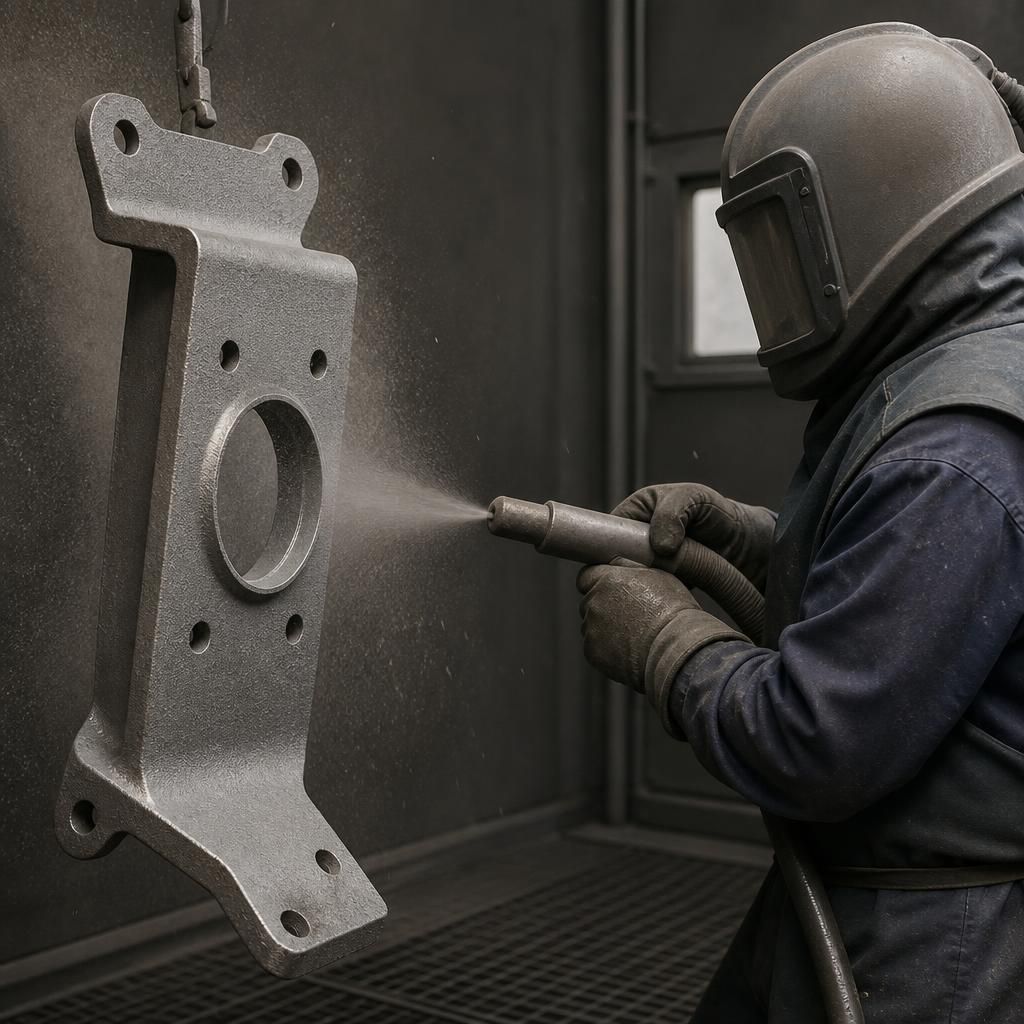
Metal shot blasting improves coating performance when the resulting surface profile is matched to the coating system. The profile describes the controlled peaks and valleys created on the metal; it affects how evenly the coating covers the component and how effectively the finished film protects the substrate.
A profile that is too shallow may provide insufficient surface texture, while an excessively coarse profile can leave peaks with reduced coating coverage and increase the amount of coating needed to fill the surface. The correct abrasive and blasting settings therefore help produce a surface that supports the specified film thickness without creating avoidable weak points. This is particularly important where components will face moisture, abrasion or chemical exposure, because uneven coverage can reduce the protection provided by the coating.