

What are the pros and cons of using aluminium oxide versus steel grit for rust removal?
Aluminium oxide cuts rust aggressively, is suitable for many metal surfaces and can produce a clean, consistent finish, while steel grit removes heavy corrosion quickly and creates a stronger surface profile for coatings. Aluminium oxide can be more abrasive and costly to replace, whereas steel grit is heavier, may embed ferrous particles in some substrates and can leave a sharper profile than required for certain powder-coating applications.
Aluminium oxide is generally the more versatile choice for rust removal, particularly where the substrate must remain free from ferrous contamination and the blast profile needs careful control. Steel grit is usually better suited to robust steelwork with heavy corrosion, where rapid cutting and a pronounced anchor profile are more important than avoiding iron-based residue. The correct option depends on the base metal, corrosion severity, required surface profile, equipment and the coating that will follow.
Aluminium oxide: main advantages
- It is a non-ferrous abrasive, so it does not introduce steel particles into aluminium, stainless steel or other non-ferrous substrates.
- Its angular grains cut through rust, mill scale and old coatings rather than merely polishing them. This makes it useful where the surface needs to be mechanically opened before powder coating.
- It is available in different grades, allowing the aggressiveness of the process and the resulting surface texture to be matched more closely to the component and coating system.
- It can be used across a broad range of metal preparation work, provided the blasting pressure, nozzle distance and abrasive grade are selected appropriately.
Its main limitation is that the sharp grains gradually fracture and become less effective as they are reused. Aluminium oxide can also be relatively expensive when a high volume of abrasive is required, particularly if the work produces substantial spent media or the blasting system has limited recovery and separation facilities. Excessive aggression or an unsuitable grade may roughen thin sections, soften defined edges or create a profile deeper than the subsequent coating requires.
Steel grit: main advantages
- Its angular shape is effective against thick rust, scale and firmly bonded coatings on carbon-steel components.
- It creates a pronounced mechanical key, which can be useful where the coating system requires a clearly defined surface profile for adhesion.
- Steel grit is durable and can often be reclaimed and reused in suitable blast equipment, reducing the need to introduce fresh abrasive for every cycle.
- Its greater mass can make it productive for substantial steel fabrications and heavy components that can tolerate a more forceful treatment.
Steel grit also has disadvantages. It is unsuitable where ferrous contamination could compromise the substrate, appearance or later service performance. It may leave iron residues in surface irregularities, and any remaining dust must be removed thoroughly before coating. On ordinary carbon steel, this contamination is less problematic than it would be on stainless steel or aluminium, but it still needs to be controlled. Steel grit can also produce a sharper or deeper profile than is appropriate for a thin powder coating, potentially increasing the amount of coating needed to cover the surface consistently.
Comparison by project requirement
- Heavy rust on carbon steel: Steel grit is often the stronger candidate because it combines aggressive cutting with a durable abrasive that is suitable for robust components.
- Aluminium, stainless steel or mixed-metal work: Aluminium oxide is generally safer from a contamination perspective because it does not add ferrous particles to the surface.
- A controlled profile for powder coating: Aluminium oxide may offer greater flexibility through abrasive-grade selection, although steel grit can be appropriate when a stronger key is specified and the profile is checked.
- Repeated blasting with abrasive recovery: Steel grit may have an economic advantage where the equipment can reclaim, clean and recirculate it effectively. The comparison should include collection, separation, disposal and equipment wear rather than the purchase price alone.
- Complex or thinner components: A less aggressive aluminium oxide grade and carefully controlled blasting parameters can reduce the risk of excessive roughening or distortion. Neither abrasive should be selected solely by name; the component’s thickness and geometry remain important.
The resulting surface should be assessed rather than assumed from the abrasive used. Check that rust, scale, oil, dust and previous coating residues have been removed, then verify that the surface profile is compatible with the powder coating specification. A profile that is too shallow may give the coating insufficient mechanical key, while one that is too deep can remain visible through the finish or leave peaks with inadequate coating coverage. Surface cleanliness is equally important: an appropriate abrasive cannot compensate for oil, moisture or residual blast dust.
For a powder-coating project, the practical decision is therefore to match the abrasive to the substrate and the required finish. Aluminium oxide is usually the more adaptable option where clean, controlled preparation and avoidance of ferrous contamination are priorities. Steel grit is often the more efficient option for substantial carbon-steel work with severe corrosion and a specified, stronger surface profile. Before processing a production batch, the chosen media and settings should be checked on a representative area or sample so that the profile, cleanliness and final appearance meet the coating requirements.
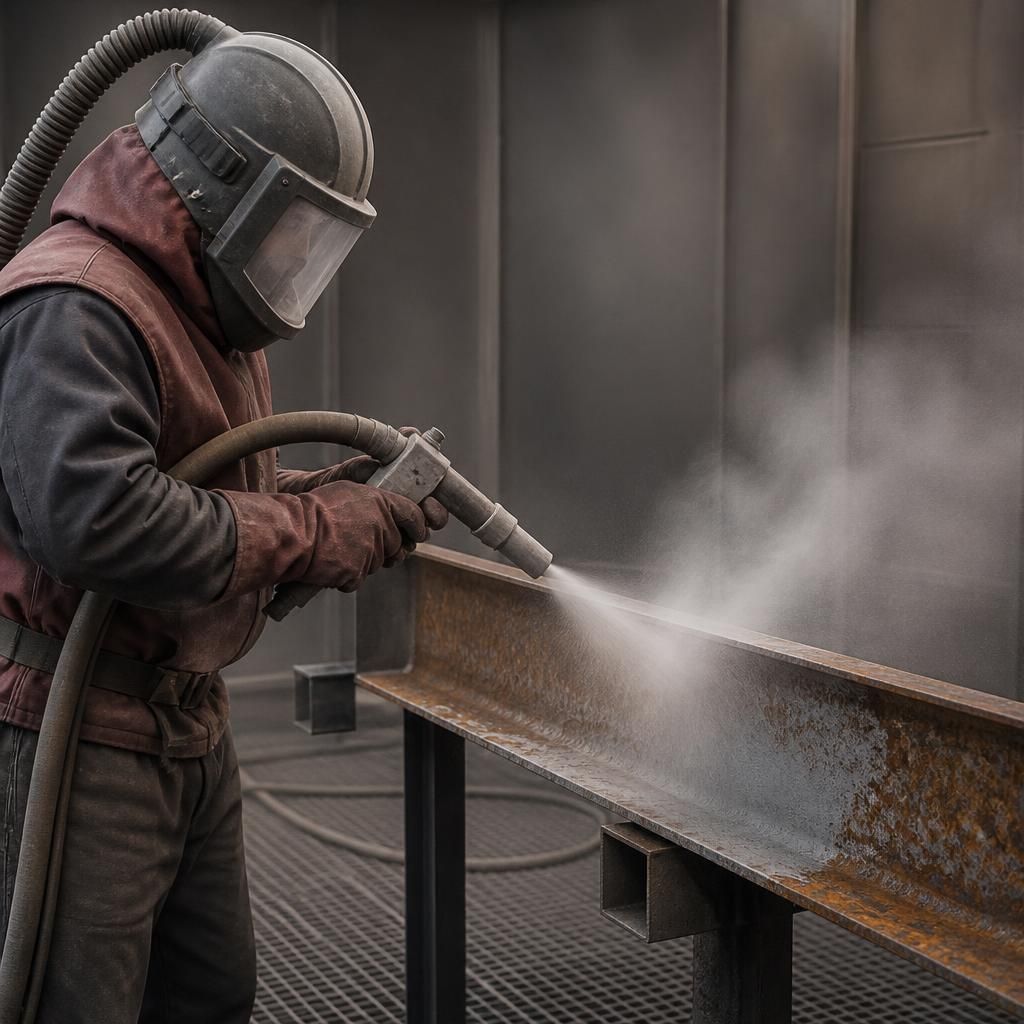
Dust control and clean-up are important differences between the two abrasives. Both aluminium oxide and steel grit generate airborne dust as rust, coating residue and spent media are removed, so suitable extraction, respiratory protection and housekeeping remain necessary. Steel grit additionally produces ferrous dust, which can spread onto nearby non-ferrous work or equipment if the blasting area is not properly segregated and cleaned.
Aluminium oxide avoids that particular source of iron contamination, but its fractured particles still need to be captured and removed before coating. The choice should therefore account not only for cutting performance, but also for the blast room, extraction system, work separation and waste-handling arrangements available for the project.