

How does Hamilton Industrial Powder Coating ensure the correct surface profile is achieved for optimal powder coating application?
Hamilton Industrial Powder Coating achieves the correct surface profile by assessing the metal substrate, selecting a suitable preparation method and controlling the blasting process to produce a consistent, coating-ready texture. The prepared surface is then checked for uniformity and cleanliness before powder application, helping the coating bond effectively without excessive roughness affecting the finish.
Hamilton Industrial Powder Coating achieves the required surface profile by treating it as a controlled specification rather than an incidental result of blasting. The profile must provide sufficient microscopic keying for the powder coating to bond while remaining even enough to avoid excessive texture, thin coverage on peaks or an uneven final appearance.
The required profile is considered in relation to the coating system and component. The metal type, condition of the surface, geometry of the part and intended use all affect the preparation requirement. Flat areas, edges, welds, corners, recesses and fabricated joints may respond differently to the same blasting treatment, so the preparation process has to account for the whole component rather than only its most accessible faces.
Blasting parameters are kept under control. Factors such as abrasive condition, equipment setting, working distance, nozzle movement and impact angle influence the resulting anchor pattern. Excessive impact can create an unnecessarily coarse surface or alter delicate features, while insufficient or inconsistent treatment may leave areas without an effective key. Controlled operator technique and attention to difficult-to-reach sections help maintain a more even profile across the component.
Profile assessment focuses on consistency as well as roughness. A surface may appear suitably textured but still contain local variations, untreated patches or overly prominent peaks. Hamilton Industrial Powder Coating examines the prepared finish for an even anchor pattern and checks areas that are particularly likely to affect coating performance, including edges, weld zones and recesses. Where appropriate, surface-profile comparators or measurement equipment can be used to assess whether the result is within the requirement for the specified coating application.
The prepared surface is also protected from conditions that could compromise the profile. Handling, storage and movement between preparation and coating must not introduce oil, moisture, dust or other contaminants. Components are therefore treated and handled in a way that preserves the prepared key until powder is applied. This is important because a suitable profile cannot compensate for contamination between blasting and coating.
Profile control also supports the final appearance. A surface that is too rough can make the powder film follow pronounced peaks and valleys, potentially affecting coverage and visual uniformity. A profile that is too shallow may provide less mechanical keying for the coating. By matching the preparation intensity to the component and coating requirement, Hamilton Industrial Powder Coating aims to balance adhesion, coverage and finish quality rather than maximising roughness.
- Component-specific preparation: the part’s material, form and service requirements are taken into account.
- Controlled blasting: equipment settings, abrasive condition and operator technique are managed to produce a consistent anchor pattern.
- Detailed inspection: edges, joints, recesses and other variable areas receive particular attention.
- Profile verification: the prepared surface is assessed against the relevant coating requirement, using suitable visual or measurement methods.
- Clean handling: the surface is kept free from contamination before powder application.
This approach reduces the risk of relying on appearance alone and provides a more dependable basis for powder coating application. It is particularly relevant to fabricated and batch components where variation between parts, weld areas or complex profiles could otherwise lead to inconsistent adhesion or finish.
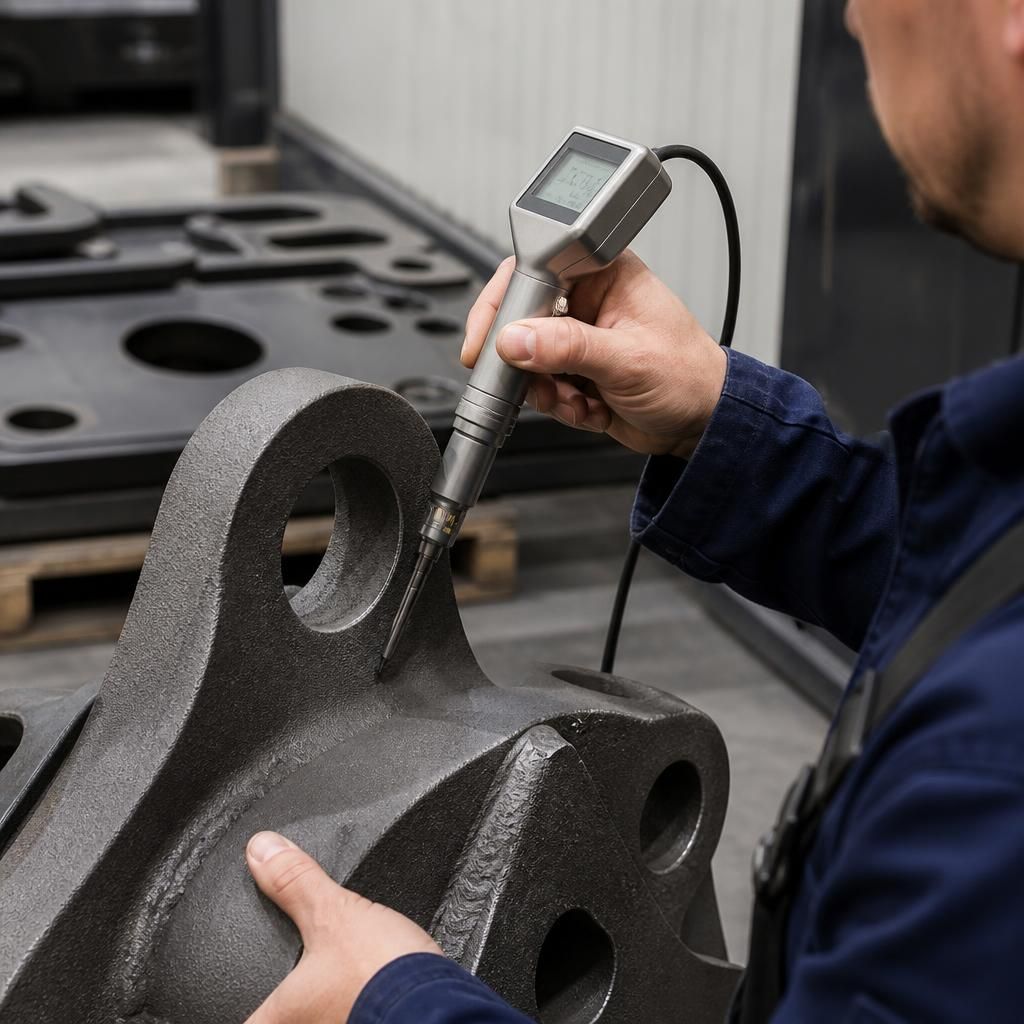
Where the measured surface profile falls outside the requirement for the coating system, Hamilton Industrial Powder Coating treats this as a preparation issue rather than attempting to compensate during powder application. The component can be reviewed and the preparation adjusted before coating proceeds, helping prevent an unsuitable anchor pattern from being concealed beneath the powder film.
This distinction is important because powder cannot correct an inappropriate surface texture. Applying more material may mask some visual variation, but it does not reliably resolve poor mechanical keying or excessive peaks. Confirming that the profile is acceptable before coating therefore provides a clear control point between blasting and powder application, particularly for components with defined finish or service requirements.