

How does the application environment influence the choice of anti-corrosion coating for steel components?
The application environment determines the level and type of protection a steel component needs. Moisture, salt, chemicals, temperature, ultraviolet exposure and abrasion can influence the required coating chemistry, surface preparation and film thickness.
Choose an anti-corrosion coating for steel by identifying the dominant failure mechanism in service, then specifying a coating system that addresses it. A component kept dry indoors requires a different system from one exposed to condensation, salt contamination, chemical vapour, standing water or repeated mechanical damage.
Begin with the component’s actual exposure rather than its intended location alone. An indoor item may still experience corrosion if it is installed in a humid production area, close to washing equipment or where condensation forms during temperature changes. Outdoor steel is affected by rainfall, pollutants and deposits that remain on horizontal surfaces. Coastal and heavily industrial locations generally demand more robust systems because conductive contaminants can remain on the surface and accelerate electrochemical corrosion.
- Sheltered internal environments: a suitable powder coating may provide adequate protection where humidity and contamination are controlled.
- External or semi-exposed environments: the specification should account for rain, condensation, drainage and ultraviolet exposure, with particular attention to exposed edges and joints.
- Coastal or industrial atmospheres: a higher-performance multi-coat system may be appropriate, often combining a corrosion-resistant primer with a compatible decorative or protective topcoat.
- Wet, submerged or frequently washed areas: the coating must be assessed for continuous moisture, immersion, cleaning chemicals and the possibility of water becoming trapped against the steel.
The distinction between occasional wetting and continuous immersion is important. A coating suitable for atmospheric exposure may not remain reliable when water is retained in a joint, inside a hollow section or beneath a component. Where immersion or persistent condensation is expected, the specification should cover water resistance, adhesion after prolonged exposure and the consequences of any coating damage. Drainage holes, sealed joints and accessible surfaces can be as important as the coating chemistry itself.
Chemical exposure must be described in practical terms. Identify the substance, its concentration, temperature, contact time and whether exposure is by splash, vapour or immersion. Oils, fuels, cleaning agents, acids, alkalis and process chemicals can affect coatings in different ways. A system chosen only for general atmospheric corrosion may soften, blister, swell or lose adhesion when exposed to a substance outside its resistance range. Safety data and cleaning procedures should therefore form part of the coating specification.
Mechanical conditions also influence the choice. Components that are handled, assembled, dragged, struck or exposed to abrasion need a finish with suitable hardness and adhesion, but hardness alone does not prevent corrosion after a deep scratch. Where impact damage is likely, consider the ease of repair, the protection of edges and whether a primer or additional coating layer can reduce the risk of steel becoming exposed.
Component design affects how well any coating performs. Sharp edges may receive less coating coverage than broad faces, while narrow gaps and overlapping parts can retain moisture. Welds, cut edges, drilled holes and areas contaminated by weld spatter require particular attention during preparation. Hollow sections should be designed to prevent water retention, and dissimilar metals should be assessed for galvanic corrosion. These details can determine whether the specified coating is exposed to a manageable atmosphere or to a concentrated source of corrosion.
Surface preparation should be matched to both the steel condition and the selected system. Remove oil, grease, rust, mill scale, dust and soluble salts before coating. The required cleaning method and surface profile depend on the substrate and coating specification. New steel, previously painted steel, blasted steel and galvanised steel each present different adhesion considerations. Galvanised or zinc-coated components may require a compatible pre-treatment and coating sequence to avoid poor adhesion, pinholing or premature delamination.
For many demanding applications, the correct decision is not a choice between isolated products but a complete coating system. This normally includes preparation, primer where required, intermediate protection and topcoat. The layers must be chemically compatible and applied at appropriate film thicknesses. A decorative topcoat can improve appearance and resistance to weathering, but it should not be expected to compensate for inadequate preparation or an unsuitable primer.
Temperature should be considered in terms of the component’s operating and cleaning conditions, not just the surrounding air. Repeated heating and cooling can create condensation and movement between the steel and coating. High process temperatures may require a coating specifically intended for heat exposure, while sudden temperature changes can test adhesion and flexibility. The coating supplier or applicator should be given the expected temperature range and cycle rather than a general description such as “warm” or “hot”.
Finally, specify the environment in a way that can be checked during manufacture. Record the location, exposure category, contact substances, cleaning regime, expected service stresses, substrate condition, preparation standard, coating sequence and inspection requirements. Trial panels or sample components can help confirm appearance, adhesion and compatibility where the service conditions are unusual. This approach makes the coating choice traceable and reduces the risk of selecting a finish that is suitable in principle but poorly matched to the way the steel component will actually be used.
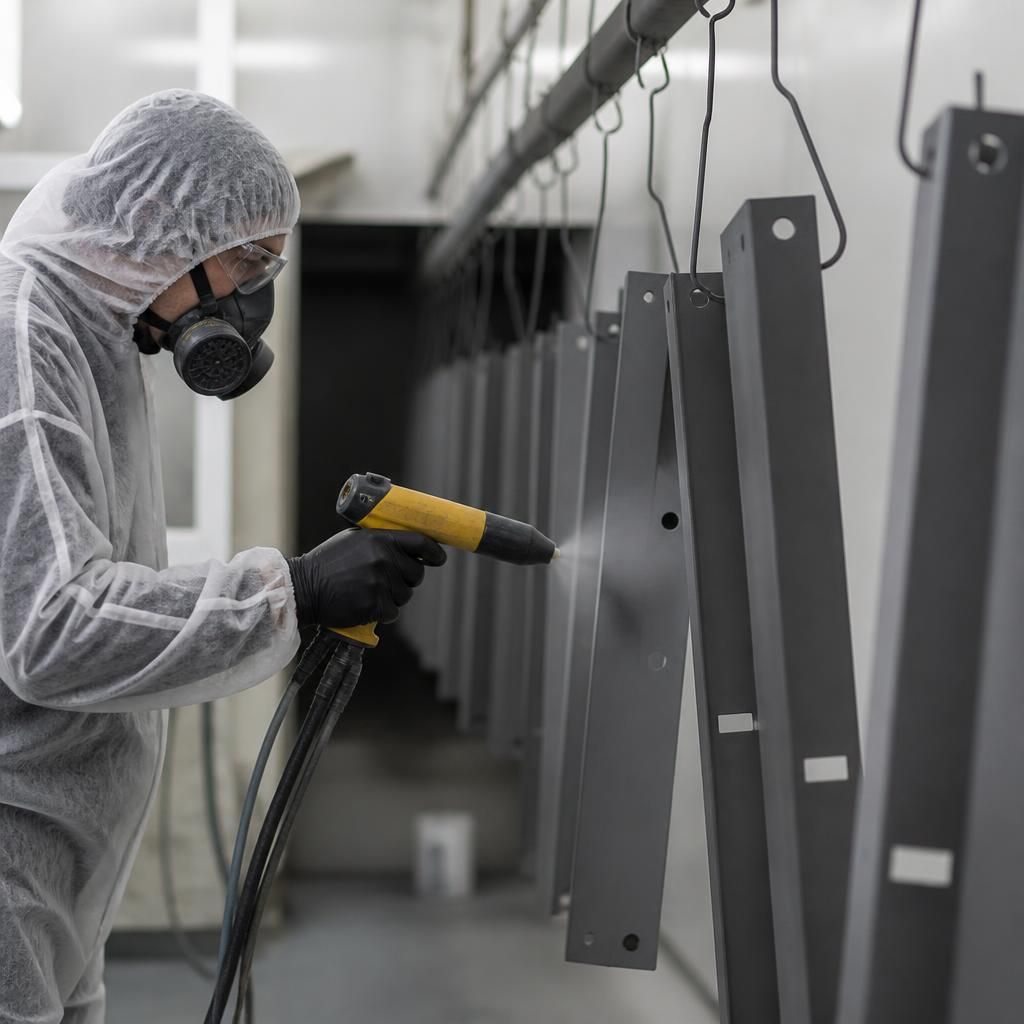
The environment during coating application is also important because moisture or unsuitable curing conditions can undermine an otherwise appropriate anti-corrosion system. Steel should be free from condensation, and the component, coating material and surrounding conditions must be suitable for the specified preparation and curing process.
Humidity, surface temperature, airflow and contamination can affect adhesion, finish and film formation. For powder coating, the curing cycle must be matched to the component and the selected powder; heavy sections and thin sections may respond differently to heat. Application records should therefore include relevant environmental conditions and curing details, particularly where components vary in size or are coated in batches.