

How does the choice of black powder coated aluminium affect thermal management in industrial applications?
Black powder coated aluminium generally absorbs more solar radiation than lighter finishes, which can raise the component’s surface temperature and increase cooling demands in outdoor or high-radiation environments. However, the coating’s emissivity, aluminium substrate, airflow, surrounding temperature and operating conditions also affect heat dissipation, so the finish should be selected alongside the application’s complete thermal design.
Black powder coated aluminium affects thermal management through three linked factors: the coating’s surface behaviour, the aluminium’s ability to conduct heat, and the way the finished component transfers heat to its surroundings. The black colour is only one part of the calculation. Component geometry, heat sources, contact areas, airflow, mounting arrangements and the coating specification determine whether the finish has a useful, neutral or adverse thermal effect.
The aluminium substrate remains the main heat-conducting element. Aluminium can spread heat efficiently through a panel, enclosure, bracket or other component, while the powder coating forms a comparatively thin insulating layer on the surface. In many general industrial applications, this layer does not dominate the thermal design. It can become more significant where heat must pass through a coated interface, where the coating is relatively thick, or where the component relies on direct contact with a heat sink, mounting plate or other conductive surface.
For this reason, the areas that provide the thermal path should be identified before coating. Mating faces, bolt seats, earthing points and heat-transfer surfaces may need to remain free from coating or be treated as controlled masking areas. Any uncoated zones must then be positioned and protected so that corrosion resistance, electrical safety and mechanical performance are not compromised.
Industrial enclosures require a whole-system assessment. A black coated aluminium enclosure may conduct heat across its walls, but the final internal temperature also depends on how heat is generated and removed. Important considerations include:
- the heat output of internal electrical or mechanical equipment;
- the surface area available for heat transfer;
- whether air can circulate naturally inside the enclosure;
- the direction of installation and the position of vents or cooling equipment;
- the thermal conductivity of mounting rails, brackets and fasteners; and
- whether the enclosure is exposed to surrounding hot equipment or confined spaces.
Changing the exterior finish without reviewing these factors can produce an inaccurate thermal assessment. A coating decision should therefore be incorporated into the enclosure calculation rather than treated as a purely cosmetic choice.
Radiation and convection behave differently. A coated surface can transfer heat by radiation as well as by contact with moving air. The importance of each route depends on the component’s temperature, the temperature and distance of surrounding surfaces, and the amount of airflow. A black finish may therefore behave differently on a naturally ventilated outdoor housing than on a component enclosed within a plant cabinet. Where the part operates at an elevated temperature, radiative heat transfer may become an important part of the cooling route; where airflow is restricted, changing the colour alone will not resolve poor heat removal.
Heat-sink and high-conductivity applications need particular care. If a black powder coated aluminium part is intended to act as a heat spreader, the coating should not cover the surfaces that must make close thermal contact with another component. Coating on exposed fins or outer surfaces may be acceptable where those surfaces are intended to transfer heat to air or surrounding space, but the design should account for the coating’s thickness and continuity. Sharp edges, recesses and internal corners can also receive a different coating build from broad faces, which may affect both dimensional fit and heat-transfer assumptions.
Dimensional tolerances are especially important for components that slide into channels, clamp against conductive plates or use close-fitting covers. Powder coating adds a measurable layer to the substrate, so coating thickness should be agreed against the drawing and the function of each surface. Excess material around apertures or contact points can reduce clamping consistency, interfere with assembly or create a less predictable thermal path.
Operating temperature must be checked against the coating system. The selected powder, substrate preparation and curing process should be suitable for the component’s service conditions. A part that experiences repeated heating and cooling may place greater demands on adhesion and flexibility than one operating at a stable temperature. Thermal cycling can also expose weaknesses caused by contamination, poor preparation, incorrect curing or unsuitable masking. The expected peak temperature, cycle pattern and exposure to chemicals or moisture should be supplied when specifying the finish.
Testing is valuable where thermal performance is safety-critical or where the design has little tolerance for temperature variation. A representative coated component can be assessed under the intended mounting, airflow and heat-load conditions. Measurements should compare the relevant contact points and internal areas, not just the most accessible external surface. This helps distinguish a coating-related effect from problems caused by restricted ventilation, poor thermal contact or insufficient heat-spreading capacity.
When choosing black powder coated aluminium, the practical specification should therefore cover the intended heat path, surfaces to be masked, allowable coating build, operating temperature, thermal cycling and installation environment. The finish can then be selected as part of the component’s mechanical, electrical and thermal design rather than applied after those requirements have been fixed.
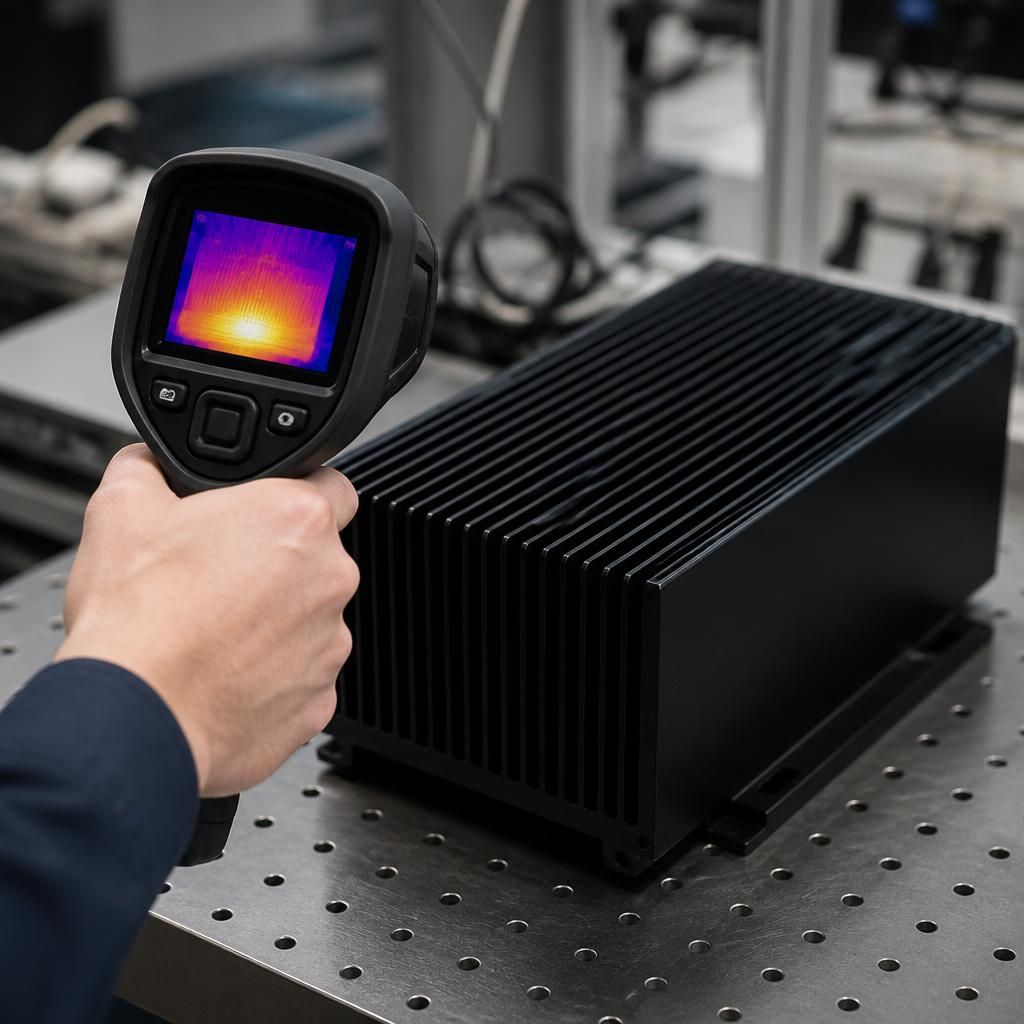
Black appearance alone is not a complete measure of thermal behaviour. Different powder formulations, gloss levels and surface textures can have different solar absorptance and infrared emissivity, so two visually similar black finishes may produce different surface temperatures under the same conditions. The coating specification should therefore be assessed alongside the aluminium grade, component geometry and expected exposure.
For critical applications, use thermal data for the proposed finish or test a representative coated component under realistic heat-load and environmental conditions. This is particularly important where a small change in surface temperature could affect seals, electronics, dimensional stability or operator safety. A measured result is more reliable than assuming that every black powder coating will have the same effect.
Discuss your black powder coated aluminium requirements
Share your component drawings, operating conditions and thermal constraints with our powder coating team to discuss a suitable black finish and any required masking. This helps establish whether the proposed coating specification is appropriate for the component’s thermal design.