

How do high gloss and specialty powder coatings compare to traditional paint in terms of environmental impact and sustainability?
Powder coatings generally have a lower environmental impact than traditional liquid paint because they contain little or no solvent, produce fewer volatile organic compound (VOC) emissions and can allow overspray to be recovered rather than discarded. However, sustainability also depends on curing energy, substrate preparation, coating formulation, application efficiency and the eventual durability of the finish, so high gloss and specialty coatings should be assessed across their full life cycle.
High gloss and specialty powder coatings can offer a lower overall environmental burden than many traditional liquid paint systems, but the result depends on the complete coating process rather than the finish alone. A fair comparison should consider raw materials, application losses, air emissions, surface preparation, curing, service life, maintenance and end-of-life treatment.
Air emissions and solvent content
The main environmental distinction is the way the coating is formulated and applied. Conventional solventborne paint uses organic solvents to keep the coating liquid. These solvents can evaporate during application and drying, contributing to VOC emissions and requiring suitable extraction and control measures. Water-based paints can reduce solvent use, but they are not automatically impact-free: they may still contain co-solvents and additives, and their environmental profile varies by formulation.
Powder coatings are supplied as dry particles rather than a liquid carried by solvent. Their application therefore avoids the solvent evaporation stage associated with solventborne paint. This can simplify emissions control, although the full process still requires responsible management of preparation chemicals, dust, cleaning materials and curing energy.
Material efficiency and overspray
Powder application can be highly material-efficient when equipment is correctly set up. Unattached powder may be collected and, where the process and coating specification permit, reclaimed for controlled reuse. This is different from liquid paint overspray, which is generally captured in filters or other collection systems and becomes a waste stream contaminated with solvent, paint solids or cleaning residues.
Recovery is not automatic. Reclaimed powder must be kept free from incompatible colours, resins and contaminants. High gloss and specialty finishes can be particularly sensitive to contamination because small variations may affect colour, gloss level, texture or surface uniformity. Where recovered material cannot meet the required specification, it should not be forced into production simply to avoid disposal; consistent quality and proper waste handling remain essential.
Energy used during curing
Powder coating requires controlled heating to melt and chemically cure the film. The environmental impact of this stage depends on oven design, insulation, temperature control, loading pattern, conveyor settings and the energy source used. An inefficient oven or a poorly loaded batch can consume unnecessary energy regardless of the coating’s low-solvent formulation.
Part design also matters. Large, heavy or irregular components can require more energy to bring the metal to the required curing condition than smaller, efficiently grouped parts. A coating specification should therefore be checked against the substrate, component mass and production method. Some specialist formulations are designed for particular curing conditions, but the appropriate temperature and time must come from the coating system and process requirements rather than assumption.
Durability and the life-cycle effect
A finish that remains intact for longer can reduce the environmental burden associated with stripping, surface preparation, recoating, transport and replacement. Powder coatings are often selected for their resistance to wear, corrosion, weathering and handling damage, but performance depends on the resin system, film thickness, pre-treatment, application quality and service environment.
High gloss is an appearance characteristic, not a guarantee of longer life. Gloss retention can be affected by ultraviolet exposure, pollutants, abrasion, chemicals and cleaning methods. A specialty coating should be matched to the actual conditions rather than selected solely for its initial appearance. If a coating loses adhesion or requires early rework because the substrate was inadequately prepared, the original material and energy advantages are reduced.
Pre-treatment and associated impacts
Metal preparation is important for both performance and sustainability. Degreasing, conversion treatments, rinsing and drying can involve water, heat and chemical products. These stages may generate wastewater or residues requiring controlled treatment. Powder coating does not remove the need to consider these impacts; it changes the balance of impacts within the overall process.
The appropriate preparation depends on the metal substrate and the exposure conditions. A process that provides reliable adhesion and corrosion resistance may have a better life-cycle outcome than a superficially simpler process that leads to premature failure. Good process control also reduces rejected components, stripping and repeat coating.
Specialty formulations and colour choice
Specialty powders can contain different resins, pigments, additives or functional materials to provide properties such as chemical resistance, insulation, texture, flexibility or enhanced protection. These differences affect manufacturing impacts, curing requirements and end-of-life options. A high gloss formulation may require careful application to avoid visible defects, while metallic, textured or multi-stage systems can involve additional process controls or coats.
Colour selection can also influence material efficiency. Frequent colour changes may require equipment cleaning and can increase powder waste, particularly where strict appearance requirements prevent the use of mixed reclaimed material. For batch production, grouping compatible colours and planning the coating sequence can reduce cleaning and changeover losses without compromising the specification.
Comparison at the end of a component’s life
Neither powder-coated metal nor painted metal should be assessed only by what happens during application. If the coated component remains in service and the metal can later enter an established recycling stream, the durable finish may support a more favourable overall outcome. Removal of the coating may nevertheless be required for some recycling or remanufacturing processes, and the suitability of any stripping method should be checked before work begins.
Coating layers should not be treated as a reason to disregard normal waste classification. Spent powder, contaminated filters, liquid preparation residues and stripping materials may require different handling routes. Documentation from the coating supplier and the waste contractor can help establish the appropriate route.
How to make a sound environmental comparison
- Compare powder with the specific liquid paint system, distinguishing solventborne and water-based formulations.
- Ask about the coating’s solvent content, curing requirements and expected service environment.
- Review application efficiency, overspray recovery, colour-change procedures and the handling of unrecoverable powder.
- Include pre-treatment, rinsing, drying and wastewater management in the assessment.
- Specify the performance needed for the component so that durability is not sacrificed for initial appearance or a nominally lower-impact process.
- Consider batch size, component geometry and oven loading, as these affect energy use and rework risk.
- Request relevant technical and environmental information from the coating supplier rather than relying on the term “powder” or “eco-friendly” alone.
For industrial metalwork, the most credible choice is usually the system that achieves the required appearance and protection with minimal rework, controlled material use and a long service life. Powder coating often has important environmental advantages over solventborne paint, but those advantages are realised only when formulation, preparation, application, curing and waste management are considered as one connected process.
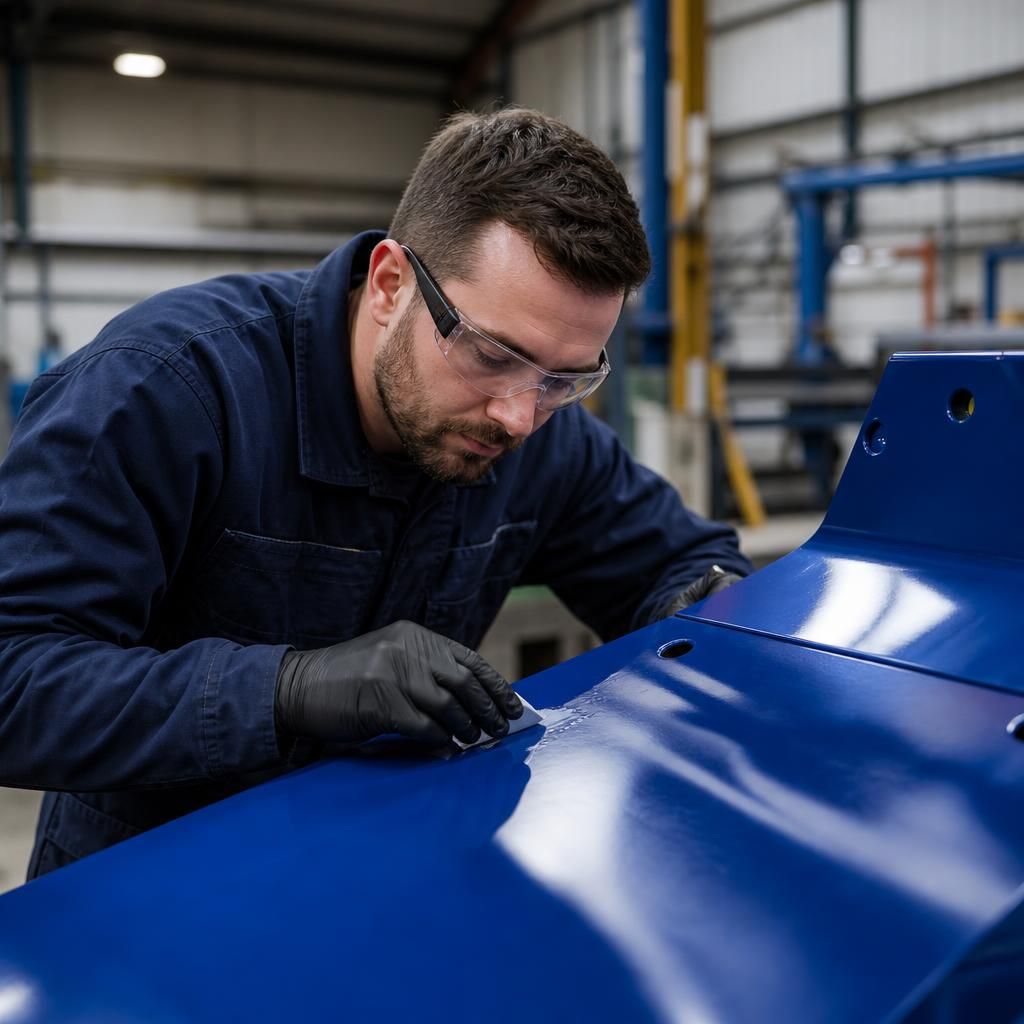
Repairability is an important but often overlooked part of the sustainability comparison. A cured powder coating cannot normally be remelted to repair a local defect, so significant damage may require preparation and recoating of the component or the use of a compatible repair coating. On high gloss, metallic, textured or otherwise specialist finishes, a local repair may also be visibly different from the original surface.
When assessing environmental impact, consider how the finished part will be maintained as well as how it will be coated initially. A system that supports practical repair, avoids unnecessary stripping and preserves the component in service may have a lower overall impact than one judged only by solvent content or application emissions.