

How does the epoxy primer’s composition affect its suitability for different metal substrates?
An epoxy primer’s resin, curing chemistry, pigments and additives determine how well it wets, bonds to and protects a particular metal substrate. Formulations should therefore be matched to the metal’s surface chemistry, corrosion risk, thermal demands and the powder coating or finish applied over it, rather than treated as universally interchangeable.
Epoxy primer composition determines whether a coating can form a stable bond with a particular metal, tolerate that metal’s movement and surface condition, and provide the required barrier against corrosion. The most suitable formulation is therefore selected by considering the substrate type, its surface chemistry, likely service conditions and the coating system that will be applied over it.
Carbon steel and mild steel: Primers for untreated or blasted steel commonly contain corrosion-inhibiting pigments and a resin system able to penetrate the prepared surface. The pigment package can help restrict corrosion at small defects, while the binder must produce a continuous film over the steel profile. A formulation intended for lightly prepared steel may contain different wetting and corrosion-control characteristics from one designed for abrasive-blasted steel. Excessive film hardness can also be unsuitable where fabricated parts are likely to flex or receive impact during handling.
Blast-cleaned steel: The primer must wet the exposed steel consistently and hold onto the anchor profile created by preparation. Its viscosity, surface tension and solids content influence whether it fills the profile or leaves thin areas on peaks. The composition should be checked against the specified preparation standard and target film thickness, because a primer designed for smooth, well-cleaned sheet may not behave in the same way on heavily profiled structural components.
Aluminium: Aluminium rapidly develops a tenacious oxide layer, so a primer for this substrate needs adhesion characteristics suited to that surface rather than relying solely on mechanical keying. The formulation may use specific adhesion-promoting components and corrosion-control pigments appropriate for a non-ferrous metal. It should also avoid interactions that could undermine the aluminium surface or create staining beneath the finish. Degreasing and controlled abrasion remain essential, since fingerprints, lubricants and unstable oxide can prevent the primer from contacting sound metal.
Galvanised steel and zinc-coated parts: Zinc surfaces can present a smooth, chemically active layer that behaves differently from bare steel. A suitable epoxy primer must be compatible with zinc and should not depend on corrosion mechanisms that are relevant only to iron-based substrates. Formulations for galvanised work are often assessed for adhesion after the surface has been cleaned and, where appropriate, lightly abraded or chemically treated. The primer also needs to accommodate the possibility of zinc salts or residues being present if the surface has weathered.
Stainless steel: Stainless steel’s passive chromium-rich surface provides corrosion resistance but can make bonding more demanding. A primer intended for this substrate needs a reliable route to adhesion after suitable preparation, without assuming that the behaviour of carbon steel will be repeated. Contamination from workshop tools or contact with ordinary steel can also affect the surface, so the primer specification should be considered alongside preparation controls.
Cast iron and porous castings: Cast iron may contain graphite, machining residues, trapped oils and pores that can release air or contaminants during curing. A primer’s flow, wetting and tolerance for outgassing are therefore important. A composition that cures too quickly at the surface may trap defects, while one with insufficient body may fail to cover irregularities consistently. Porous castings often require particular attention to cleaning, preheating practices and film build, rather than simply applying more coats.
Copper, brass and other non-ferrous alloys: Copper-based metals can react differently with pigments, curing agents and corrosion inhibitors. Some formulations may cause discolouration or lose adhesion if they are not intended for the alloy concerned. The primer should be assessed for chemical compatibility with the specific metal, particularly where the component will experience moisture, heat or contact with other metals that could promote galvanic corrosion.
The composition also affects the mechanical behaviour of the cured film. The balance between cross-linking, flexibility and hardness influences resistance to impact, abrasion and thermal movement. A highly rigid film may be appropriate for a stable steel component but less suitable where aluminium or a thin fabricated part expands and contracts noticeably. Conversely, a softer formulation may not provide sufficient resistance to handling or service wear. Selecting by substrate alone is therefore not enough; the component’s shape, thickness, joint design and operating temperature also matter.
Several formulation details deserve particular attention when comparing technical data:
- Resin functionality and curing agent: These influence cure development, chemical resistance, flexibility and the risk of an under-cured or overly brittle film when the application conditions vary.
- Corrosion-inhibiting pigments: The pigment type and concentration should suit the metal. A package designed for ferrous corrosion is not automatically appropriate for aluminium, zinc or copper alloys.
- Adhesion promoters: These can improve bonding to difficult oxide or conversion layers, but only when compatible with the substrate preparation and the complete coating system.
- Fillers and extenders: They affect flow, surface profile, film build and shrinkage. Their inclusion can be useful for covering irregular steel, but excessive loading may reduce flexibility or leave a less uniform surface.
- Additives: Wetting, flow, defoaming and anti-settling additives influence application quality. Poorly balanced additives can contribute to cratering, pinholes, separation or uneven coverage.
- Solvent or carrier balance: This affects wetting, evaporation and the way the primer settles over a prepared surface. It must also be compatible with the application equipment and any subsequent powder coating process.
For powder-coated components, the primer’s cured surface must allow the next layer to bond without lifting, pinholing or other defects. The technical information should therefore identify the approved recoat conditions, cure requirements and compatible topcoat types. A primer that performs well beneath a liquid finish may not provide the same result beneath a powder coating if its surface remains contaminated, under-cured or too smooth for the specified system.
Selection should be confirmed using the exact substrate and preparation method rather than relying on a generic description such as “multi-metal”. Useful checks include the manufacturer’s substrate recommendations, chemical-resistance information, curing schedule, film-thickness range and recoat guidance. For a production coating line, a representative trial can reveal issues caused by edges, welds, cast porosity, mixed-metal assemblies or thermal movement that a flat laboratory panel will not show.
In practice, the best formulation is the one that matches the metal, preparation standard and service demands as a complete system. A technically suitable epoxy primer cannot compensate for oil, moisture, loose oxide, zinc salts or poorly controlled preparation, so the composition and the pre-treatment specification should always be assessed together.
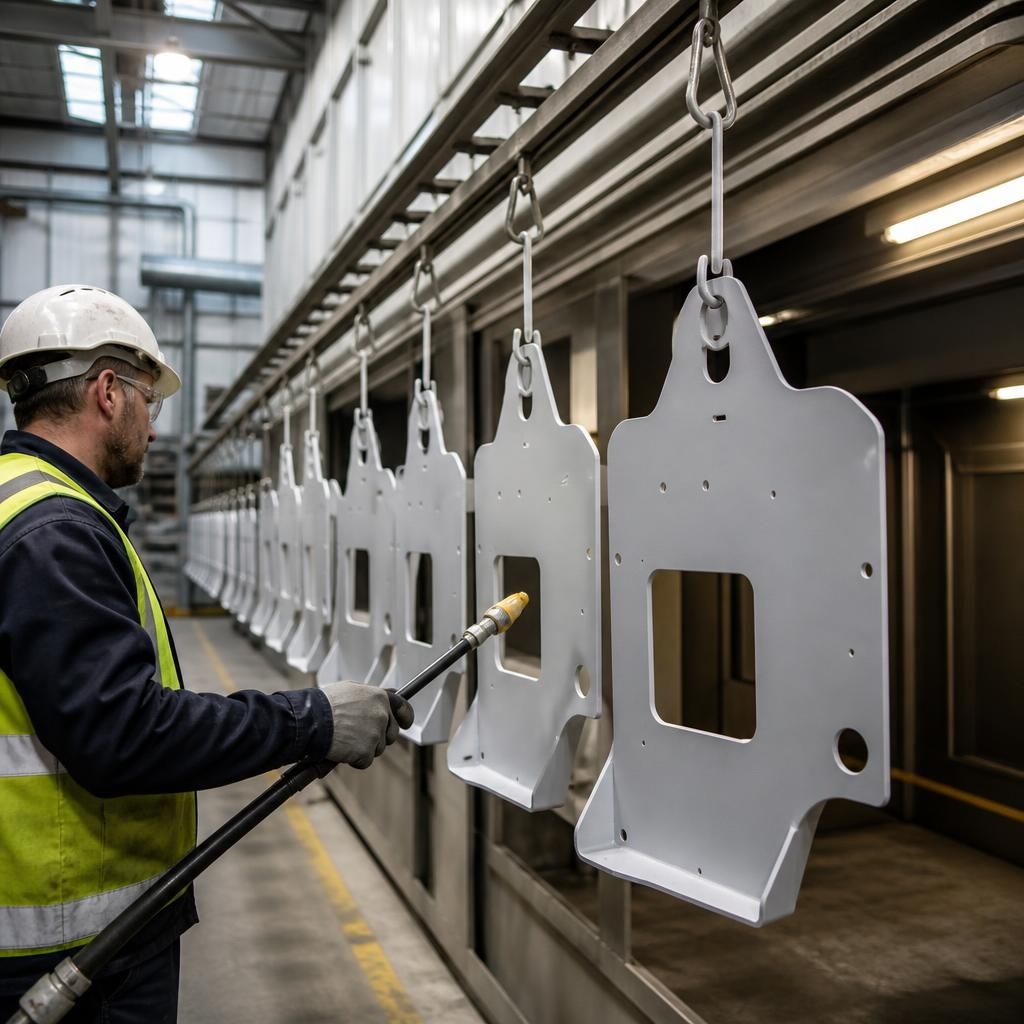
Epoxy primer composition must also suit the way the metal reaches and retains curing temperature. Thin aluminium sheet, heavy steel fabrications and mixed-metal assemblies can heat and cool at different rates, so a formulation’s cure response matters alongside its nominal cure schedule. If the primer does not develop the required film properties throughout the component, the result may be inconsistent hardness, adhesion or resistance beneath the final coating.
This is particularly important where one assembly combines different metal thicknesses or substrates. The primer should be assessed using the actual component profile, not only a flat test panel, with attention to shaded areas, joints and sections that may lag behind the main surface during curing. Technical information should confirm the minimum metal temperature, permitted curing range and any restrictions on recoating before the powder layer is applied.