

How do nylon and protective aluminium coatings perform in high-temperature industrial environments?
Nylon coatings can perform well in elevated-temperature industrial environments when the operating conditions remain within the coating system’s specified limits, while specialised protective aluminium coatings may be more suitable for sustained heat and demanding corrosion exposure. Selection should consider peak and continuous temperatures, exposure duration, chemicals, substrate and surface preparation.
In high-temperature industrial environments, nylon and protective aluminium coatings perform differently because they respond to heat through different material mechanisms. Nylon provides a tough, electrically insulating barrier with good resistance to abrasion and many chemicals, but excessive heat can soften or degrade the polymer. A specialised protective aluminium coating is generally better suited to sustained higher temperatures where metallic protection, heat resistance and resistance to oxidation are priorities, provided the complete coating system is specified for the service conditions.
Nylon coating performance is controlled by the stability of the polymer matrix. Within its stated operating range, it can protect a metal component from moisture, salts, chemicals and mechanical contact. It may also reduce damage caused by impact because the coating has a degree of flexibility rather than behaving like a brittle surface film. As temperature rises, however, nylon can lose hardness and stiffness. Prolonged exposure may lead to softening, creep, dimensional change or loss of adhesion, particularly where the coated part is under load or has tight dimensional tolerances.
Temperature exposure is not limited to the air temperature around a component. The coating may be affected by heat conducted through the substrate, contact with hot fluids, radiant heat, or repeated heating and cooling. A nylon finish that is acceptable on an external guard may not be suitable for a component continuously exposed to hot oil, exhaust gases or a heated process line. The coating specification should therefore consider the temperature at the metal surface and the nature of the heat transfer, not only the general temperature of the surrounding workspace.
Protective aluminium coatings are often selected where the coating must retain its protective function during more demanding heat exposure. The aluminium component of the system can provide a metallic barrier and help protect the underlying steel or other suitable substrate against oxidation. Performance still depends on the binder, additives, film construction and application method: an aluminium-containing finish is not automatically suitable for every high-temperature duty. The technical data for the specific system should confirm its intended service conditions.
Both coating types can be affected by thermal cycling. Repeated expansion and contraction creates movement between the coating and the substrate, which can expose weaknesses in adhesion or surface preparation. Sharp edges, welds, corners and threaded areas are particularly important because they can receive a thinner or less uniform film. A coating that appears sound after application may still require assessment for cracking, blistering, flaking or changes in colour and texture after repeated heat exposure.
Other factors that influence performance include:
- Substrate condition: rust, mill scale, oil and fabrication residue can prevent proper adhesion and may continue to affect the coating when heated.
- Coating thickness: excessive or uneven film build can affect curing, flexibility and the way heat-induced stresses are distributed.
- Contaminants: process chemicals, salts, cleaning agents and hot condensate can accelerate deterioration, even when the temperature is within the coating’s stated range.
- Mechanical loading: nylon may be vulnerable to deformation when softened, while any coating can fail if movement, vibration or impact exceeds its design conditions.
- Joint and edge design: gaps, crevices and sharp transitions can concentrate corrosion or make complete coverage difficult.
- Maintenance access: components that cannot be inspected easily may need a coating system with a wider tolerance of the expected exposure and a clearly defined inspection plan.
For a reliable specification, the coating supplier or applicator should review the full service profile rather than selecting a finish by colour or nominal coating type. Useful information includes the material and geometry of the component, how heat is applied, whether exposure is continuous or intermittent, the surrounding atmosphere, contact media, mechanical stress and the consequences of coating failure. Test panels, sample components or documented system data can help confirm adhesion, appearance and resistance before a production batch is coated.
In practical terms, nylon is most appropriate when its temperature limits are compatible with the duty and the component benefits from a resilient, insulating and abrasion-resistant polymer surface. Specialised protective aluminium coatings are more appropriate when sustained heat and oxidation protection dominate the specification. Neither should be treated as a universal high-temperature solution: the correct choice depends on the complete coating system, the metal substrate and the way the finished part will be used.
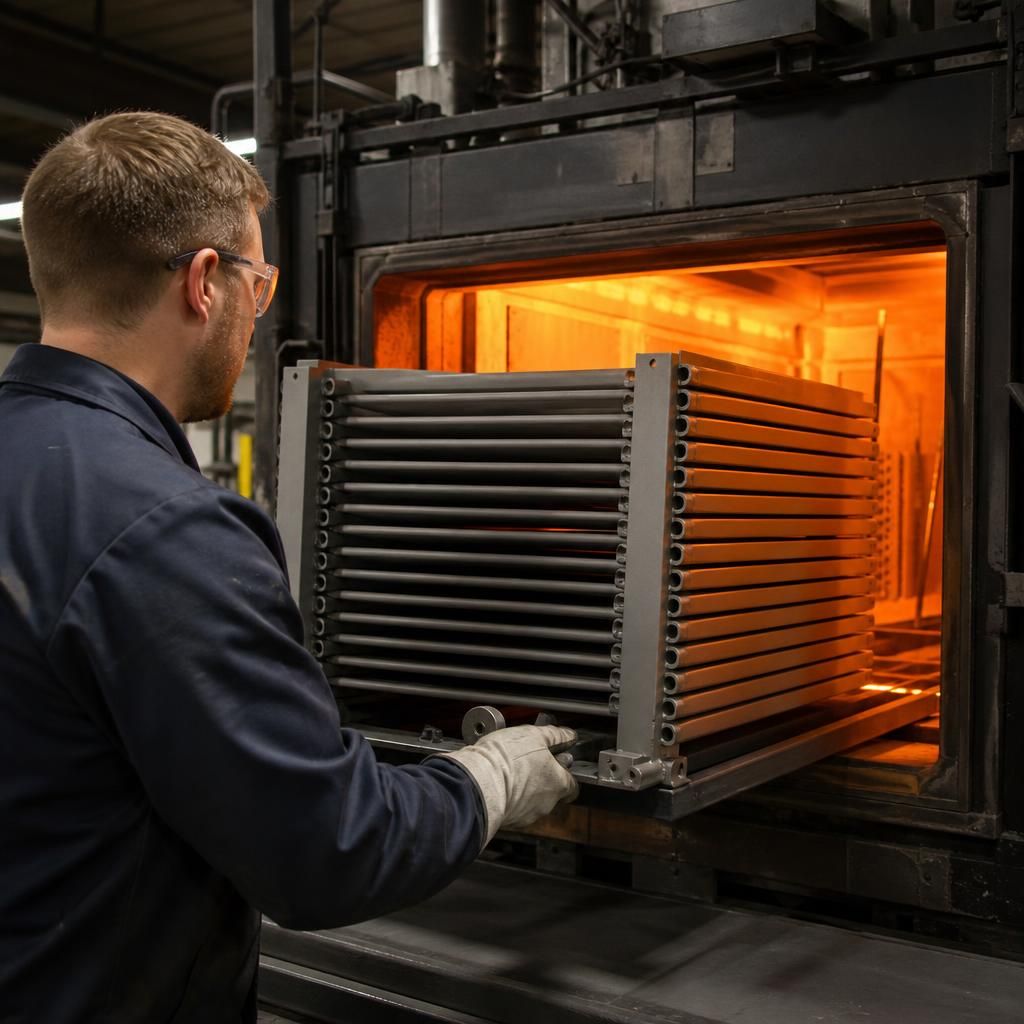
A coating’s curing temperature should not be confused with its service temperature. The heat used during application is part of the process that develops the coating’s final properties, whereas the service temperature describes how the finished film performs in use. A nylon or protective aluminium system that has been under-cured may have reduced adhesion or inconsistent film properties, while excessive curing can affect the finish and substrate.
High-temperature specification should therefore confirm the complete application requirements, including surface preparation, film build and cure conditions, before assessing suitability for service. The finished component can then be judged against its actual exposure, rather than against the temperature used in the coating process.
Discuss your high-temperature coating requirements
Provide details of your component’s substrate, operating temperature, heat exposure and surrounding conditions so the most suitable nylon or protective aluminium coating system can be assessed. Discuss your high-temperature coating requirements with the powder-coating team before final specification.