

How do powder coated aluminium profiles compare in performance and longevity to traditionally painted or anodised aluminium in industrial settings?
In industrial settings, powder coated aluminium profiles generally provide a more consistent and durable finish than traditionally painted aluminium, with good resistance to impact, corrosion and weathering when correctly specified and applied. Anodised aluminium offers a hard, integral oxide layer and strong colour stability, so the best choice depends on the operating environment, appearance requirements, pretreatment and maintenance conditions.
For industrial aluminium profiles, powder coating usually offers the most balanced combination of surface protection, appearance and production consistency, but it is not automatically the longest-lasting finish in every environment. Performance depends on the coating chemistry, profile design, surface preparation, application control and exposure conditions. Anodising can be preferable where a very hard integral surface and a metallic appearance are priorities, while liquid paint remains useful where on-site application, very specific colour matching or later recoating is required.
Mechanical performance is one of the clearest areas of difference. A correctly cured powder film forms a continuous polymer layer over the aluminium and can withstand routine handling, abrasion and moderate impact without the same risk of localised flaking associated with poorly bonded liquid paint. The coating still can be cut, gouged or damaged by severe impact, particularly at sharp edges, drilled areas and fixing points. Anodising produces a hard oxide layer that is highly resistant to scratching, but it is relatively thin and cannot bridge damage in the way a thicker organic coating can. Once the anodised layer is breached, the exposed aluminium cannot be restored simply by applying a matching anodised finish on site.
Liquid-painted aluminium can achieve a high-quality result, but its durability is more dependent on application conditions. Film build, solvent evaporation, overspray, surface cleanliness and curing all affect adhesion and uniformity. A painted surface may be easier to refresh or overcoat during refurbishment, although this normally requires careful cleaning, preparation and compatibility checks. Powder coating is applied as a dry powder and then cured, avoiding the solvent-related issues associated with conventional wet paint, but it requires suitable factory equipment and accurate control of the curing cycle.
Corrosion protection depends on the complete coating system rather than the visible finish alone. Aluminium naturally forms an oxide layer, but industrial contamination, moisture retention and contact with dissimilar metals can still create local corrosion risks. A suitable pre-treatment improves powder adhesion and helps protect the substrate at coating defects. Poor preparation, trapped moisture, unsealed joints or damage around cut ends can undermine an otherwise sound finish. Anodising offers integral protection to the treated aluminium surface, but drilled, cut or machined areas remain potential weak points unless they are dealt with appropriately. Painted surfaces have similar vulnerabilities where edges, fasteners or damaged areas expose the metal.
Weathering performance varies substantially between specifications. Powder coatings formulated for exterior exposure can retain colour and gloss effectively, but different resin and pigment combinations have different resistance to ultraviolet light, moisture and pollutants. A standard internal-grade powder should not be treated as equivalent to a coating intended for prolonged external exposure. Anodised finishes often provide a stable metallic appearance, although colour and gloss can change gradually with exposure and may vary between production batches. Liquid paint can also perform well outdoors when the primer and topcoat are selected as a compatible system, but lower-grade products may chalk, fade or lose adhesion sooner.
Appearance matching is an important practical distinction. Powder coating provides a broad choice of colours, gloss levels and textures, including finishes that help disguise minor handling marks. It is generally well suited to repeat production because the finish can be specified and applied consistently across batches. Anodising preserves the visual character of the aluminium and is often selected where a natural metallic effect is required. However, extrusion composition, surface condition and processing can influence the final shade. Wet paint offers flexibility for bespoke colours and remedial work, but colour and texture can vary with application technique, ambient conditions and the age of the existing coating.
Profile geometry affects the expected service life of all three finishes. Recesses, sharp corners, internal channels and close-fitting joints can make it difficult to achieve uniform coverage or allow adequate drainage. Powder coating may provide less effective coverage at extreme edges because of the way charged particles distribute over the profile. Anodising follows the aluminium surface closely but does not fill imperfections or mask machining marks. Liquid paint can reach some complex areas through spray application, yet runs, sags and uneven film thickness become risks in deep recesses. A design review before finishing should consider drainage, masking, access, handling and the location of cut ends and fixings.
Temperature and chemical exposure should be assessed before choosing the finish. Powder coatings are available in different formulations, but the selected film must be compatible with the operating temperature and any contact with oils, cleaning agents, fuels, solvents or process chemicals. Anodised aluminium can perform well in many industrial environments, although strong alkaline or acidic substances may attack the oxide layer. Liquid paint performance depends on the resistance of both primer and topcoat. Compatibility should be based on the actual substances, concentration, contact time and cleaning regime rather than on a general description such as “industrial use”.
Repair and end-of-life considerations also affect longevity. Minor powder-coating damage may be repaired with a compatible touch-up system, but a repair will not necessarily reproduce the original texture or provide the same factory-cured performance. Anodised damage is difficult to blend invisibly because the finish is integral to the aluminium surface. Painted aluminium is normally the most straightforward to repaint, provided the underlying substrate is sound and the existing layers are properly prepared. In every case, early treatment of scratches, corrosion staining and failed sealant is preferable to allowing moisture and contamination to spread beneath the finish.
For a fair industrial comparison, specify the intended exposure, required appearance, profile geometry, handling conditions, chemical contacts and maintenance method before selecting the finish. The coating specification should also define the pre-treatment, powder type, colour and gloss tolerance, curing requirements, inspection method and treatment of cut edges. Independent checks such as adhesion, film thickness, cure and visual uniformity can help confirm that the finished profiles meet the intended requirement.
In practical terms, powder coated aluminium is often the strongest general-purpose option where a repeatable decorative and protective finish is needed across manufactured profiles. Anodised aluminium is a strong alternative where surface hardness, a metallic appearance or an integral finish is more important than straightforward repair. Traditionally painted aluminium remains useful when flexibility of application and future recoating outweigh the advantages of a factory-applied powder system. The longest service life comes from matching the finish to the environment and controlling preparation, application, handling and maintenance—not from choosing a finish in isolation.
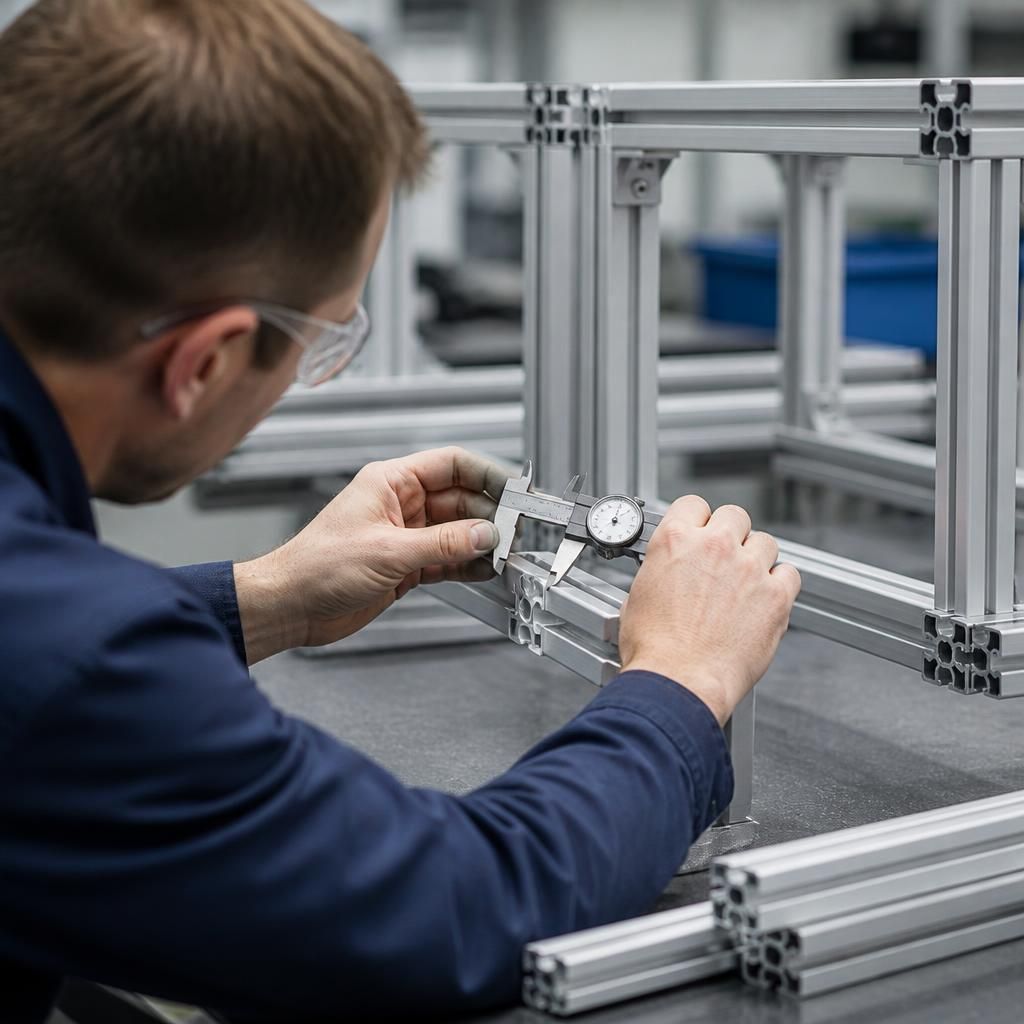
Dimensional control is an important consideration when aluminium profiles form part of an assembled product. Powder coating adds a measurable film to the surface, so coating build-up at mating faces, slots, holes and press-fit areas can affect clearances or make components harder to assemble. These locations may need to be masked, allowed for in the design or finished after machining.
Anodising normally has less effect on profile dimensions because the treatment forms an oxide layer within and slightly beyond the aluminium surface. Traditional paint can also alter dimensions, particularly where several coats are applied or film thickness varies. For profiles used in close-tolerance assemblies, the finish should therefore be selected alongside the dimensional tolerances, masking requirements and assembly method, rather than judged on appearance and corrosion resistance alone.