

How does the choice of blasting media affect the quality and durability of aluminium powder coating?
The blasting media determines the aluminium surface profile, cleanliness and risk of substrate damage before powder coating. Selecting a suitable, controlled medium helps create a consistent key for adhesion while reducing defects that can shorten the finish’s service life.
The choice of blasting media affects aluminium powder coating by controlling how aggressively the substrate is treated, the texture produced and the likelihood of embedded contamination. A suitable medium produces the required finish without eroding edges, altering dimensions or leaving residues that interfere with subsequent pretreatment and powder application.
Media hardness and shape are among the most important factors. Sharp, angular media such as aluminium oxide cut into the surface more readily than rounded glass beads. This can be useful where a more pronounced mechanical key is required, but excessive aggression may create an unnecessarily rough finish, soften fine detail or damage thin sections. Rounded glass bead generally produces a more uniform, satin-like appearance and is less likely to cut deeply into the aluminium, although it may be unsuitable where the specification requires more substantial material removal or a particular surface texture.
Plastic media and other relatively soft, non-ferrous options can be appropriate for delicate aluminium components, machined areas and parts with tight dimensional tolerances. They remove coatings or light contamination with less risk of sharp impact damage. Their effectiveness depends on the existing coating, the condition of the component and the finish required; a softer medium is not automatically the best choice if it cannot prepare the part adequately.
Particle size also changes the result. Coarser media can treat a surface more quickly and create a more pronounced texture, but may be too aggressive for narrow edges, threads, apertures or lightweight sections. Finer media give greater control over detail and can produce a more even appearance, but may require a different process setting or additional preparation where substantial residues or previous coatings are present. The selected grade should therefore match the component’s geometry and the coating specification rather than being chosen solely for speed.
Aluminium is relatively soft compared with many blasting substrates, so pressure, nozzle distance, traverse speed and dwell time must be controlled alongside the media itself. Poorly controlled blasting can cause localised over-treatment, rounded edges, distortion or changes to critical mating surfaces. It can also leave inconsistent areas that become visible through the powder finish, particularly on large flat panels or components where uniform appearance is important.
Media cleanliness affects long-term performance. Reused abrasive gradually collects removed paint, grease, oxides and particles from other metals. If this contamination is transferred to aluminium, it can contribute to coating defects or create localised points of poor adhesion. Ferrous contamination is especially undesirable because trapped iron particles can promote staining or corrosion beneath a coating. For this reason, media used on aluminium should be suitable for non-ferrous work, stored correctly and replaced or managed when its condition falls outside the process requirements.
The media must also be compatible with the next preparation stage. Blasting can leave dust or fine particles in recesses, holes and joints, while some media may produce a residue that is difficult to remove. Effective extraction, inspection and cleaning are needed before any chemical treatment, primer or powder is applied. If residues remain, they can cause pinholes, inclusions, craters or areas where the coating does not fully bond to the prepared aluminium.
The effect on durability is therefore indirect as well as physical. A well-matched medium gives the pretreatment and powder coating a consistent foundation, allowing the applied film to remain properly supported during handling and service. An unsuitable medium may produce a finish that looks acceptable initially but contains local variations, contamination or damaged areas that become vulnerable to underfilm corrosion, flaking or premature wear.
- Glass bead: commonly considered where a controlled, relatively uniform satin finish is required and aggressive cutting must be limited.
- Aluminium oxide: useful where a sharper, more active treatment is needed, provided pressure and exposure are controlled to protect the aluminium.
- Plastic media: suitable for more delicate work, existing coating removal and components where minimising impact is a priority.
- Other non-ferrous mineral media: may be selected for particular levels of cleaning or texture, subject to compatibility with the alloy, component design and subsequent coating system.
There is no single blasting medium that is correct for every aluminium component. The decision should consider the alloy, thickness, profile, edge detail, previous finish, required appearance and service conditions. Trial preparation or process validation may be appropriate for unfamiliar parts, especially where dimensional tolerances or a consistent visible finish are critical. The final assessment should cover both the blasted aluminium and the powder-coated result, since a medium that appears effective during preparation may still be unsuitable if it creates defects in the finished coating.
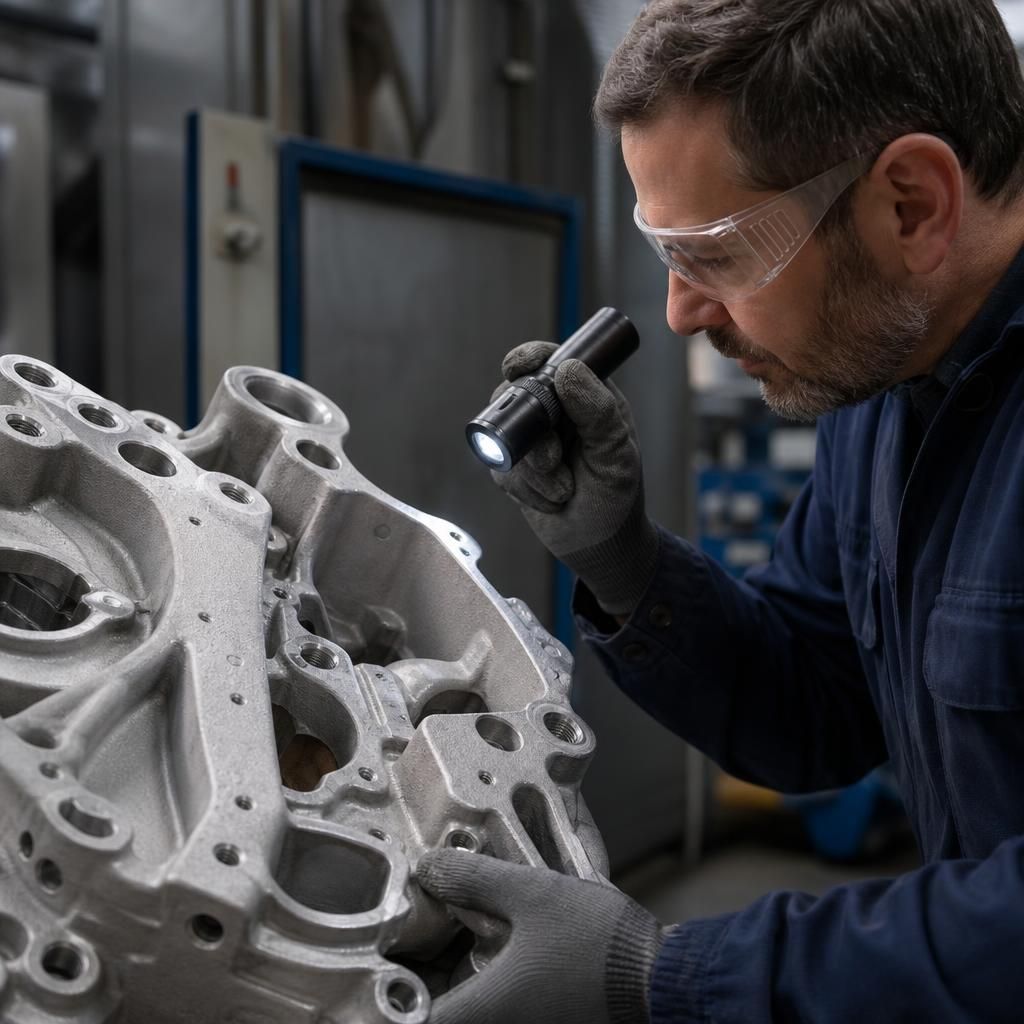
On cast aluminium, blasting media can affect how readily surface-connected porosity is exposed. A highly aggressive treatment may reveal pores or disturb residues trapped near the surface, which can later contribute to pinholes, blistering or local coating irregularities during powder curing. This makes media selection particularly important for castings, housings and other components with a porous structure. The blasted surface should be inspected for revealed defects before coating, so that the finished powder layer is not relied upon to conceal conditions within the aluminium.