

How does the surface preparation process affect the adhesion and performance of Nylon & Rilsan powder coatings?
Surface preparation directly determines how well Nylon and Rilsan powder coatings bond to metal and withstand wear, chemicals and corrosion. Thorough cleaning, removal of rust, oil and existing coatings, and the correct surface profile help create a sound foundation, while poor preparation can cause lifting, blistering, uneven coverage and premature coating failure.
For Nylon and Rilsan powder coatings, surface preparation controls the quality of the bond, the continuity of the film and the coating’s ability to perform consistently in service. The preparation must suit the base metal, the component’s design and the chosen application method; a process that is suitable for plain steel may need modification for aluminium, galvanised steel, castings or welded assemblies.
Preparation begins with assessing the component. The coater should identify the substrate, its previous treatment, areas affected by welding or heat, and any features that could retain contamination. Weld spatter, burrs, sharp projections and poorly finished joints can create thin spots or physical interruptions in the coating. Sharp corners are particularly difficult to cover evenly, so edge condition and component design can influence the final result as much as the coating material itself.
The surface must be chemically suitable as well as visibly clean. Residues that are not obvious during visual inspection can interfere with bonding. These may include salts, blasting dust, conversion-treatment residues, silicone contamination or deposits from fabrication processes. Rinsing and drying therefore need to be controlled, especially where components have recesses, overlaps or hollow sections that can retain moisture. Any remaining residue can form a weak interface beneath the nylon layer and provide a route for local deterioration.
Mechanical preparation creates a key for the coating. Abrasive treatment can remove weak surface layers and produce a controlled texture that gives the molten coating more opportunity to grip the metal. The abrasive, pressure, angle and cleanliness of the equipment should be selected for the substrate. Excessively aggressive treatment may distort thin parts or leave embedded abrasive, while insufficient treatment may leave a surface that is too smooth or mechanically weak. The prepared surface should not be handled with bare hands before coating, as fingerprints can reintroduce oils and salts.
Different substrates require different controls:
- Mild and structural steels: fabrication scale, corrosion products and residues from manufacturing must be removed without creating an unsuitable or inconsistent profile.
- Galvanised steel: the zinc surface may require a compatible preparation method that avoids damaging the coating while providing a suitable foundation for the nylon system.
- Aluminium: the naturally forming oxide layer and the metal’s sensitivity to aggressive abrasion need careful control to prevent an unstable or uneven surface.
- Castings and porous parts: cavities may hold air, moisture or process residues. Heating can reveal trapped gases, which may produce pinholes or other defects in the finished film.
- Welded assemblies: weld areas, heat-affected zones and crevices often require additional attention because their surface condition can differ from the surrounding metal.
Pre-treatment can improve consistency when it is compatible with the coating system. A conversion layer or other chemical treatment may help protect the prepared metal and support bonding, but it must be properly controlled. Incorrect concentration, incomplete rinsing or poor drying can leave a residue that is less reliable than the original surface. The treatment should therefore be selected for the substrate and verified as part of the complete coating specification, rather than added as an isolated step.
Component geometry also affects coating performance. Threads, bores, mating faces and drainage points may need suitable masking or access arrangements. Enclosed sections should be designed or prepared so that air and moisture do not remain trapped. Drainage and venting are especially relevant for hollow fabrications because retained liquid or gas can affect both preparation and the heating stage. Masking must be secure enough to prevent unwanted coating while avoiding damage to the prepared surface.
Timing between preparation and coating matters. Prepared metal can begin to oxidise or collect airborne contamination before powder is applied. The interval should be controlled according to the substrate, the environment and the preparation method. If the surface becomes damp, visibly contaminated or altered, it may need to be reprocessed rather than coated. Clean handling, protected storage and controlled transfer help preserve the condition established during preparation.
The preparation process must also be compatible with Nylon and Rilsan application conditions. These coatings are thermoplastic, so the powder must melt and form a continuous film during application. Any moisture, volatile residue or trapped contamination can affect flow and create local defects as the component is heated. Parts should therefore be dry and able to tolerate the required thermal cycle without releasing contaminants from oils, sealants, porous areas or concealed fabrication residues.
Quality checks should cover more than the appearance of the finished component. Depending on the specification, inspection may include surface condition before coating, cleanliness, profile consistency, masking, film continuity, coating thickness and adhesion testing. Defects such as pinholes, craters, thin edges, incomplete coverage or local lifting should be investigated back to the preparation stage rather than corrected only by applying additional powder.
In practical terms, effective preparation is a controlled sequence matched to the metal and the service environment: assess the component, produce a suitable surface, apply any compatible pre-treatment, protect the prepared metal from recontamination, and confirm the finished film. This approach gives Nylon and Rilsan coatings a more dependable foundation and reduces the risk that fabrication residues, substrate differences or component geometry will limit their performance.
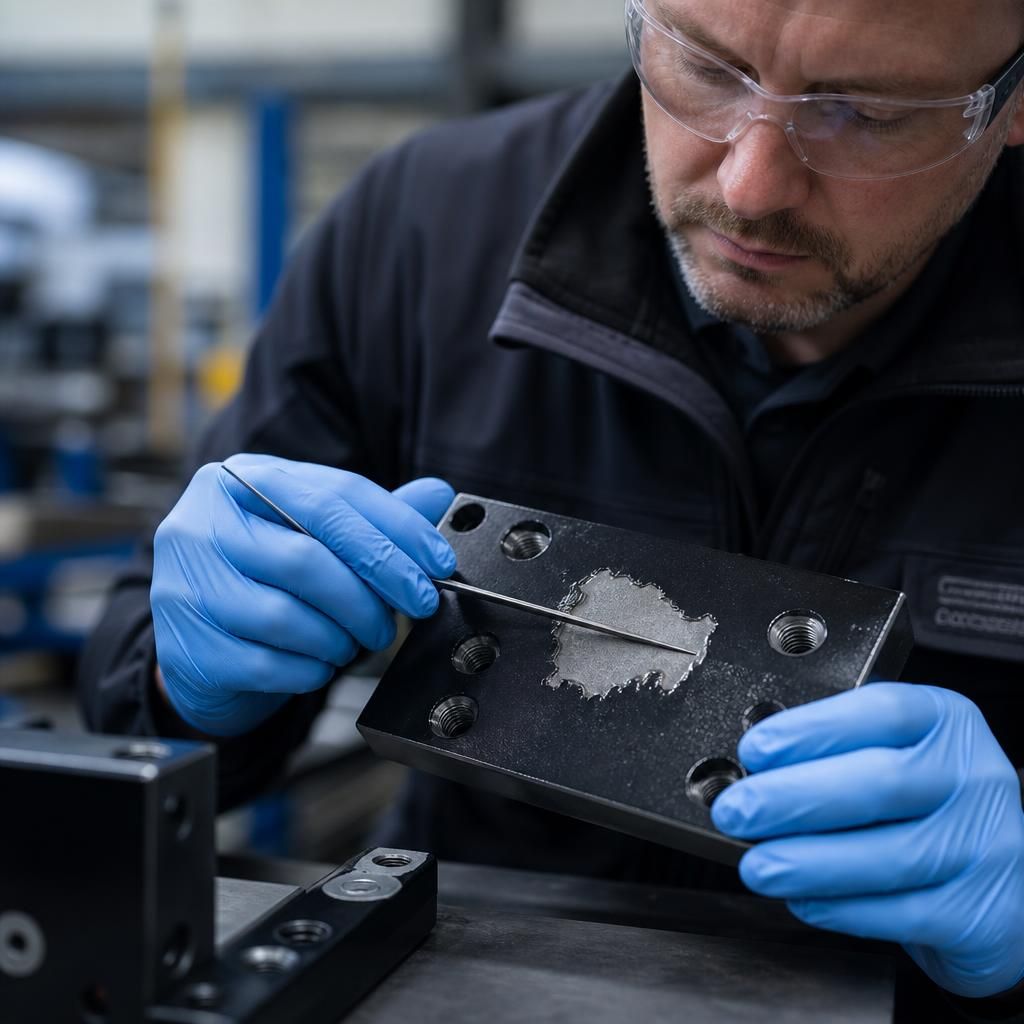
Adhesion performance should be assessed by identifying where a failure occurs, not simply by noting that the coating has detached. If Nylon or Rilsan separates cleanly from the metal, the interface may have been weakened by contamination, oxidation or an unsuitable pre-treatment. If the coating splits within its own film while remaining attached to the substrate, the cause may instead relate to film formation, impact or service stress.
This distinction helps determine whether the preparation process was appropriate for the component. It also prevents unnecessary reworking when the underlying issue lies elsewhere in the coating system or in the conditions experienced during use. Adhesion results are therefore most useful when considered alongside the substrate, preparation method, coating thickness and the component’s operating environment.