

What are the key benefits of choosing high temp powder coating over traditional liquid coatings for heat-resistant applications?
High temp powder coating provides a heat-resistant, tightly bonded finish that is less prone to breakdown, cracking or loss of adhesion than many traditional liquid coatings in demanding thermal environments. Its dry application also avoids solvent-based wet-film issues, while producing a consistent protective surface on suitable metal components.
High temperature powder coating can offer a more consistent, durable and environmentally controlled finish than traditional liquid coatings when the powder chemistry, substrate and curing process are matched to the operating temperature. Its main advantages are resistance to thermal exposure, efficient dry-film application, reduced solvent-related risks and a finish that can provide useful protection against wear, corrosion and chemicals alongside heat resistance.
Improved performance during repeated heating
Heat-resistant powder coatings are formulated to tolerate elevated temperatures without the rapid softening, blistering or breakdown that can affect unsuitable general-purpose coatings. This is particularly relevant to components exposed to ovens, exhaust systems, heating equipment, industrial furnaces or other hot environments. The correct product may also cope more effectively with repeated heating and cooling, although the expected temperature range and severity of thermal cycling must be confirmed before specification.
Performance is not determined by the coating alone. Continuous operating temperature, short-term peak temperature, heating rate, cooling rate, exposure to flames or hot gases, and contact with chemicals can all influence service life. A coating that performs well on a continuously warm component may not be suitable for direct flame exposure or frequent extreme temperature changes.
More controlled dry-film application
Powder is applied as a dry material and then cured to form the finished film. This avoids the wet-film flow, sagging and solvent-evaporation issues associated with many liquid systems. On correctly prepared metalwork, the process can produce a consistent coating thickness and an even appearance across batches, which is valuable when manufacturers need repeatable results for components made to the same specification.
Powder application also avoids adding liquid solvents to the coating process. That can reduce solvent handling and solvent-emission considerations compared with solvent-borne liquid coatings. It does not remove the need to assess surface preparation chemicals, curing emissions, extraction and wider site controls, but it can simplify the coating stage itself.
Useful protection beyond heat resistance
A high temperature coating may provide several forms of protection in one finish, depending on its formulation. These can include resistance to abrasion, impact, corrosion, oils, fuels, cleaning chemicals and general industrial handling. This matters where a component is heated during use but is also exposed to installation damage, vibration, workshop handling or contact with contaminants.
Liquid coatings can also be engineered for demanding conditions, so the comparison should be made between complete coating systems rather than between the words “powder” and “liquid” alone. The relevant questions are whether the coating retains adhesion at the required temperature, whether its surface properties remain acceptable, and how it behaves when heat is combined with mechanical or chemical exposure.
Efficient coverage of suitable metal components
Powder can be applied in a single controlled operation to achieve the specified film build, reducing the need for multiple wet coats where a liquid system would require primer, intermediate and topcoat stages. This may help simplify handling and reduce the number of process stages, provided the component geometry, required protection and powder specification are suitable.
Powder is particularly practical for conductive metal parts that can be electrically grounded during spraying and placed in an oven for curing. Complex assemblies, enclosed sections, heat-sensitive inserts and parts too large for the available curing equipment may require a different approach. Powder is not automatically the best choice simply because the component will operate at high temperature.
Finish quality and production consistency
Once the correct preparation, application and cure have been established, powder coating can provide consistent colour, texture and film formation across repeat production. This supports quality control for fabricated parts and manufactured components, where variations in liquid viscosity, spray technique, flash-off and drying conditions can affect the final finish.
That consistency depends on controlling the full process. The metal must be clean and appropriately prepared; the powder must be stored and applied correctly; the oven must achieve the required metal temperature; and the coating must be selected for the intended thermal environment. A decorative finish may change colour, gloss or texture at a temperature below the point at which the coating visibly fails, so appearance requirements should be included in the specification.
Important limitations when comparing the two systems
- Not every powder coating is heat resistant. Standard architectural or general industrial powder should not be assumed suitable for high-temperature service.
- The maximum temperature claimed for a product may apply only under particular conditions. Continuous exposure, intermittent exposure and thermal shock can produce different results.
- High-temperature formulations can have different colour, gloss, flexibility or corrosion-protection characteristics from conventional powders.
- Powder requires a suitable curing process. If the component cannot safely enter the curing equipment, a liquid system may be more appropriate.
- Surface preparation remains essential. Oil, scale, rust, residues and poor pretreatment can reduce adhesion regardless of whether the coating is powder or liquid.
- Coating thickness, sharp edges, joints and areas shielded during spraying should be reviewed because local weaknesses may become more significant when the part is repeatedly heated.
For a sound comparison, define the component’s base metal, operating and peak temperatures, thermal cycle, exposure to chemicals or abrasion, required appearance and available curing method. A coating specialist can then assess whether a high temperature powder formulation provides a practical advantage over a liquid system for that particular part, rather than relying on the coating type alone.
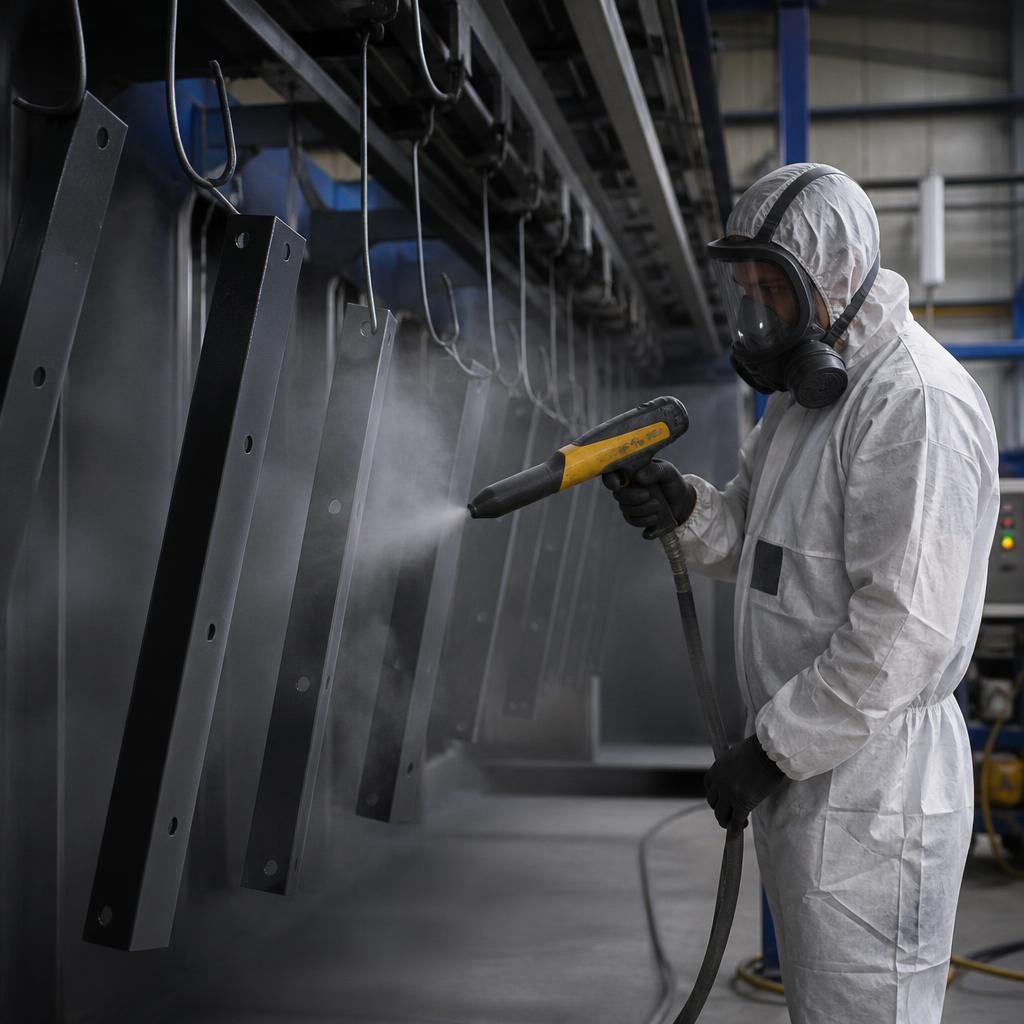
A key advantage of high temperature powder coating is the way the finished film is formed. The powder melts and chemically cross-links during curing, creating a continuous coating rather than relying solely on solvent evaporation to leave a dry film. When correctly specified, this structure helps the finish retain its integrity as the metal is heated, reducing the risk of defects associated with an incompletely dried or poorly consolidated coating.
This distinction is most relevant where the component must maintain a stable protective barrier during repeated thermal exposure. The benefit still depends on the powder chemistry, correct metal temperature during curing and suitable surface preparation; liquid coatings can also be formulated to cure effectively, so the comparison should be based on the complete system and its tested operating limits.