

How can epoxy powder coating be customised to meet specific durability and aesthetic requirements for different industrial applications?
Epoxy powder coating can be customised by selecting a formulation, film thickness, surface preparation and curing process suited to the component’s exposure to abrasion, chemicals, moisture and heat. Aesthetic requirements can be tailored through colour, gloss level, texture and finish, allowing the coating specification to balance protection with the appearance and functional needs of each industrial application.
Customised epoxy powder coating is specified around the component’s service conditions, functional duties and required appearance rather than treated as a one-finish solution. The coating specification should define how the part will be used, what it must withstand, which areas must remain uncoated and how the finished surface will be inspected and accepted.
Start with the component’s operating environment. The same epoxy coating may not be appropriate for every industrial location. A component installed inside a dry electrical enclosure has different requirements from a fabricated part exposed to process fluids, repeated handling or contact with other metalwork. The specification should consider:
- Whether the part is used indoors, outdoors or between both environments.
- The type and frequency of contact with oils, cleaning agents, fuels, solvents or other chemicals.
- Potential impact, rubbing, sliding contact and handling during assembly.
- Exposure to condensation, standing water, humidity or corrosive atmospheres.
- Operating temperature and any short-term temperature excursions.
- Whether the finish is decorative, protective, electrically insulating or required to support several of these functions.
Epoxy is particularly useful where adhesion, chemical resistance and a hard protective surface are important. However, prolonged direct sunlight can cause epoxy finishes to lose gloss or develop surface chalking. Where a component will remain exposed to ultraviolet radiation, this limitation should be considered at the specification stage rather than discovered after installation. The required service life and visual standard may determine whether epoxy is suitable on its own or whether another coating system should be assessed.
Functional requirements can be set more precisely than simply choosing a colour. For example, a coating for a machine guard may need to tolerate repeated handling and minor impacts, while a coating for an enclosure may place greater emphasis on a smooth, cleanable surface and consistent electrical isolation. A component used in a manufacturing process may need resistance to particular fluids, whereas a structural item may be assessed mainly for adhesion, edge protection and resistance to damage during transport and assembly.
These requirements should be linked to the component’s design. Sharp corners, recessed sections, slots, perforations, folded returns and joined parts can all affect how consistently a finish is applied. Areas that must not receive powder, such as earth points, threaded holes, bearing seats, mating faces and close-tolerance bores, should be identified on the drawing or agreed before processing. Masking and hanging arrangements can then be planned to protect critical features without compromising the visible finish.
Aesthetic customisation also includes consistency and acceptance criteria. A project specification can identify a recognised colour reference, acceptable gloss range, surface texture and the faces that will be visually assessed. It should also clarify whether the finish must be smooth, lightly textured or selected to help disguise minor substrate irregularities. For assembled products, the appearance of adjacent parts may need to be considered together so that differences caused by component shape, orientation or production batch are controlled.
Appearance should be judged under suitable viewing conditions and from an agreed inspection distance. Small differences in visual effect can be more noticeable on large flat panels than on small brackets, while a textured finish may make minor marks less apparent but can be harder to clean. A practical specification therefore balances the desired appearance with the way the part will be handled, cleaned and inspected in service.
Trial pieces can resolve uncertainties before full production. A representative sample, test panel or first-off component can be used to assess:
- Whether the selected appearance is suitable across flat and formed areas.
- Coverage of difficult features such as returns, recesses and internal faces.
- Clearance around masked holes, threads and mating surfaces.
- Compatibility between the coating and the component’s intended assembly process.
- Whether the finished surface meets the agreed visual and functional standard.
For batch work, retaining an approved reference sample and recording the agreed specification helps maintain consistency across repeat orders. Relevant details may include the component revision, coating identification, finish description, areas to be masked, inspection points and any agreed exclusions. This is especially important where coated parts are supplied to a larger assembly or must interchange with previously finished components.
Quality requirements should reflect the part’s actual use. Inspection may involve checking for visible defects, incomplete coverage, contamination, damage, adhesion and correct masking. Where the application is safety-critical or subject to a customer standard, the required tests and acceptance limits should be agreed before coating begins. It is unhelpful to specify a finish only by colour if performance, dimensional clearances or chemical exposure are equally important.
For manufacturers, fabricators, construction businesses and automotive suppliers, the most reliable approach is to provide drawings, material details, intended use, exposure information, critical dimensions and appearance requirements at quotation or pre-production stage. A coating specialist can then assess whether the proposed epoxy specification is compatible with the part and identify practical issues before the complete batch is processed. Collection and delivery options can support this process for businesses across the Midlands and surrounding areas.
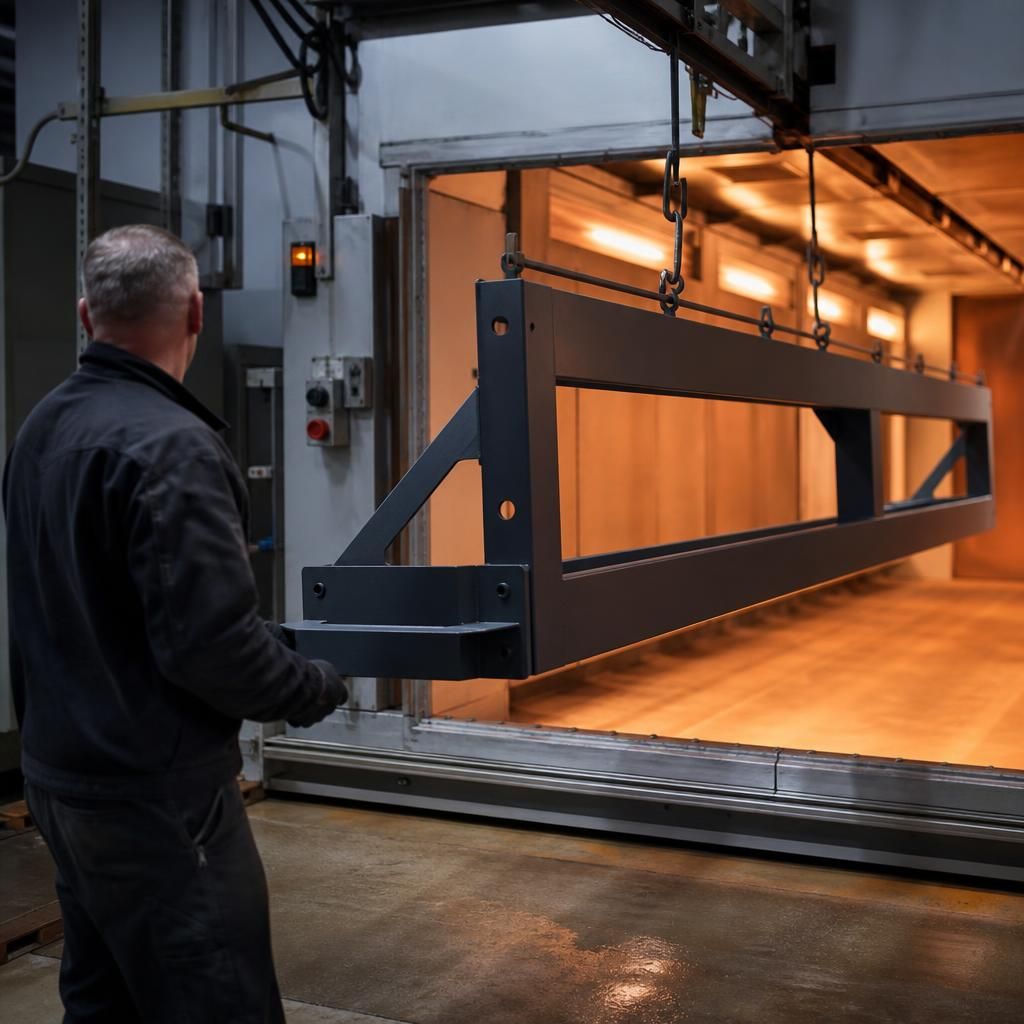
Curing is a key part of customising epoxy powder coating because the powder must reach the correct metal temperature for the required time to develop its intended properties. The suitable cure process depends on the component’s material, thickness, mass and geometry, as heavy sections and complex shapes may heat differently from thin, flat areas.
An appropriate cure profile helps the finish achieve consistent adhesion, hardness, chemical resistance and appearance. Insufficient curing can leave the coating below its intended performance, while excessive heat or an unsuitable cycle may affect colour, gloss or substrate-sensitive components. For complex parts, cure conditions can be assessed on a representative piece before production so the selected specification is practical for the whole component.