

What specific properties should I look for in a high-performance powder coating to ensure it meets industrial standards?
A high-performance powder coating should be selected for verified adhesion, hardness, impact and abrasion resistance, corrosion protection, UV and weather resistance, and compatibility with the service temperature and chemicals the component will encounter. Industrial suitability also depends on controlled film thickness, correct curing, consistent batch quality and documented test results against the specification or standard relevant to the application.
A high-performance powder coating should be judged against the component’s actual operating conditions and the requirements of the relevant specification, rather than by the term “high-performance” alone. Key properties include resistance to the chemicals, moisture and temperature changes encountered in service, sufficient flexibility for the component’s geometry and handling, stable appearance, and reliable performance supported by appropriate technical data.
Chemical resistance is important where coated parts may contact oils, fuels, solvents, cleaning agents, salts, acids or alkaline substances. Check whether the technical documentation identifies the specific chemicals, concentration, contact time and temperature covered by the test. A coating that performs well against occasional splashes may not be suitable for continuous immersion or repeated chemical cleaning.
Thermal capability should be considered across the full operating cycle, not just the maximum temperature. Repeated heating and cooling can place stress on the coating and the metal beneath it because the materials expand and contract at different rates. Ask for the recommended continuous and intermittent service temperatures, and confirm that the coating remains suitable for the component’s manufacturing, transport and operating conditions.
Flexibility and resistance to deformation matter for formed, folded or assembled metalwork. A coating may have good surface properties but still be unsuitable if it cracks when the part is bent, pressed, fastened or subjected to vibration. This is particularly relevant to fabricated enclosures, brackets, frames and components that experience movement or mechanical assembly after coating.
Moisture and water exposure should be assessed according to the way the part will be used. Consider condensation, standing water, immersion, humidity, road spray and wet storage. The design of the component also matters: seams, joints, recesses and areas where water can collect may create conditions that are more demanding than those on an exposed flat surface. The coating specification should therefore be considered alongside drainage, joint design and the condition of the substrate.
Electrical properties may be relevant for cabinets, housings, switchgear and other equipment where the finish forms part of an electrical design. Depending on the application, the required characteristic might be insulation, controlled conductivity, resistance to static charge or compatibility with earthing arrangements. These requirements should be defined by the equipment specification; a standard decorative coating should not be assumed to provide a particular electrical function.
Finish consistency is an industrial property as well as an aesthetic one when components are installed together or produced in batches. Check the acceptable limits for colour, gloss, texture, film appearance and coverage. The specification should state how these characteristics will be assessed, because visual differences can result from part geometry, viewing angle, texture, curing conditions and the use of different production batches.
Substrate and pre-treatment compatibility should be confirmed before coating begins. Aluminium, mild steel, galvanised steel and other metals can require different preparation methods. Welds, sharp edges, cast surfaces, existing coatings and areas contaminated with oil or processing residues may also affect the final result. A suitable powder formulation cannot compensate for unsuitable preparation or a substrate condition that falls outside the agreed specification.
Repair and maintenance requirements are worth including in the original selection. Industrial components can be drilled, cut, assembled or damaged during installation, so the specification should explain how exposed areas are to be treated and which touch-up materials are compatible. It should also identify suitable cleaning methods and substances, particularly where aggressive detergents or pressure washing will be used.
To establish whether a coating meets industrial requirements, request technical documentation that covers:
- the intended substrate and pre-treatment system;
- the permitted operating environment and service temperature;
- chemical, moisture and cleaning-agent resistance relevant to the application;
- flexibility and suitability for forming, assembly or vibration;
- electrical, fire or other specialised properties where required;
- acceptable colour, gloss, texture and visual variation;
- test methods, acceptance criteria and the conditions under which testing was performed; and
- storage, handling, application, repair and maintenance instructions.
Standards should be treated as part of the specification rather than as a substitute for it. Identify the standard, classification or customer requirement that applies to the finished component, then check that the coating data relates to the same substrate, preparation, application conditions and exposure category. Test results from a different system may not be directly transferable.
Finally, consider whether the evidence covers the complete coating system rather than the powder material in isolation. Pre-treatment, substrate condition, application method and curing all influence the finished performance. For batch production, retain the agreed coating reference, finish requirements and inspection criteria so that incoming parts can be assessed consistently against the industrial specification.
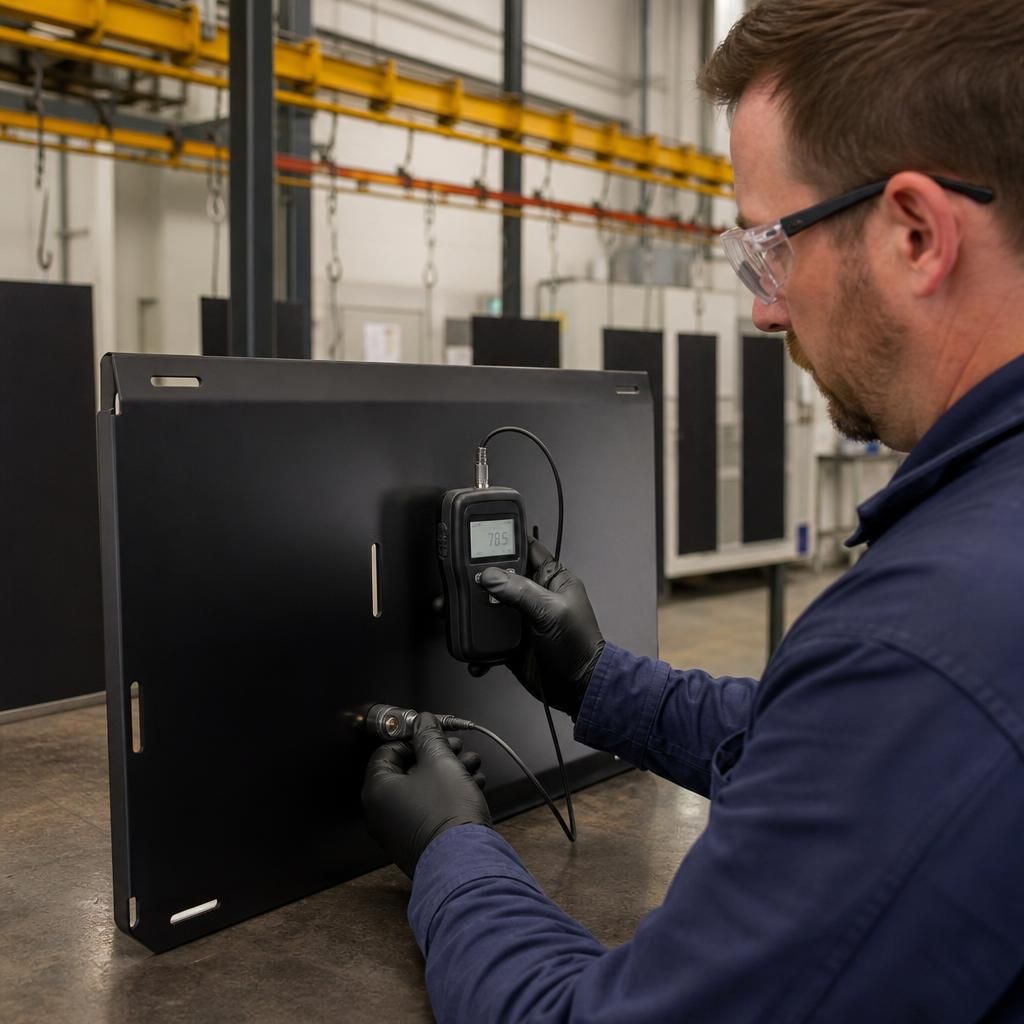
Hardness, impact resistance and abrasion resistance are separate properties, so they should not be treated as interchangeable indicators of coating performance. Hardness describes resistance to scratching, indentation or marking; it does not necessarily show how well the finish will withstand a sudden blow or repeated rubbing.
For components exposed to handling, loading, vibration or contact with other parts, check the coating’s impact resistance and flexibility as well as its surface hardness. A very hard finish may still chip if it is brittle, while a more flexible formulation may better tolerate movement or local deformation. Abrasion resistance is the relevant property where surfaces are repeatedly rubbed by equipment, materials, seals or moving components.
Ask for test results that identify the method used and the failure criterion, rather than relying on descriptive terms such as “tough” or “heavy duty”. The selected balance of hardness, impact performance and abrasion resistance should reflect the likely damage mechanism during manufacture, installation and service.
Discuss Your High-Performance Powder Coating Requirements
Discuss your high-performance powder coating requirements with Powder-coatings.co.uk, including the component’s operating environment, substrate and required performance criteria. This allows the appropriate coating system and inspection requirements to be considered against your industrial specification.