

How does the specific chemical composition of a thermoset powder coating affect its performance and suitability for your project?
The resin, curing agent, pigments and additives in a thermoset powder coating determine how it crosslinks during curing, which directly affects hardness, flexibility, adhesion, corrosion resistance, chemical resistance and weatherability. The most suitable formulation depends on the metal substrate, required finish, service environment, exposure to heat or chemicals, and the curing conditions available for your project.
A thermoset powder coating’s chemical composition determines the crosslink structure formed during curing. That structure controls how the finished film behaves in service, while the selected resin family, curing chemistry, pigments, fillers and functional additives determine whether the formulation is suitable for a particular substrate, environment and production process.
Resin chemistry establishes the coating’s main performance profile. Epoxy-based formulations are commonly selected where adhesion, corrosion protection, impact resistance and resistance to many chemicals are important. They are often suitable for components used indoors or where ultraviolet exposure is limited. Standard epoxy chemistry can lose appearance through chalking or colour change in sustained sunlight, so it may not be the right choice where long-term exterior appearance is a priority.
Polyester formulations are generally more appropriate for external metalwork because their chemistry offers better resistance to ultraviolet exposure and weathering. They are used where colour and gloss retention are important as well as basic protection. The precise grade still matters: a formulation intended for sheltered equipment may not provide the same durability as one designed for prolonged outdoor exposure.
Hybrid powders combine epoxy and polyester chemistry to balance selected properties. They can provide useful adhesion and mechanical performance for interior components, but they should not automatically be treated as exterior coatings. The ratio between the resin components, the curing agent and the rest of the formulation affects the final behaviour, so the product’s technical specification should be checked rather than relying on the word ‘hybrid’ alone.
Other thermoset systems, including acrylic-based formulations, may be developed for particular appearance, smoothness, weathering or functional requirements. These are chosen less often on the basis of resin name alone and more often against a defined specification covering exposure, finish, film performance and curing conditions. Fusion bonded epoxy is another epoxy-based approach used where a thick, strongly adherent protective layer is required, including certain fabricated and infrastructure components.
The curing agent determines how the resin network develops. Different curing agents react at different temperatures and rates, producing differences in hardness, flexibility, chemical resistance, surface appearance and resistance to overbaking. The formulation must be matched to the actual metal temperature and time at temperature, not simply to the oven air setting. Under-curing can leave the film with inadequate mechanical or chemical performance, while excessive heat or dwell time can affect colour, gloss and long-term properties.
Cure chemistry also affects the balance between hardness and movement. A highly crosslinked film may resist indentation and chemicals well but have less ability to tolerate forming, vibration or impact. A formulation with greater flexibility may be more suitable for parts that experience handling or dimensional movement, although this can involve a different balance of hardness, solvent resistance or surface performance. The right choice therefore depends on the failure mode the component is most likely to experience.
Pigments, fillers and additives modify the base chemistry rather than acting as cosmetic extras. Pigment selection affects opacity, colour stability and the way the coating responds to light and heat. Fillers can influence film build, texture, hardness, density and flow. Flow agents help the powder form a continuous surface; degassing additives can assist where the substrate or casting may release trapped gas; matting and texturing systems alter appearance and can also change how readily dirt or marks are seen. Additives must remain compatible with the resin and curing system, otherwise they may impair intercoat adhesion, surface uniformity or durability.
The formulation must also suit the substrate. Steel, galvanised steel, aluminium and cast components can present different adhesion, outgassing and corrosion risks. A powder designed for bare steel may not be the best option for a zinc-coated surface or a porous casting. On difficult substrates, the specification may require a compatible primer or a formulation designed to work with a particular pretreatment. Chemical composition cannot compensate for oil, oxides, moisture, inadequate preparation or contamination on the metal.
For a practical selection, assess the coating in the following order:
- Identify whether the part will be used indoors, outdoors, or in an environment involving sunlight, moisture, salt, chemicals or elevated temperature.
- Define the principal service risks, such as corrosion, abrasion, impact, chemical contact, colour change, loss of gloss or deformation during assembly.
- Confirm the substrate, its preparation and whether it is likely to release gas or require a primer.
- Check the required finish, including colour, gloss, smoothness, texture, opacity and acceptable visual variation.
- Compare the product’s curing requirements with the component’s thickness, geometry, production method and available oven process.
- Review technical data and, for demanding applications, validate the proposed system with representative parts or test panels.
In practice, the most suitable coating is rarely the one with the highest single test result. It is the formulation whose crosslinked film, appearance and processing requirements remain appropriate throughout the component’s expected service life. A clear performance specification helps distinguish between similar powder types and prevents an interior-grade, appearance-led or mechanically hard formulation being selected for conditions that require a different chemical balance.
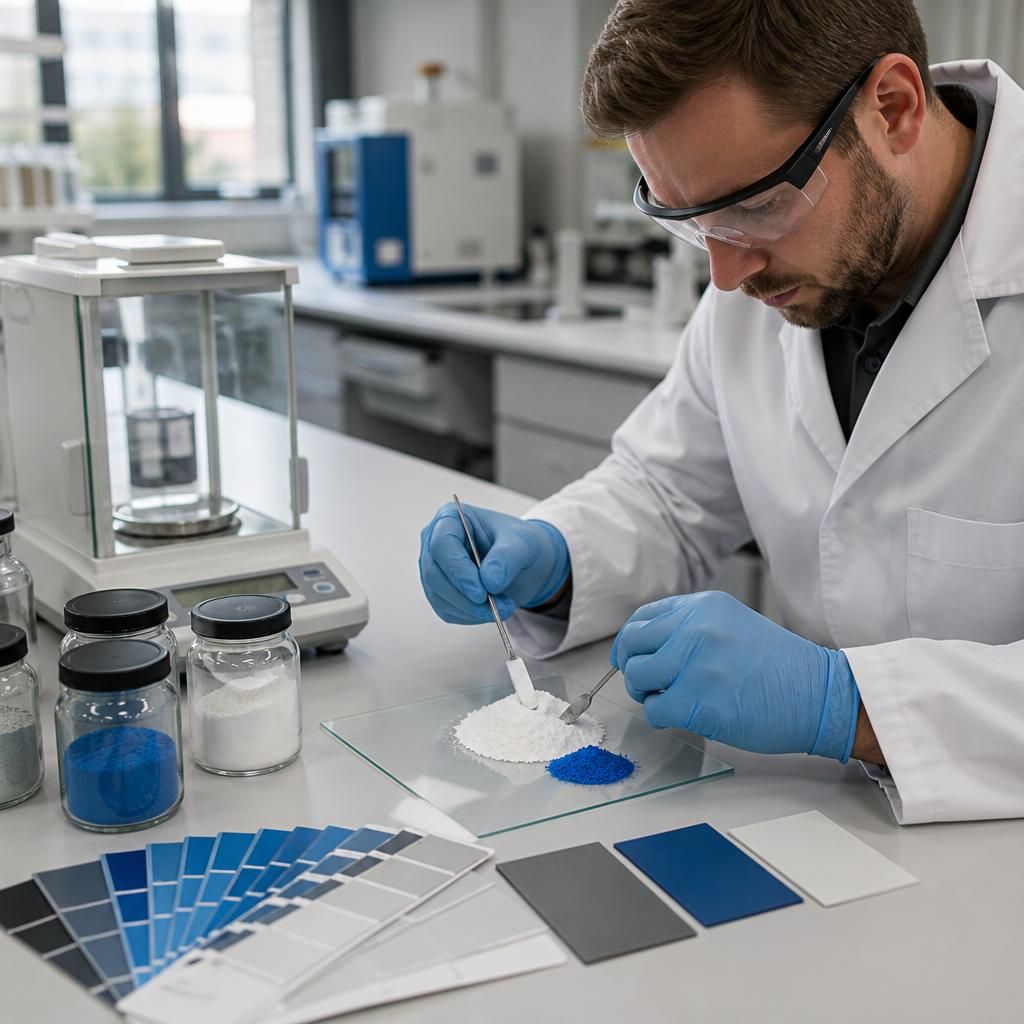
Two powders described as the same type can perform differently because their formulation balance is not identical. The resin’s molecular structure, the ratio between resin and curing agent, catalyst level and pigment or filler loading all influence the number and strength of links formed in the cured film. An imbalance can leave reactive material insufficiently converted, or create a film that is harder and more brittle than the component can tolerate.
This is why the resin family alone is not a complete specification. For demanding parts, compare the manufacturer’s technical data for the actual grade, including recommended film build, cure schedule, adhesion, flexibility, impact and chemical-resistance results. Those details show how the chemistry has been formulated for its intended use and help identify whether the coating is suited to the component’s operating demands.