

What are the key factors to consider when selecting a powder coating service provider for automotive applications?
When selecting a powder coating service provider for automotive applications, assess their preparation and curing controls, experience with vehicle components, ability to meet the required finish and durability, and capacity for your part sizes and batch volumes. Also check how they manage masking, quality inspection, packaging and collection or delivery, so the finished components meet your technical and production requirements.
Choosing a powder coating service provider for automotive applications means matching the coater’s technical process, material knowledge, documentation and commercial arrangements to the component’s actual operating conditions. The right choice is not based on appearance alone: the provider must understand the substrate, the stresses the part will face, the required tolerances and the evidence needed to confirm that the coating meets the specification.
Start with a clear technical specification. Before comparing suppliers, define the component material, dimensions, intended use, required colour and gloss, areas that must remain uncoated, and any performance requirements. State whether the part will be exposed to road salt, moisture, fuels, oils, cleaning chemicals, heat, abrasion or stone impact. A provider should be willing to review these requirements and identify any points that could affect coating selection or application.
Check coating chemistry against the application. Different powder formulations provide different balances of chemical resistance, flexibility, hardness, corrosion protection and appearance. A coating suitable for an interior bracket may not be appropriate for a part exposed to weather or repeated mechanical contact. Where the component needs a specialist protective finish, ask what coating type is proposed, why it is suitable and whether its limitations are understood. Nylon and other specialist coatings may be relevant for parts requiring particular abrasion, impact or chemical-resistance characteristics, but the choice should be based on the component’s service conditions rather than a generic product description.
Consider the substrate and component design. Aluminium, steel, galvanised metal and other substrates can require different preparation and handling considerations. Castings, welded fabrications, pressed parts and components with deep recesses may present different risks, including trapped contaminants, difficult-to-reach areas or uneven coating build. Discuss holes, threads, mating faces, hinges, bearing seats and close-fitting interfaces before work begins. The provider should identify where coating thickness could interfere with assembly and agree suitable protection or finishing requirements.
Agree dimensional and functional tolerances. Powder coating adds a layer to the surface, so the specification should distinguish between cosmetic surfaces and areas where dimensions are critical. This is particularly important for brackets, housings, suspension-related components, covers and parts that must fit against another manufactured item. Confirm how critical dimensions will be protected or checked, and provide drawings or measurement requirements where necessary. A visually acceptable part can still cause production problems if coating reaches a threaded hole, sealing surface or precision interface.
Review colour and appearance controls in practical terms. If coated parts are assembled alongside existing components, colour matching and gloss consistency may matter across different materials or production batches. Ask how colour standards, approved samples and changes in powder formulation are managed. It is also useful to define acceptable levels of orange peel, texture, edge coverage and minor visual variation before production, particularly for visible automotive parts. This prevents subjective disagreements after the work is complete.
Ask about traceability and technical records. For production components, useful records may include the powder specification, batch details, job references, substrate information, agreed requirements and inspection results. Traceability becomes more important where parts are safety-related, supplied into a controlled manufacturing process or likely to require investigation later. A provider should be able to explain what documentation accompanies the work and how it is linked to the relevant parts or batch.
Evaluate sample and approval procedures. A trial part or representative sample can expose issues that are difficult to identify from a written quotation. It can confirm the colour, texture, edge coverage, masking boundaries, fit and general appearance before larger quantities are processed. The sample should represent the actual substrate and geometry wherever possible. Any agreed deviations or acceptance criteria should be recorded rather than left to informal discussion.
Examine how the provider manages non-conforming parts. Ask what happens if a component has contamination, unsuitable previous coatings, damage, dimensional problems or an appearance outside the agreed standard. Rework is not always appropriate, particularly where stripping could affect the substrate or component tolerances. A defined process for identifying, segregating and reporting issues helps prevent unsuitable parts from entering assembly.
Assess production compatibility and communication. The service should fit the customer’s purchasing and manufacturing processes. Important points include quotation clarity, part identification, order changes, drawing revisions, batch separation and notification of technical issues. Confirm whether the quotation includes preparation, specialist coating requirements, masking, rework considerations and any agreed testing or records. Transparent scope is more useful than comparing headline prices that cover different levels of service.
Check environmental and regulatory considerations. Automotive supply chains may impose requirements relating to restricted substances, waste handling, material declarations or customer-specific standards. Establish which requirements apply to the component and whether the provider can supply relevant information. This is especially important where the part is being incorporated into a larger vehicle system or sold into a regulated supply chain.
Finally, compare providers using the same written specification and sample expectations. A suitable powder coating partner should be able to explain the proposed coating system, identify design or tolerance risks, document the agreed requirements and communicate clearly when a part falls outside them. That structured assessment gives a more reliable basis for selection than appearance, price or a general claim of automotive experience alone.
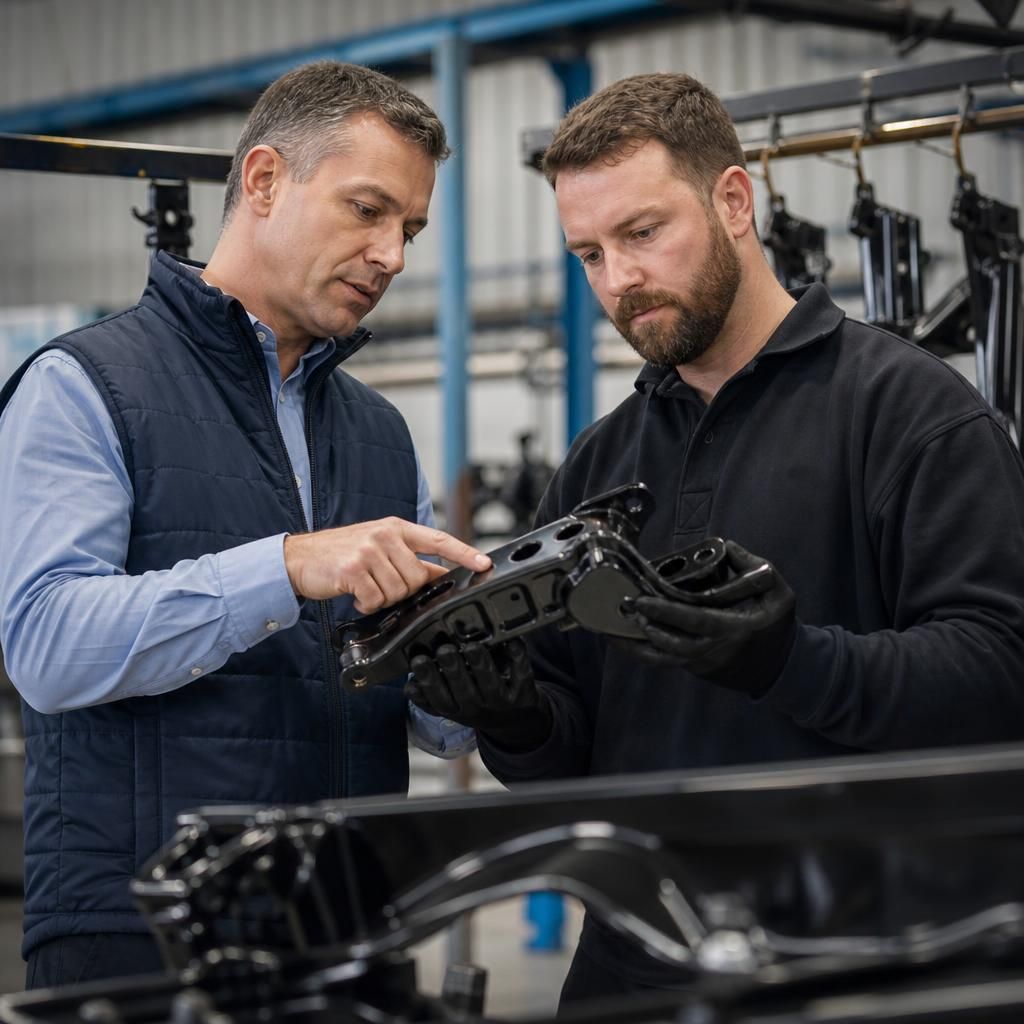
A key selection factor is the provider’s ability to distinguish cosmetic quality from functional suitability. For automotive components, an attractive finish is not enough if coating affects a mating face, restricts movement or fails to protect an exposed edge. Ask the coater to explain how the proposed process will preserve the part’s intended operation, including any areas that need controlled coating build, masking or post-coating inspection. This technical discussion can reveal whether the provider is assessing the component as an engineered part rather than treating it as a purely cosmetic item.
Discuss Your Automotive Powder Coating Requirements
Discuss your automotive component requirements with Powder-coatings.co.uk to establish whether the proposed coating system and process are suitable for your parts. Provide the relevant component details, finish expectations and production requirements for an informed assessment.