

What role does zinc phosphate treatment play in powder coating pretreatment, and how does it enhance adhesion and corrosion resistance?
Zinc phosphate treatment is a chemical conversion stage in powder coating pretreatment that forms a fine, adherent phosphate layer on suitably prepared steel. This micro-textured layer provides a stronger key for the powder film and helps slow corrosion by improving the barrier between the metal substrate and the coating.
Zinc phosphate treatment is a conversion-coating stage used to prepare steel and, in some systems, galvanised or zinc-coated substrates before powder is applied. Its purpose is not to replace the powder film, but to modify the metal surface so that the complete coating system has a more stable foundation for adhesion and improved resistance to corrosion at the substrate interface.
The treatment works through a controlled chemical reaction between the prepared metal and the phosphate solution. Instead of leaving the steel with a chemically active, relatively uniform surface, the process develops a thin crystalline deposit. This deposit increases the effective surface area and provides microscopic irregularities into which the powder coating can anchor after melting and curing. The result is a more dependable bond than powder applied to inadequately cleaned or untreated steel.
How the treatment fits into pretreatment
Zinc phosphate is one part of a sequence rather than a stand-alone solution. The exact stages vary according to the substrate, contamination present, coating specification and equipment used, but a typical process includes:
- Degreasing to remove oil, grease, handling residues and similar contaminants.
- Rinsing to prevent cleaning chemicals from interfering with later stages.
- Removal or control of mill scale, rust and other oxides where required.
- Application of the zinc phosphate solution under controlled chemical and operating conditions.
- Further rinsing, where specified, to remove loose or residual chemistry.
- Drying the components thoroughly before powder application.
Every stage affects the next one. If oil remains on the metal, the conversion coating may be incomplete or uneven. If rinsing is poor, residues can contribute to surface contamination, staining or coating defects. If water remains in joints, recesses or folded sections, it can affect application and contribute to later corrosion. Zinc phosphate therefore improves a properly managed pretreatment process; it cannot compensate for inadequate cleaning, unsuitable metal preparation or poor powder application.
How it improves adhesion
Powder coating adhesion depends on both mechanical keying and chemical compatibility between the coating system and the substrate. Zinc phosphate contributes to the mechanical side by creating a fine, textured surface. When the powder melts during curing, it flows across this profile and forms a closer physical grip than it would on a contaminated or excessively smooth surface.
The conversion layer also helps create a consistent interface across the component. Consistency is particularly important on fabricated parts that include welds, edges, flat areas, drilled holes and areas with different levels of previous oxidation. It does not eliminate the need to treat these areas correctly, but it can provide a more uniform basis for the powder film when the preceding cleaning and preparation have been carried out correctly.
Good adhesion still depends on the powder being suitable for the metal and service conditions, the film being applied at the specified thickness, and the component reaching the correct curing conditions. Under-cure, over-cure, contamination, trapped moisture and excessive film build can all weaken performance even where zinc phosphate has been used.
How it supports corrosion resistance
Steel corrodes when moisture and oxygen reach active areas of the metal. The cured powder coating provides the primary barrier, while the phosphate layer helps strengthen the boundary between that barrier and the steel. It can reduce the ease with which corrosion develops beneath a coating that has been locally damaged, although the level of protection depends on the complete system rather than on the phosphate stage alone.
This is important because a scratch, chip, cut edge or small area of poor adhesion can expose the substrate. A suitable conversion coating can restrict the spread of corrosion from the exposed area and reduce the likelihood of the coating lifting around it. The degree of benefit is influenced by substrate condition, coating formulation, film thickness, component design and the environment in which the finished part will be used.
Zinc phosphate should not be treated as a substitute for sound design or a properly cured powder coating. Water traps, unsealed overlaps, inaccessible internal faces and sharp edges can still create weak points. Drainage holes, appropriate weld finishing, effective cleaning and coverage of all required surfaces remain essential, especially for fabricated assemblies exposed to moisture or corrosive contaminants.
Factors that control the result
- Substrate condition: Rust, scale, old coatings and welding residues may need additional preparation before chemical treatment can work evenly.
- Cleaning quality: Oils and fabrication residues can prevent the solution from contacting the metal consistently.
- Chemical control: Concentration, temperature, contact time and solution condition must be managed according to the chosen pretreatment system.
- Rinsing: Carry-over between stages can alter the surface or leave residues that interfere with powder adhesion.
- Drying: Components must be free from visible and trapped moisture before powder is applied.
- Handling: Gloves, clean supports and suitable handling methods help prevent recontamination after treatment.
- Powder application and cure: Correct electrostatic application, film coverage and oven conditions are needed to realise the benefit of the prepared surface.
Complex components require particular attention. Box sections, overlapping joints, deep recesses and perforated parts can be difficult to clean, rinse and dry. Their design may also affect how the pretreatment solution reaches every surface. Reviewing the component before processing helps identify areas where drainage, masking, racking or additional preparation may be necessary.
Zinc phosphate compared with other pretreatment approaches
Zinc phosphate is selected when the coating specification requires a conversion layer that supports adhesion and corrosion performance on the relevant substrate. Iron phosphate may be used in other systems, while newer zirconium- or other non-phosphate-based technologies may be selected for different environmental, process or substrate considerations. These treatments are not interchangeable by default: their suitability depends on the metal, the powder system, the intended service environment and the required performance validation.
For this reason, the correct question is not simply whether a component has been chemically treated. The important points are whether the treatment is compatible with the substrate and powder, whether the complete process is controlled, and whether the finished system is appropriate for the component’s exposure conditions.
Checking the finished pretreatment
Process checks can include visual examination for uniform coverage, inspection for staining or residues, and review of cleaning, rinsing and drying controls. Where a project specification calls for it, adhesion and corrosion testing can assess the complete coating system rather than the conversion layer in isolation. Test methods and acceptance criteria should be agreed for the particular application, as a finish for an indoor fabricated part will not necessarily be judged in the same way as one intended for a demanding external environment.
In practical terms, zinc phosphate is most effective when it is treated as part of a controlled chain: sound component preparation, suitable chemical conversion, clean drying, correct powder application and proper curing. Its contribution is to make the metal-to-coating interface more reliable and less vulnerable to corrosion, but the durability of the finished part ultimately depends on the performance of the whole pretreatment and powder coating system.
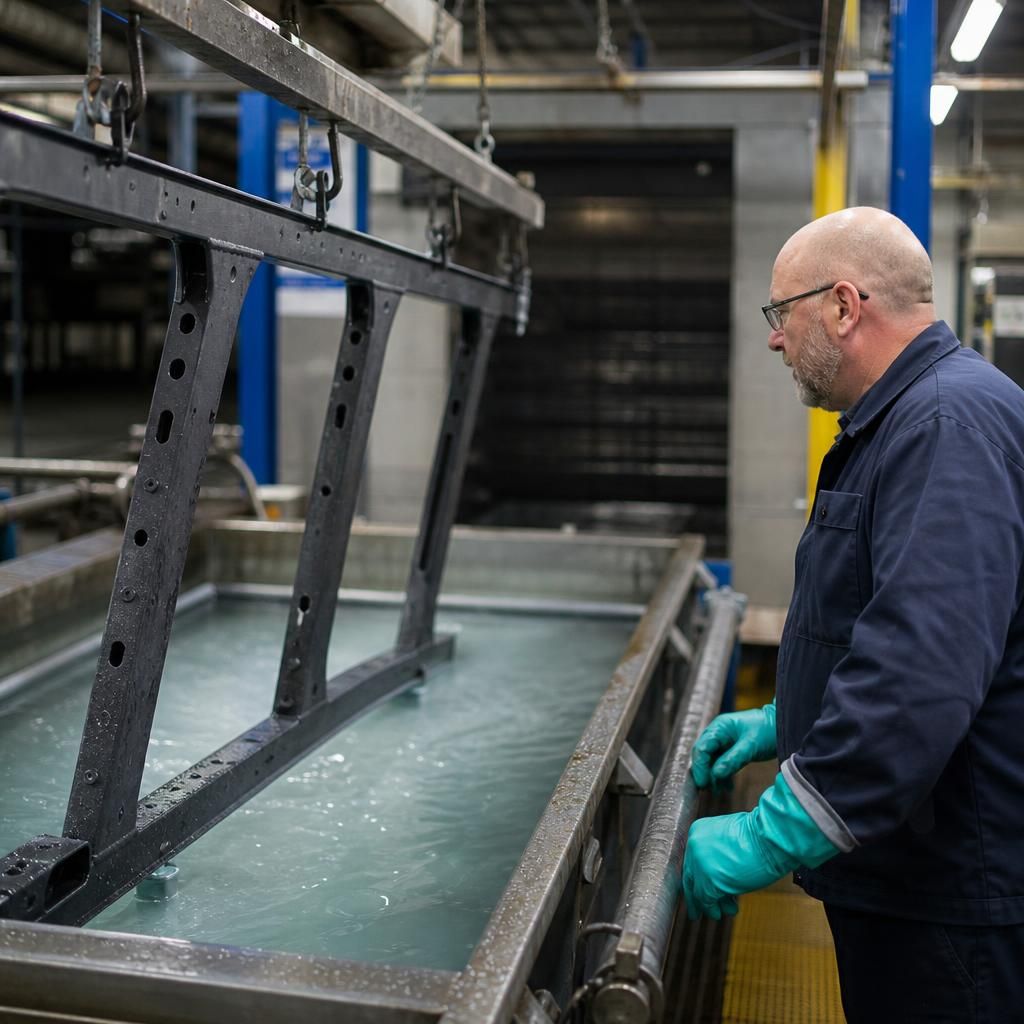
A zinc phosphate requirement should be defined as part of the complete powder coating specification, not treated as an isolated chemical treatment. The specification should identify the substrate, intended exposure, powder system, required pretreatment route and the method used to verify the finished coating. This prevents a treatment selected for one type of steel or service environment being applied without checking its suitability for the actual component.
- State whether the parts are mild steel, galvanised steel or another compatible substrate.
- Describe the environment, including indoor, external, humid or chemically contaminated conditions.
- Set out the required appearance and performance checks, such as adhesion or corrosion testing where appropriate.
- Agree how non-conforming areas, contamination and visible pretreatment residues will be assessed.
This approach separates two questions that are sometimes confused: whether the phosphate layer has been produced correctly, and whether the complete coating system is suitable for service. Both need to be considered when zinc phosphate treatment is specified for industrial metalwork.