

How do environmental conditions impact the choice between nylon and protective coatings for metal components?
Environmental conditions determine whether nylon or a protective coating is more suitable, based on factors such as moisture, chemical exposure, abrasion, temperature and outdoor weathering. Nylon is often selected for durable, impact- and wear-resistant coverage, while protective coatings are chosen where corrosion resistance and a barrier against demanding environmental exposure are the main priorities.
The choice between nylon and protective coatings should be based on the complete exposure profile of the component, rather than on one environmental condition in isolation. The assessment should consider how the part is used, how often conditions change, which surfaces are exposed, and whether failure would result from corrosion, loss of adhesion, surface wear or dimensional change.
Nylon coatings are generally considered where a tough, relatively thick polymeric layer is needed to withstand repeated contact, impact and sliding. They can be suitable for components that require a resilient, non-metallic surface, particularly where the coating must tolerate handling or contact with other parts. However, the exact nylon formulation and application method matter: different grades can vary in resistance to moisture absorption, chemicals, ultraviolet exposure and elevated temperatures.
Protective coatings cover a wider range of formulations, including systems designed primarily to isolate the metal substrate from corrosive contaminants. They may be more appropriate where the principal risk is oxidation caused by water, salts, process residues or atmospheric pollutants. The coating system must still be matched to the substrate, preparation standard and exposure conditions; a generic protective finish is not automatically suitable for immersion, marine-influenced atmospheres or contact with aggressive process chemicals.
Moisture should be assessed in terms of how it reaches and remains on the component. Intermittent splash, condensation, trapped water and continuous immersion create different demands. Components with joints, recesses or poorly drained sections may retain contaminants even when most of the surface appears dry. In these cases, edge coverage, film continuity and preparation around welds or fabricated details can be as important as the nominal coating type. A protective system that forms an effective barrier may be preferred for corrosion control, while nylon may be selected where the same part also needs a robust contact surface.
Temperature affects both the coating and the metal beneath it. The relevant conditions include normal operating temperature, short-term peaks, cooling cycles and the rate at which the component changes temperature. Repeated expansion and contraction can place stress on the bond between coating and substrate. Nylon selection should therefore take account of its service-temperature range and any change in flexibility or hardness at the extremes. For protective coatings, the formulation must retain adhesion and barrier performance throughout the expected thermal cycle, not merely at room temperature.
Chemical exposure requires identification of the actual substance, its concentration, temperature, contact time and method of contact. A coating may tolerate occasional splashes but not prolonged contact or immersion. Cleaning agents, oils, fuels, solvents, alkaline materials and acidic residues can have very different effects. Where chemicals are involved, the proposed system should be checked against the supplier’s resistance data and, where the consequence of failure is significant, evaluated using representative samples or service testing.
Outdoor use introduces combined exposure rather than a single test condition. Rain, condensation, sunlight, airborne contaminants and repeated drying can act together, while exposed edges and fixing points may deteriorate before broad flat areas. A protective coating may need a formulation with suitable weathering and ultraviolet resistance. Nylon may remain appropriate where mechanical protection is the priority, but its suitability should be confirmed for the specific grade, colour, thickness and exposure duration. Design details that prevent water retention can improve the performance of either option.
Mechanical conditions also influence the decision. Impact, sliding contact, vibration and repeated loading can expose weak adhesion or brittle areas that would not be revealed by a static environmental assessment. Nylon is often considered for surfaces subject to physical contact because of its toughness and wear characteristics. A protective coating may be the better choice where the part is largely stationary and corrosion isolation is the dominant requirement. Where both risks are substantial, a system may need to combine an appropriate substrate preparation with a coating selected for both barrier and mechanical performance.
The condition of the metal before coating is another environmental consideration. Mill scale, rust, oil, moisture and fabrication residues can prevent consistent adhesion or create corrosion beneath the coating. Fabricated components should be reviewed for weld spatter, sharp edges, crevices and inaccessible faces. Coating selection cannot compensate for unsuitable preparation or a design that allows contaminants to remain trapped. The required preparation and curing conditions should be established before production, especially for large or complex batches.
A practical selection process is to:
- Map the component’s exposure, including direct contact, sheltered areas, immersion risk and cleaning regime.
- Define the temperature range and the number and severity of thermal cycles.
- List chemicals and contaminants that may contact the finish, including maintenance products.
- Identify mechanical actions such as impact, abrasion, sliding, vibration and repeated loading.
- Review the substrate, geometry, edges, joints and drainage points.
- Compare the proposed nylon or protective coating with technical resistance, adhesion and service-temperature information.
- Confirm the required surface preparation, coating thickness, curing process and inspection method.
When conditions are mixed, the decision should be based on the most damaging credible exposure and on the consequence of coating failure. A nylon coating may provide the stronger solution for a component dominated by contact and wear, whereas a protective coating may be more suitable when long-term separation from corrosive surroundings is the main objective. For demanding parts, representative testing and discussion of the intended service environment can help establish whether one coating is sufficient or whether a more specialised system is required.
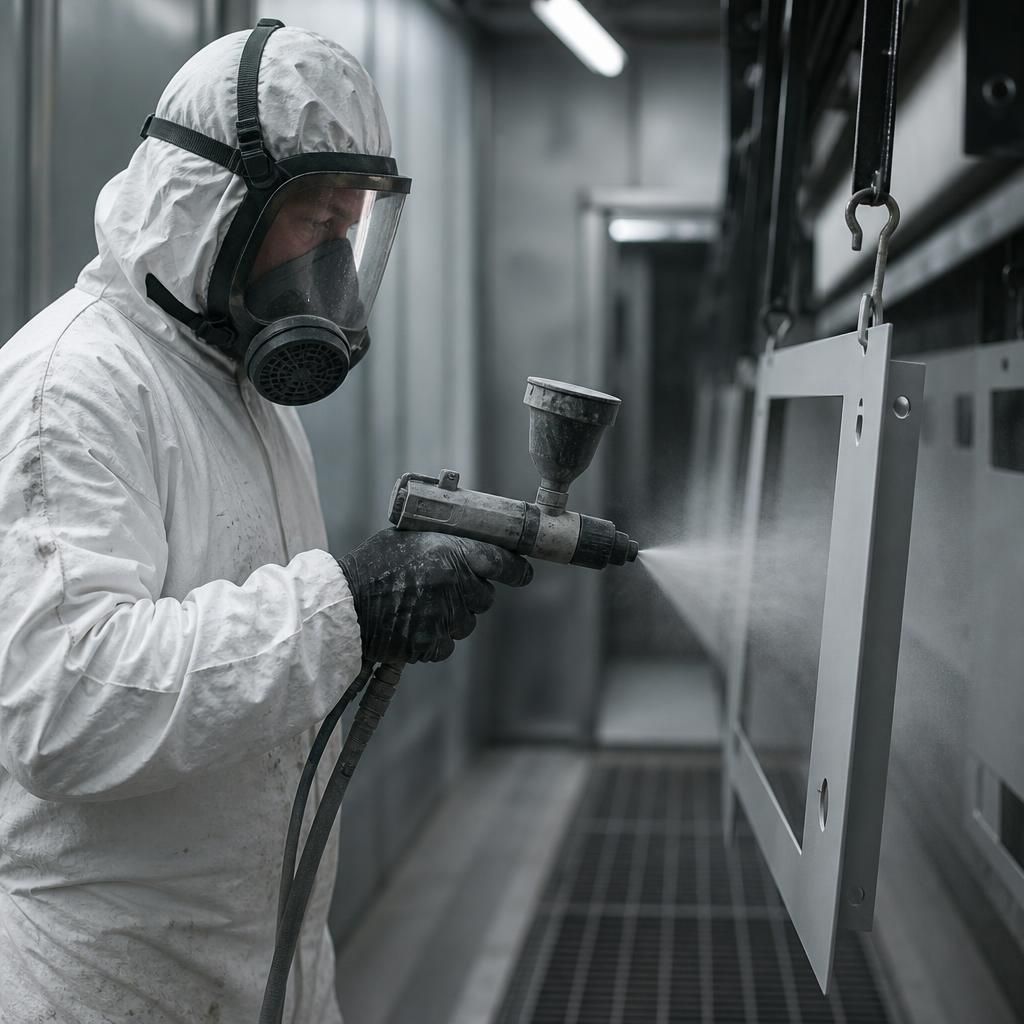
Environmental conditions during preparation and application can influence the suitability of a nylon or protective coating just as much as the conditions the component will face in service. Moisture on the metal, condensation, airborne contamination and unsuitable substrate temperature can interfere with adhesion and leave defects beneath an otherwise appropriate finish.
The coating system should therefore be assessed alongside its processing requirements. Consider whether the component can be prepared, coated and cured under controlled conditions, whether its size or geometry creates areas that are difficult to treat consistently, and whether the required curing temperature is compatible with the metal and any attached parts. For large or complex components, these practical constraints may influence the choice between systems and should be confirmed before production.
Discuss the right coating for your operating environment
Share your component’s operating environment, substrate and expected exposure with the powder-coating team to identify whether nylon or a protective coating is the more suitable option. For complex or demanding applications, provide representative parts or specifications so the proposed system can be assessed against the conditions it must withstand.