

What are the key features to compare when evaluating mini powder coating machines for industrial use?
When evaluating mini powder coating machines for industrial use, compare powder capacity and feed consistency, application controls, coating compatibility, spray performance, curing integration, electrical efficiency, safety features, cleaning requirements and access to replacement parts. The right specification should provide repeatable coverage for the component sizes, coating materials and production volumes involved without adding unnecessary complexity.
The key features to compare in mini powder coating machines are their usable work envelope, construction quality, operating duty, utility requirements, handling arrangements, powder management, documentation and total cost of ownership. These factors determine whether a compact machine is suitable for industrial production rather than only occasional or workshop use. Compare the complete operating system, not just the advertised machine size or purchase price.
Usable work envelope and component handling
Check the maximum component dimensions and mass that can be accommodated in the complete coating arrangement. The practical limit may be determined by the hanging method, access around the part, booth dimensions or the position of the operator, rather than by the machine itself. Consider whether the equipment can handle the shapes, recesses, edges and internal faces found in the intended parts.
- Assess the available clearance around the component and the ease of rotating or repositioning it.
- Check whether fixtures, hooks, racks or jigs can be used without obstructing the coating process.
- Confirm that the machine suits the smallest parts as well as the largest items in the planned product range.
- Consider whether a compact footprint genuinely helps the production layout or simply transfers space requirements to nearby extraction, compressed-air or curing equipment.
Build quality and industrial durability
Inspect the materials, finish and access panels used in the machine’s construction. Equipment intended for regular industrial use should withstand powder exposure, repeated handling and routine movement without becoming difficult to adjust or inspect. Look for robust connections, protected electrical components, secure hose routing and a frame that remains stable during operation.
Ask which parts are most exposed to abrasion or powder accumulation and whether they can be inspected without dismantling major sections. A machine that is easy to access can reduce disruption during routine servicing, even where the cleaning procedure itself is considered separately.
Duty cycle and production suitability
Compare the stated duty cycle with the actual pattern of work. A machine used for intermittent batches may have different requirements from one supporting repeated production runs. Review permitted operating periods, rest or cooling requirements, maximum continuous use and any restrictions linked to ambient conditions.
It is also useful to assess how quickly the equipment can be set up between different jobs. Tool-free adjustments, straightforward hose connections and accessible component changes may matter more to a mixed-batch operation than a high headline specification. Establish whether the machine is designed for the workload without relying on assumptions about occasional use.
Compressed-air and electrical requirements
Miniature equipment can still require carefully specified site services. Compare the required air pressure, air volume and air quality, including whether filtration or moisture control is needed. Poor-quality compressed air can affect operation and introduce contamination into the coating process.
Check the electrical supply, plug or connection arrangement, protection requirements and cable length. The installation should be assessed by a suitably qualified person where necessary. Also consider whether the machine can be isolated easily for inspection and servicing, and whether its utility connections suit the proposed production area.
Powder handling and changeover arrangements
Beyond basic feed performance, compare how powder is loaded, contained and changed between jobs. A useful system should allow operators to identify the material in use, prevent avoidable cross-contamination and deal with unused powder appropriately. Examine the design of containers, hoses, lids and contact parts, as these influence changeover effort and material waste.
For businesses applying several colours or coating types, ask whether separate contact components are available and how easily they can be exchanged. The relevant comparison is not simply how much powder the machine holds, but how cleanly and consistently the whole handling process can be managed from one job to the next.
Operator ergonomics and visibility
Evaluate the position of controls, handles, hoses and powder containers from the operator’s working position. The machine should allow the user to maintain a stable posture and a clear view of the component without unnecessary strain. Excessively stiff hoses, awkward connections or poor access can make a compact machine less practical in daily use.
Look for clearly identified settings, readable indicators and an arrangement that reduces the risk of confusing one connection or adjustment with another. These are usability features rather than cosmetic details, particularly where several operators may use the equipment.
Monitoring, records and process verification
Where coating quality must be traceable, compare the machine’s ability to display or record relevant operating information. Depending on the equipment, this may include air conditions, application settings, operating status or fault indications. A machine with useful feedback can make it easier to investigate variation between batches, provided the information is clear and can be linked to the relevant job records.
Review the operating manual, technical drawings, electrical information and recommended service procedures before making a decision. Good documentation helps production and maintenance teams understand the equipment’s limits instead of relying on informal instructions.
Lifecycle cost and supplier support
Calculate the likely ownership cost rather than comparing purchase prices alone. Include consumable contact parts, filters, hoses, seals, inspection requirements, installation work and any specialist servicing. Ask how replacement parts are identified, whether standard wear items are readily obtainable and whether the supplier provides technical documentation or operator training.
Finally, compare machines against a written specification based on the intended components, coatings, batch pattern, site utilities and available space. A smaller machine is not automatically the better choice: the appropriate model is the one whose construction, duty capability and handling arrangements match the work without introducing avoidable installation or operating constraints.
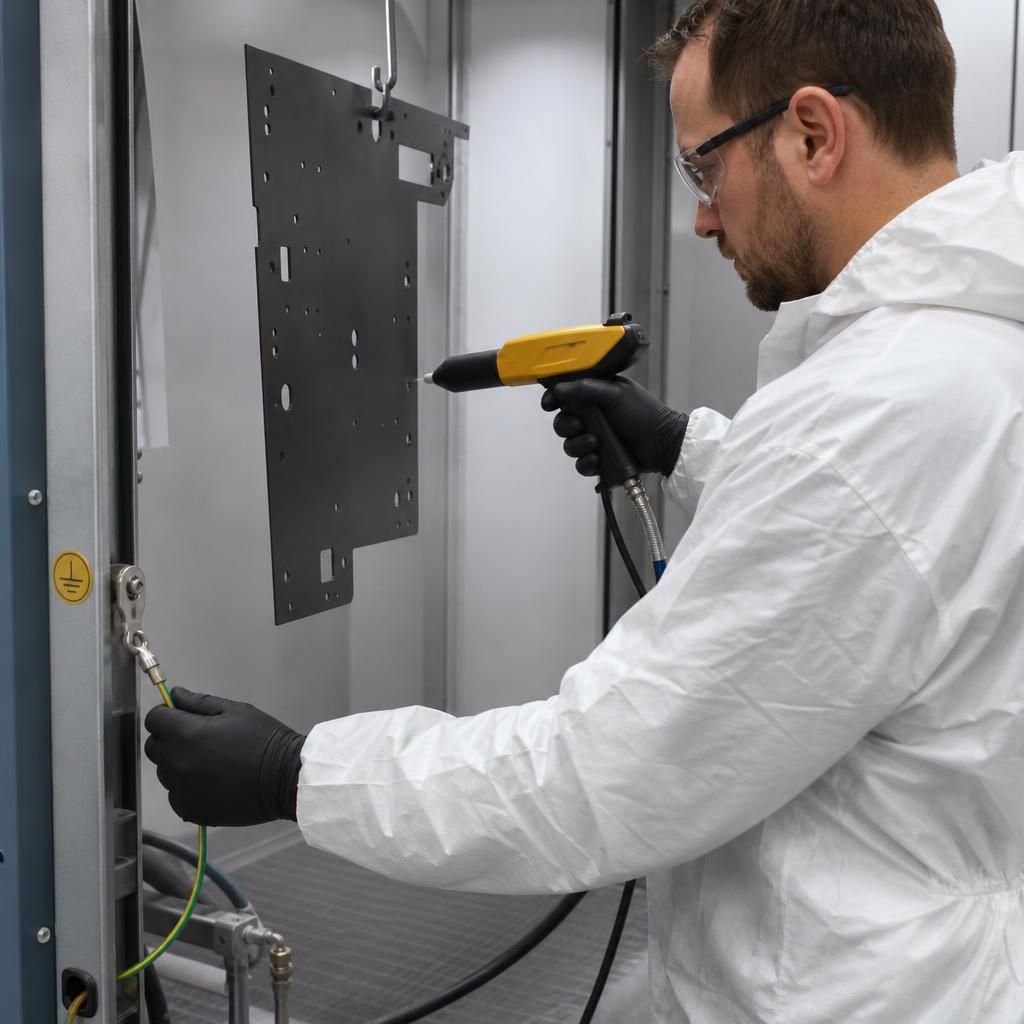
Grounding and electrical stability are important features to compare in a mini powder coating machine. The equipment should provide a dependable path between the workpiece, fixture and earth so powder can be attracted consistently during application. Compare the design of the grounding connection, the accessibility of contact points and the ease of checking that the part is properly connected before spraying.
Look for clear status indications or testing procedures that help operators identify a poor connection before it affects coating consistency. This is especially relevant when parts are painted on different hooks, racks or jigs, as contact can be reduced by contamination, wear or an unsuitable fixture. A machine that makes grounding easy to inspect can support more repeatable operation and simpler fault-finding.