

What key factors should be considered to ensure the powder coating setup provides long-term efficiency and reliability?
A reliable powder coating setup depends on correctly specified equipment, consistent process control, suitable extraction and curing capacity, and a maintenance plan based on actual production demands. Long-term efficiency also requires checking equipment compatibility, energy use, operator safety, access to replacement parts and the flexibility to accommodate changes in workload or coating requirements.
Long-term efficiency and reliability come from designing the powder coating setup around the complete coating workflow, not simply selecting individual pieces of equipment. The arrangement should support repeatable preparation, application, curing, inspection and handling while remaining practical to operate, clean and maintain as production requirements change.
Assess the full workflow before specifying equipment. Map how components enter the area, are prepared, coated, cured, inspected and moved to dispatch. A layout that creates unnecessary handling, crossing traffic or waiting between stages can reduce output and increase the risk of contamination or damage. Allow suitable space for loading and unloading, powder storage, rejected parts, cleaning activities and safe access to serviceable components. The proposed arrangement should also reflect the dimensions, weights and shapes of the parts being processed rather than relying solely on the nominal capacity of the equipment.
Give proper attention to pretreatment. Powder coating performance depends heavily on the condition of the metal before powder is applied. Oil, grease, mill scale, corrosion, welding residue and other contaminants can affect adhesion and appearance. The setup should therefore include a clearly defined preparation method appropriate to the substrate and the required finish. Consider how parts will be cleaned, rinsed, dried and protected from recontamination before coating. If pretreatment is inconsistent, improvements to the spray equipment or oven will not correct the underlying defect.
Plan for dependable material handling. Hooks, racks, jigs and conveyors should hold components securely without obstructing the areas that need coating. Their design can affect transfer efficiency, film coverage and the number of touch-up operations required. Contact points should be positioned deliberately, particularly where electrical grounding is needed during application. Racks and hooks also require a cleaning and replacement regime, because accumulated cured powder can alter the contact or reduce the available hanging space.
Control powder storage and recovery. Powder should be stored in conditions that protect it from moisture, contamination and physical damage, following the relevant supplier instructions. Clear identification of materials helps prevent colour or specification errors. Where powder recovery is used, the collection arrangement should be suitable for the materials and finish requirements being processed. Reclaimed powder must be controlled carefully; mixing incompatible colours or chemistries can affect appearance and performance. A defined policy for reclaim, disposal and changeover reduces waste and shortens cleaning tasks.
Build quality checks into the process. Reliability is easier to maintain when inspection is planned at several points rather than left until the finished batch. Checks may include surface cleanliness, coating coverage, film thickness, colour, gloss, adhesion and cure. The exact checks should reflect the customer specification, substrate, coating system and intended service environment. Recording results against batch details creates traceability and helps identify gradual changes before they produce widespread rework.
Verify cure rather than relying only on oven settings. The relevant cure condition relates to the metal part reaching the required temperature for the required time, not merely to the temperature displayed by the oven controller. Part thickness, loading density, metal mass and the position of components can all affect heat-up behaviour. Validation should therefore consider representative loads and the most demanding components. If the product specification changes, the cure process may need to be reviewed rather than assumed to remain suitable.
Specify controls that support consistent operation. Operators should be able to understand the selected settings, identify abnormal conditions and follow the same procedure from one batch to the next. Useful controls include clear status indications, access to process records and defined settings for different part or powder requirements. Avoid unnecessary complexity: a system that is difficult to interpret can encourage informal adjustments and make faults harder to diagnose. Written work instructions should cover setup, changeover, cleaning, inspection and escalation of defects.
Consider utilities and installation conditions. The electrical supply, compressed air quality, ventilation arrangement, floor condition and available space must be checked before installation. Inadequate air quality can affect application equipment, while unsuitable electrical provision can restrict safe and stable operation. The surrounding area should support cleaning and inspection without exposing the coating process to avoidable dust or traffic. Any proposed installation should be reviewed against the building, rather than assuming that an existing industrial space will automatically be suitable.
Use a risk-based approach to reliability. Identify which failures would stop production, create a safety issue or result in a large quantity of non-conforming work. Prioritise controls for those risks, such as critical spares, documented restart procedures, protective measures and alternative handling arrangements. Keep records of faults and recurring defects so that corrective action addresses the cause instead of repeatedly treating the symptom.
Finally, assess the setup over its complete working life. Compare purchase and installation requirements with consumables, cleaning, inspection, training, downtime and eventual replacement of worn components. A technically capable system may still be inefficient if it is difficult to change between finishes or if routine tasks require excessive manual intervention. For a business assessing a setup for sale, an experienced powder coating specialist can help review the proposed workflow against actual components, finishes and batch patterns before the equipment is committed to service.
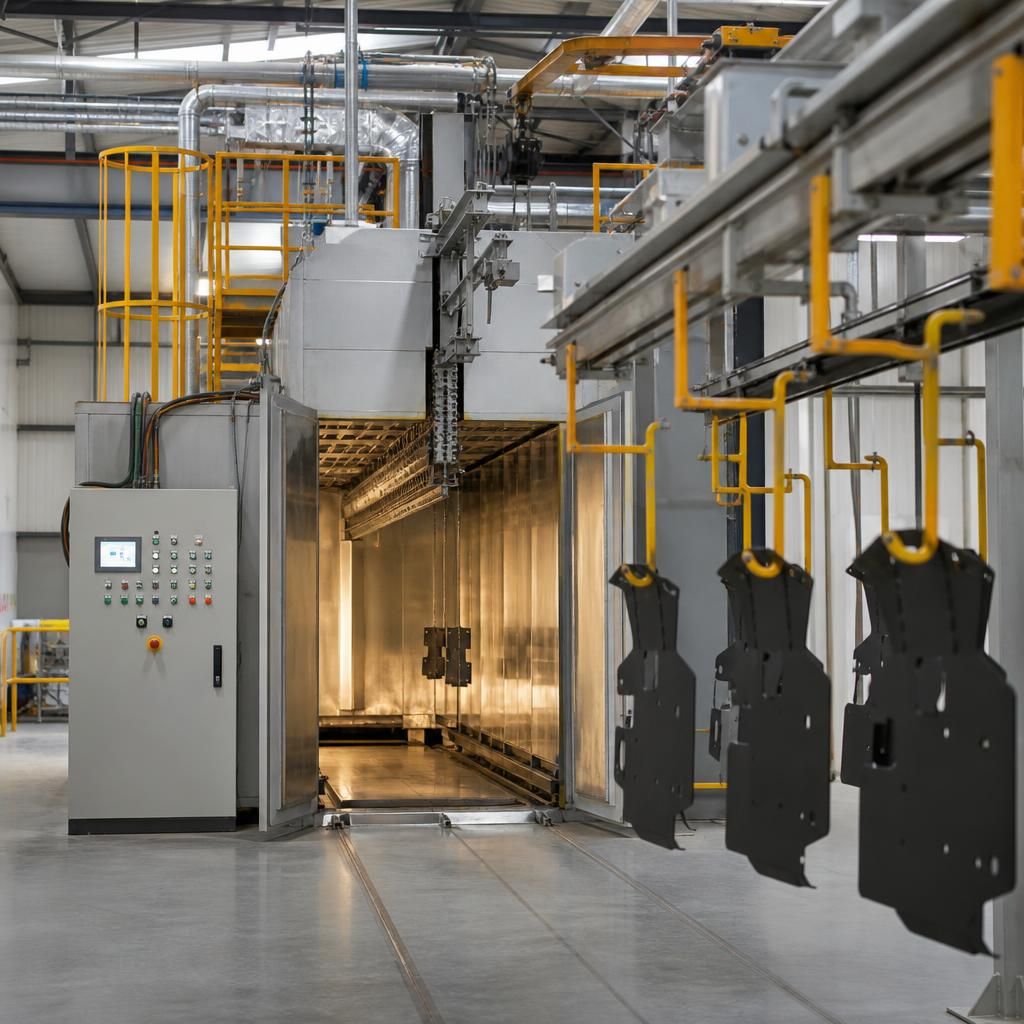
Energy efficiency is a key part of long-term powder coating reliability, particularly where the curing oven represents a substantial part of the setup’s energy demand. Assess the insulation, door seals, heating controls and ability to operate efficiently with different load sizes. An oversized oven may consume unnecessary energy on smaller batches, while inadequate capacity can create unstable curing conditions and restrict production planning.
Compare energy performance under representative operating conditions rather than relying only on the equipment’s stated rating. The assessment should consider heat-up behaviour, holding temperature, loading patterns and the effect of opening doors during normal handling. Any efficiency measure must still maintain the validated cure required by the powder and component specification; reducing energy use at the expense of under-cured coating will create rework and undermine reliability.
Review Your Powder Coating Setup for Long-Term Reliability
Discuss your component sizes, coating specifications and expected production pattern with a powder coating specialist to assess whether a proposed setup is suitable for long-term use. A practical review can identify installation, operating and lifecycle considerations before equipment is purchased.