

What criteria should I consider when selecting a powder coating preparation service provider to ensure quality and reliability?
Assess a powder coating preparation service provider by the consistency of its cleaning and pre-treatment methods, substrate inspection, contamination control, coating compatibility and documented quality checks. Also confirm that its equipment and production capacity suit your component sizes and batch requirements, with clear specifications for handling, collection and delivery.
Select a powder coating preparation service provider by assessing its technical understanding, control of the preparation process, ability to handle your particular substrates and components, and the evidence it can provide that work will be carried out consistently. A suitable provider should be able to translate your part drawings, material details and end-use requirements into a defined preparation specification rather than treating every job in the same way.
Technical assessment before quotation
The provider should ask relevant questions before confirming the work. These may include the metal type, previous coatings, welds, cast or fabricated areas, threaded sections, masking requirements, intended environment and the powder coating system to be applied afterwards. This conversation helps identify risks that may not be apparent from a photograph or a basic part description.
Check whether the quotation clearly states what preparation is included and what is excluded. It should distinguish between routine preparation, removal of existing coatings, treatment of corrosion or contamination, masking, plugging and any additional rectification. Clear scope at this stage reduces the risk of unexpected work or disagreement about whether a part was suitable for coating.
Knowledge of the substrate and end use
Preparation requirements differ between mild steel, galvanised steel, aluminium and other metal substrates. A provider should understand how the substrate, fabrication method and service environment affect the choice of cleaning, abrasion, chemical treatment or other preparation methods. For example, a component exposed to moisture, chemicals or mechanical wear may require a different preparation approach from an indoor decorative item.
Ask how the provider deals with weld spatter, sharp edges, porous castings, laser-cut edges, machining residue and areas that may retain oils or debris. These features can affect coating appearance and adhesion even when the main faces of a component look clean.
Control of masking and detail areas
Reliability also depends on how accurately the provider protects areas that must remain free from coating. This can include bores, threads, bearing seats, electrical contact points, machined faces and fixing locations. Confirm that masking requirements can be recorded from drawings or written instructions, and ask how the provider manages parts with tight dimensional tolerances.
Where dimensions are critical, provide the relevant limits rather than relying on a general instruction such as “mask as required”. The provider should be willing to identify areas where preparation or subsequent coating could affect fit and function.
Evidence of repeatability
For repeat work, look for a provider that can reproduce an agreed process across batches and retain clear job information. Useful evidence may include a written process description, job records, inspection results or a defined approval procedure for changes. The important point is not the format of the paperwork but whether the provider can demonstrate control when the same or similar parts return for preparation.
For a new or technically sensitive component, ask whether a trial part, sample area or first-off approval can be used to confirm the preparation approach before full production. This is particularly useful where the substrate is unusual, an old coating must be removed, or the finished part has functional rather than purely visual requirements.
Inspection and acceptance criteria
Agree how prepared parts will be judged before work begins. Acceptance criteria might cover the removal of previous coating, visible residue, corrosion, surface damage, masking accuracy, cleanliness and the condition of edges or welds. If the provider identifies a defect that cannot be resolved through preparation alone, it should be reported rather than concealed under the new coating.
It is also sensible to establish how non-conforming parts are handled. Ask whether the provider will seek approval before carrying out additional treatment, and how rework or rejection will be recorded. This gives both parties a clear decision route if a component arrives with unexpected damage or contamination.
Capacity and operational fit
Capacity is not only a question of the maximum size of an item. Consider whether the provider can manage your typical part mix, repeat batches, awkward geometries, heavy fabrications and any special masking or preparation requirements. A provider that accepts a component in principle may still be unsuitable if its process is designed mainly for small, simple parts.
Discuss how parts should be supplied, identified and separated to prevent mixing different specifications or batch instructions. For manufactured components, consistent labelling and an agreed packing method can be as important as the treatment itself, particularly where similar-looking parts have different requirements.
Communication and commercial reliability
A reliable provider should give practical answers about lead-in arrangements, quotation assumptions, drawing revisions, abnormal conditions and changes to the work scope. The quotation should identify preparation operations, any minimum information required from the customer, and the basis on which additional work would be discussed. Avoid selecting solely on price if the lower figure depends on an undefined process or omits necessary preparation stages.
Finally, assess whether the provider understands the role of preparation within the complete coating system. Powder coating performance depends on the relationship between the substrate, preparation, pre-treatment and powder application. Selecting a provider that can discuss these interfaces objectively gives you a stronger basis for comparing quotations and specifying work for future batches.
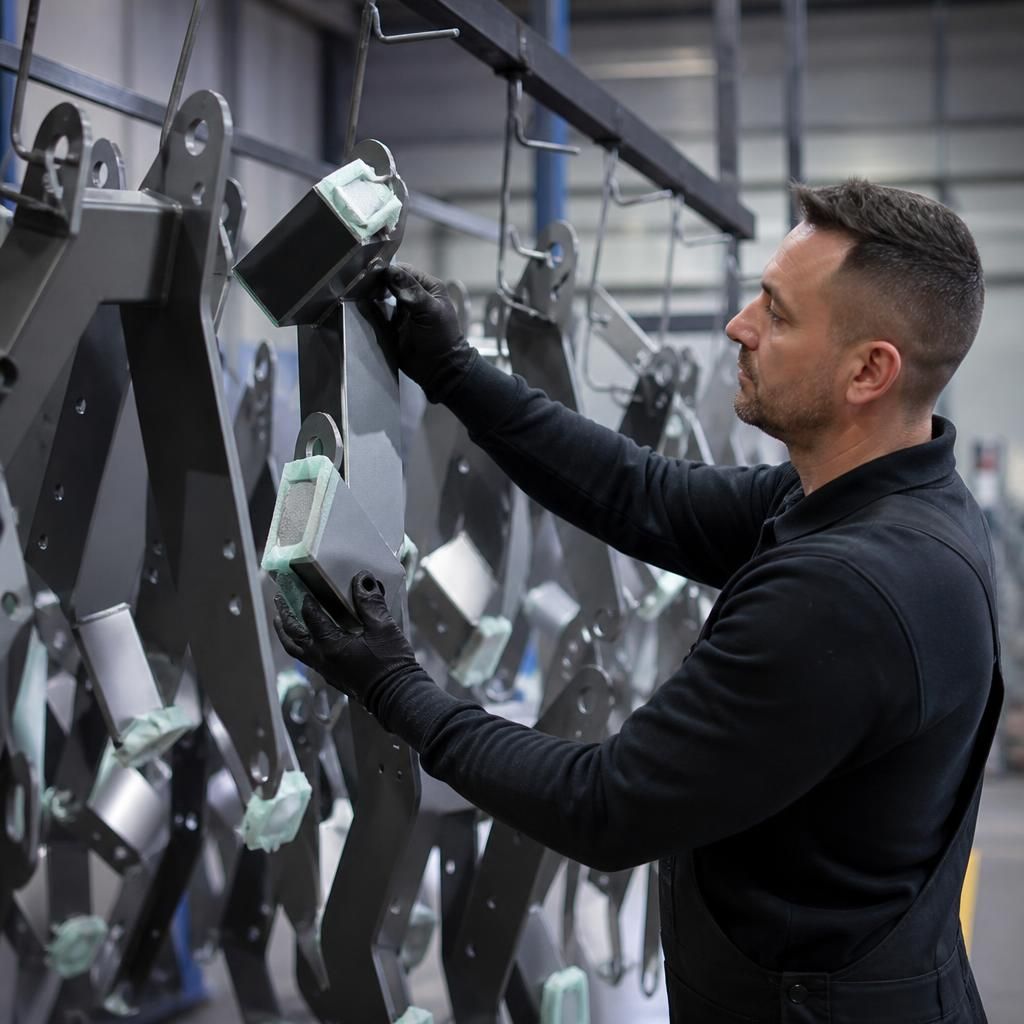
A powder coating preparation provider should control how prepared components are handled between cleaning, pre-treatment and coating. A correctly prepared surface can be compromised by dust, moisture, oil or contact with unsuitable surfaces, so assess whether the provider has a defined method for protecting parts after preparation and before powder application.
Ask how prepared components are supported, covered, moved and identified, and whether clean handling practices are used for machined faces, masked areas and other sensitive features. The provider should also be able to explain how it prevents prepared parts from being mixed with untreated work or exposed to workshop contamination. This handling stage is an important indicator of process discipline because preparation quality depends on preserving the surface condition achieved, not simply removing the original contamination.