

What factors should I consider when selecting an epoxy primer for metal in an industrial setting?
When selecting an epoxy primer for metal in an industrial setting, assess the metal substrate, required corrosion resistance, operating environment, adhesion requirements, compatibility with the finishing system, application method and curing conditions. Also consider the required film thickness, recoat window, chemical and mechanical exposure, and whether the primer is suitable for the production process and final service conditions.
An epoxy primer for metal should be selected by matching its formulation and documented performance to the component’s construction, service specification and finishing system. The most suitable product is not necessarily the one with the highest stated resistance; it is the one that provides the required protection while fitting the component design, production controls, inspection requirements and whole-life cost.
Start with the project specification. Identify which standards, test methods and acceptance criteria apply before comparing products. A primer may be described as suitable for industrial use, but that description alone does not confirm its performance for a particular component. Check the technical data sheet for intended substrates, recommended preparation, mixing instructions, application limits, film build, curing requirements and approved overcoating arrangements. Safety data should also be reviewed so that handling, storage and workplace controls are understood.
Consider the epoxy formulation. Two-pack epoxy primers generally provide different performance characteristics from single-pack products because the resin and hardener react to form the coating film. The choice may affect pot life, application control, cure development and resistance to the substances encountered in service. Some formulations are designed primarily as bonding coats, while others include corrosion-inhibiting pigments or are intended to build a more substantial protective layer. Select the formulation for its verified role rather than assuming that all epoxy primers provide equivalent protection.
Assess the component’s geometry. Corners, returns, apertures, welds, folded sections and recessed areas can be more difficult to coat consistently than broad, accessible faces. A primer specification should account for edge coverage and the likelihood of thin areas, runs or trapped material. Components with enclosed sections may also require suitable drainage and venting so that cleaning, rinsing and drying can be completed properly. If the design creates inaccessible areas, the coating process may not be able to provide uniform protection regardless of the product selected.
Define preparation and cleanliness controls. Oil, grease, dust, salts, mill scale, rust and residues from fabrication can compromise the primer film. The selected product should have a clearly defined preparation process, including the required degree of cleaning and the condition of the surface immediately before coating. This is particularly important for fabricated parts where cutting fluids, welding residues, abrasive dust and handling contamination may be present. A primer that performs well in laboratory testing can still fail if preparation is inconsistent.
Check evidence rather than relying on generic claims. Look for relevant laboratory results, qualification data, production trials or previous use on comparable components. Useful evidence may cover adhesion, humidity exposure, salt spray, cyclic corrosion, impact, abrasion or resistance to specific chemicals, depending on the application. Test results should be interpreted carefully: laboratory duration is not a direct prediction of field life, and a result for one metal, preparation standard or coating build may not apply to another.
Confirm how the primer will interact with the complete coating system. The primer, powder or liquid topcoat, pretreatment and any sealants should be assessed as one system. Verify that the topcoat can bond to the cured or partially cured primer and that the combined film can withstand the expected handling and service demands. Pay particular attention to epoxy’s limited resistance to prolonged ultraviolet exposure. Where a coated component will be exposed to sunlight, the primer normally needs a suitable protective topcoat rather than being treated as the final decorative finish.
Review production and quality-control requirements. Industrial selection should include practical controls such as:
- batch identification and traceability for the primer and hardener;
- controlled storage conditions and confirmation that materials remain within their usable shelf life;
- accurate proportioning and thorough mixing of multi-component products;
- records of surface preparation, application conditions and coating measurements;
- inspection for defects, missed areas, pinholes, runs and inadequate coverage; and
- a defined process for repairing damage or areas that do not meet the specification.
These controls help distinguish a repeatable coating process from an occasional acceptable result. They are especially important where components are produced in batches or form part of a larger certified assembly.
Factor in handling and assembly. The primer must be sufficiently developed before parts are moved, stacked, drilled, welded or assembled, in accordance with the product instructions. Premature handling can mark the film or introduce contamination even when the surface appears dry. Consider contact points, lifting methods, packaging and the possibility of damage during transport between fabrication and finishing stages. If the primer will be exposed during later work, establish whether it can be touched up and how the repair area must be prepared.
Compare whole-life cost, not just purchase price. The relevant comparison includes material usage, preparation, application, curing, inspection, rejects, repairs and future maintenance. A lower-priced product may be unsuitable if it requires additional process stages or produces inconsistent results on the component. Conversely, a more specialised primer is justified only where its documented properties address a defined technical requirement. Include waste, mixing losses and the implications of the specified film build when assessing cost.
Finally, validate the choice on representative parts or test panels before committing to full production. The trial should reproduce the actual metal condition, preparation process, application equipment and finishing sequence. Inspect the complete system against the project criteria and retain the results as part of the coating record. This approach confirms that the selected epoxy primer is appropriate for the real manufacturing process, not simply suitable in principle.
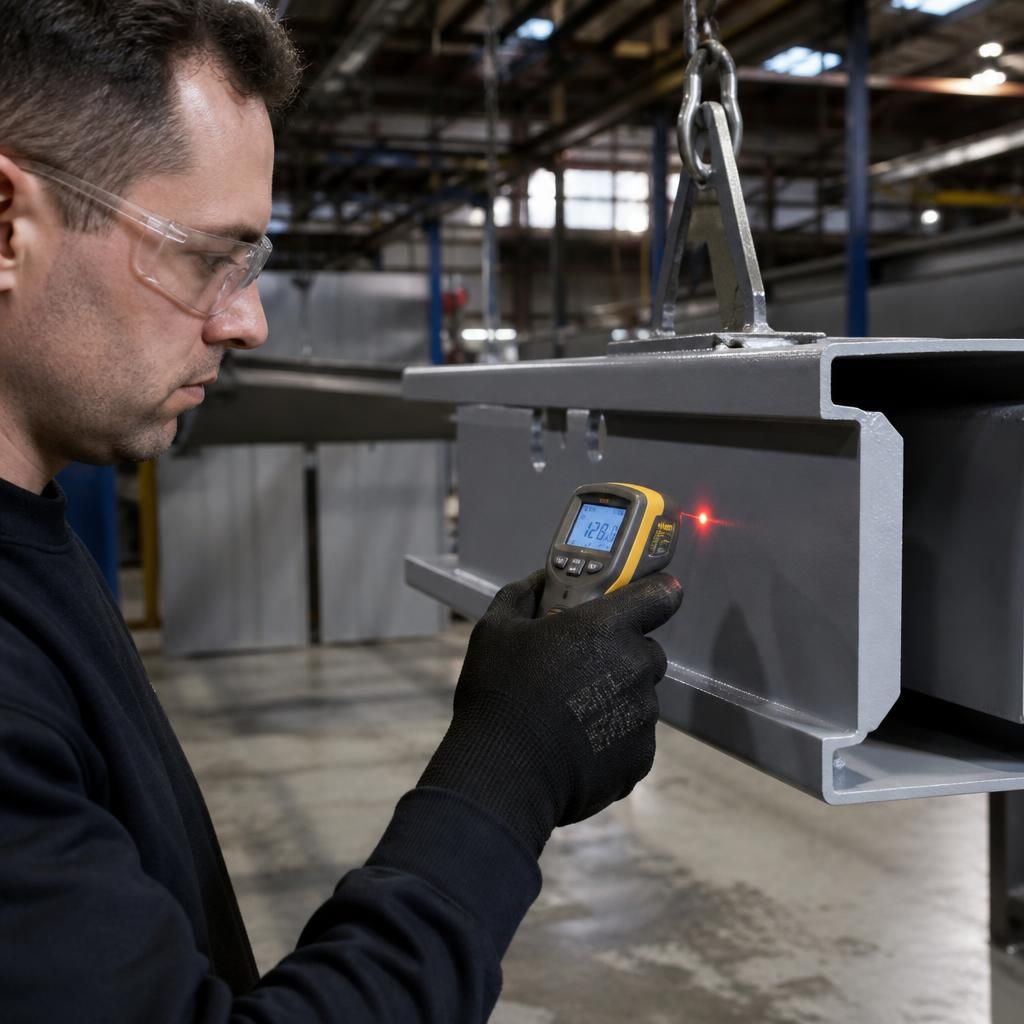
Temperature performance is a specific selection factor when metal components will experience heat, cold or repeated temperature changes. Check that the epoxy primer is rated for the component’s continuous and peak service temperatures, as well as any heat introduced during curing, processing or nearby equipment.
Thermal cycling can create stress between the metal, primer and topcoat because each material expands and contracts differently. A suitable system should retain adhesion and flexibility across the expected temperature range without softening, embrittling or cracking. Review the technical data for temperature limits and, where conditions are demanding, assess the complete coating system rather than the primer in isolation.
Discuss your epoxy primer selection
Discuss your component’s service conditions, coating specification and proposed finishing system with a powder-coating specialist before finalising the primer. Sharing drawings, material details and preparation requirements can help establish whether the selected epoxy primer is suitable for the complete application.