

What are the key benefits of opting for zinc phosphate spray pretreatment over other pretreatment methods?
Zinc phosphate spray pretreatment provides a conversion layer that improves powder-coating adhesion and helps protect metal substrates against corrosion. Compared with less comprehensive preparation methods, it offers a consistent, controllable treatment across suitable components, supporting durable finishes and reducing the risk of premature coating failure.
Zinc phosphate spray pretreatment is often preferred where a powder-coated metal component needs more than basic cleaning before coating. Its main advantages over simpler degreasing, abrasive preparation or lower-performance phosphate systems are stronger chemical preparation, better support for demanding corrosion environments, improved control of the treatment stage and suitability for repeatable industrial production.
It provides a more substantial conversion surface. Unlike degreasing alone, zinc phosphate chemically conditions the substrate rather than merely removing oil and dirt. The resulting microcrystalline layer gives the powder coating a better-prepared surface to key into. This is particularly useful for components that may experience handling, moisture, condensation, road contamination or changes in temperature during service.
It can offer greater protection than iron phosphate in demanding applications. Iron phosphate is commonly used where a straightforward, economical pretreatment is appropriate, but zinc phosphate generally forms a more robust conversion layer. The choice depends on the required specification, substrate and exposure conditions; however, zinc phosphate is often selected when the coating system must provide a higher level of resistance to corrosion progression from scratches, edges or small coating imperfections.
It supports a more comprehensive process than preparation by blasting alone. Abrasive blasting can remove scale, rust and existing finishes while creating a useful mechanical profile. It does not, however, replace chemical conversion treatment in every application. Zinc phosphate spray can complement suitable mechanical preparation by cleaning residual contamination and chemically conditioning the exposed metal. This combined approach may be appropriate where the component requires both physical surface preparation and a conversion layer.
Spray application offers useful process control. The treatment can be arranged as a defined sequence of cleaning, rinsing, phosphating and final rinsing stages. Each stage can be monitored and adjusted for factors such as chemical concentration, temperature, contact time, spray coverage and water quality. Compared with less structured preparation, this makes it easier to identify process variation and maintain consistent treatment across batches, provided the equipment and chemistry are correctly managed.
It can reduce the risk associated with poorly prepared areas. Complex fabrications, brackets, frames and formed components may contain joints, returns, recesses or areas that are difficult to prepare uniformly by hand. A correctly designed spray system can reach a wider range of surfaces than manual application, although component orientation, drainage and spray access remain important. Good pretreatment design helps prevent isolated contamination or untreated areas from becoming weak points in the finished coating system.
It preserves the component’s dimensions more readily than heavy mechanical removal. Blasting and other abrasive methods remove material as well as contamination, particularly if excessive pressure, an unsuitable abrasive or prolonged treatment is used. Zinc phosphate conversion is a chemical surface treatment, so it does not depend on removing substantial amounts of the base metal. This can be important for close-fitting parts, fabricated assemblies and components with defined edges or tolerances.
It is more suitable than basic phosphate treatment where specification and service exposure demand additional performance. The correct choice should take account of:
- the base metal, such as mild steel, galvanised steel or aluminium;
- the condition of the incoming component, including oil, mill scale, rust and previous coatings;
- the intended environment, including indoor, outdoor, humid or chemically exposed use;
- the powder-coating type and the required preparation standard;
- component geometry, drainage and the ability of spray stages to reach all relevant surfaces;
- the required appearance, film integrity and resistance to handling or service damage; and
- wastewater, rinsing and chemical management requirements.
Zinc phosphate is not automatically the best option for every metal or specification. Some substrates require a chemistry specifically developed for that material, while certain high-performance systems may call for an alternative conversion treatment or an additional seal. Using the wrong chemistry, allowing inadequate rinsing, or applying powder before the treated surface is properly dried can undermine the advantages of the process.
Compared with chromate-based systems, zinc phosphate may also be considered where the process specification aims to avoid certain hazardous chromate chemistries. This does not make it environmentally impact-free: phosphating chemicals, zinc-bearing residues and rinse water still require controlled handling and lawful disposal. The practical benefit is therefore achieved through the complete process, including chemical selection, plant control, rinsing, drying and waste management, rather than through the phosphate stage in isolation.
Overall, zinc phosphate spray pretreatment is most valuable when a powder-coated component needs a controlled and technically robust preparation stage rather than simple cleaning. Its advantages are clearest on appropriately selected substrates where corrosion performance, coating compatibility, dimensional preservation and repeatable batch processing all matter.
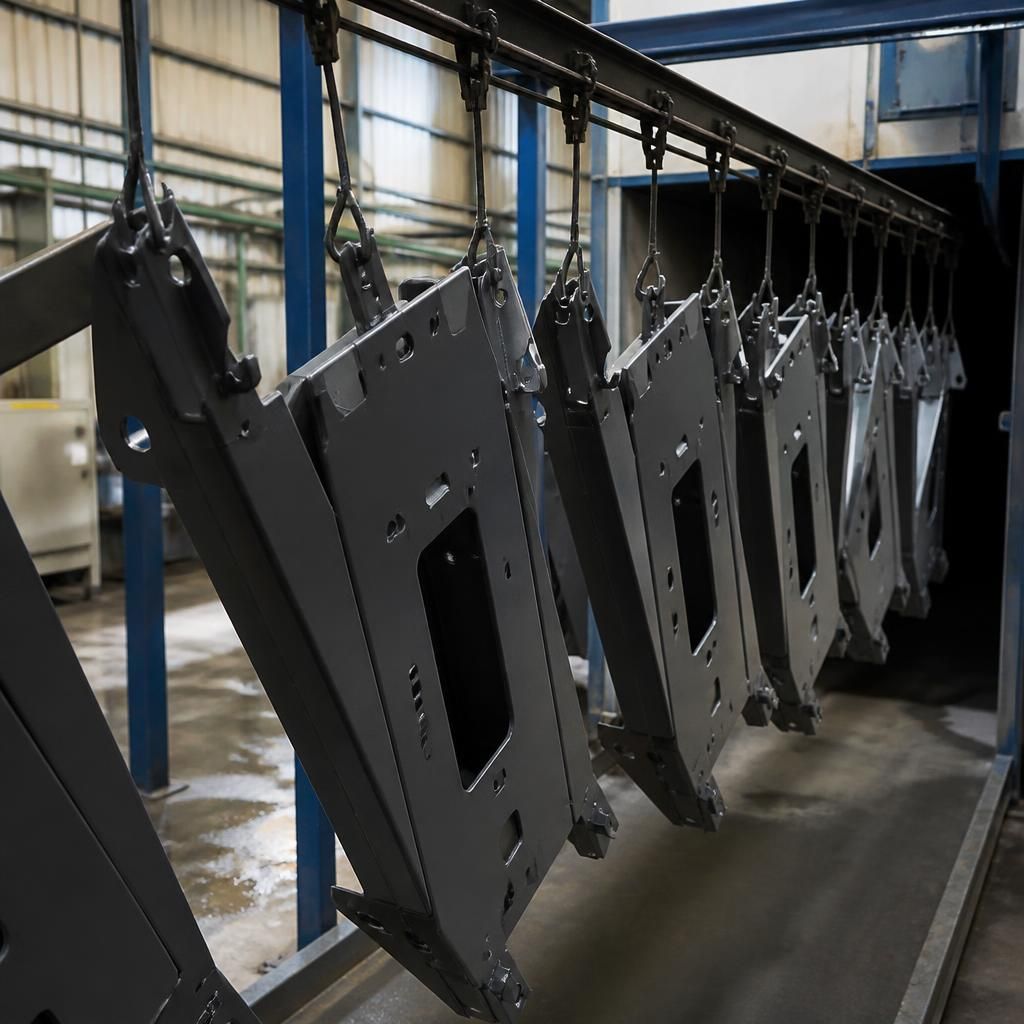
A further benefit of zinc phosphate is that it can provide limited interim protection to suitably treated steel before the powder coating is applied. The conversion layer helps reduce direct exposure of the metal surface during controlled handling and transfer, lowering the risk of light surface oxidation compared with a freshly cleaned surface with no conversion treatment. This is not a replacement for the powder coating or a reason to leave components untreated indefinitely: the parts still need effective rinsing, drying and prompt progression through the specified coating process.
Discuss Your Zinc Phosphate Pretreatment Requirements
Discuss your component material, geometry and required service environment with the powder-coating team to assess whether zinc phosphate spray pretreatment is suitable. This helps establish the appropriate preparation and coating specification for your parts.