

What specific factors should be considered when selecting shot blasting media to ensure optimal powder coating results?
Select shot blasting media by matching its hardness, shape and size to the metal substrate, contamination level, part geometry and surface profile required for powder coating. Also assess the media’s effect on dimensional accuracy, equipment settings, cleanliness and repeatability, as an unsuitable choice can leave residue, over-profile the surface or provide insufficient preparation for reliable adhesion.
Optimal powder coating results depend on choosing a blasting medium that is chemically compatible with the component, clean enough for the coating system, economical to manage and suitable for the blasting equipment. The selection should be based not only on the immediate appearance of the prepared metal, but also on what happens to the media during use and how consistently the preparation can be reproduced across a production batch.
Consider the substrate’s chemical sensitivity. Media can transfer particles or soluble residues to the surface. This is particularly important with stainless steel, aluminium and other non-ferrous metals, where iron contamination may contribute to staining or corrosion. If components will be exposed to moisture or corrosive conditions, the chosen medium should not introduce contaminants that could undermine the protective coating. Separate media, recovery systems and blasting equipment may be needed where cross-contamination between ferrous and non-ferrous work is a concern.
Check the cleanliness of new and recycled media. Used abrasive gradually collects removed paint, rust, mill scale, oil and dust. If this material is carried back onto a component, it can interfere with pretreatment and create inconsistent powder coating adhesion. Ask how the media will be screened, separated and replaced, rather than assuming that recycled material performs identically to new media. A stable working mix is more important than simply extending media life.
Assess breakdown and dust generation. Some media fracture readily under impact, producing fine particles that reduce visibility, load extraction equipment and increase cleaning requirements. Excessive breakdown can also alter the blasting action during a run, meaning that the first components in a batch receive different preparation from the last. Media that remains consistent for the intended application can improve process control, provided it is correctly separated from debris and fines.
Match the medium to the blasting equipment. The machine’s wheel or nozzle system, operating pressure, air volume, recovery equipment and filtration capacity all affect which media can be used effectively. A medium that is appropriate in one installation may perform poorly in another if it cannot be accelerated, recovered or separated correctly. Equipment compatibility also includes wear: abrasive material can affect nozzles, hoses, blast wheels, cabinet linings and reclaim systems, creating maintenance or replacement costs.
Consider the powder coating and pretreatment specification. The required preparation may differ between a standard decorative finish and a system intended for exterior, industrial or corrosive service. The coating manufacturer’s technical guidance and the pretreatment supplier’s requirements should be checked before finalising the abrasive. Some systems require a particularly clean surface or place limits on residues, salts and embedded particles. Blasting is preparation, not a substitute for suitable degreasing, conversion treatment or other specified pretreatment.
Review the component’s manufacturing history. Fabrication processes can leave different residues, including welding deposits, heat tint, cutting fluids, marking inks and handling oils. The media should be selected as part of the complete preparation sequence, alongside degreasing and inspection. Where components arrive with mixed or uncertain histories, trials should establish whether the proposed medium removes the relevant residues without creating a new contamination problem.
Account for masking and post-blast handling. Threads, bearing seats, machined faces, electrical contact points and close-fitting joints may need protection before blasting. Media that becomes trapped in cavities can later appear during curing or assembly. Parts should therefore be designed or positioned so abrasive can be removed thoroughly, and they should be handled with clean equipment after blasting. The interval between preparation and coating should also be controlled so that flash rust, fingerprints or airborne dust do not compromise the prepared surface.
Validate the choice with representative trials. A test should use the actual substrate, contamination type, equipment and intended powder coating system. Inspection should cover:
- removal of rust, scale, old coating and fabrication residues;
- visible dust, embedded abrasive or staining;
- surface cleanliness after blowing, vacuuming or other approved cleaning;
- the consistency of preparation across edges, welds, recesses and broad faces;
- coating adhesion and appearance after the complete pretreatment and curing process; and
- any dimensional, masking or assembly issues identified after coating.
Include operating and environmental costs. The purchase price of an abrasive is only one part of the decision. Media consumption, replacement frequency, waste disposal, dust extraction, energy use, equipment wear and operator handling can have a greater effect on the overall process cost. A recyclable medium may be appropriate where the recovery system can maintain its quality, while a disposable medium may be more practical for smaller or contamination-sensitive jobs. Waste classification and site safety requirements should be confirmed before use.
For repeat production, the selected medium should be recorded alongside the blasting settings, cleaning sequence, inspection method and powder coating specification. This creates a controlled preparation process rather than relying on visual judgement alone, helping identify whether a change in media, equipment condition or incoming material is responsible for a variation in the finished coating.
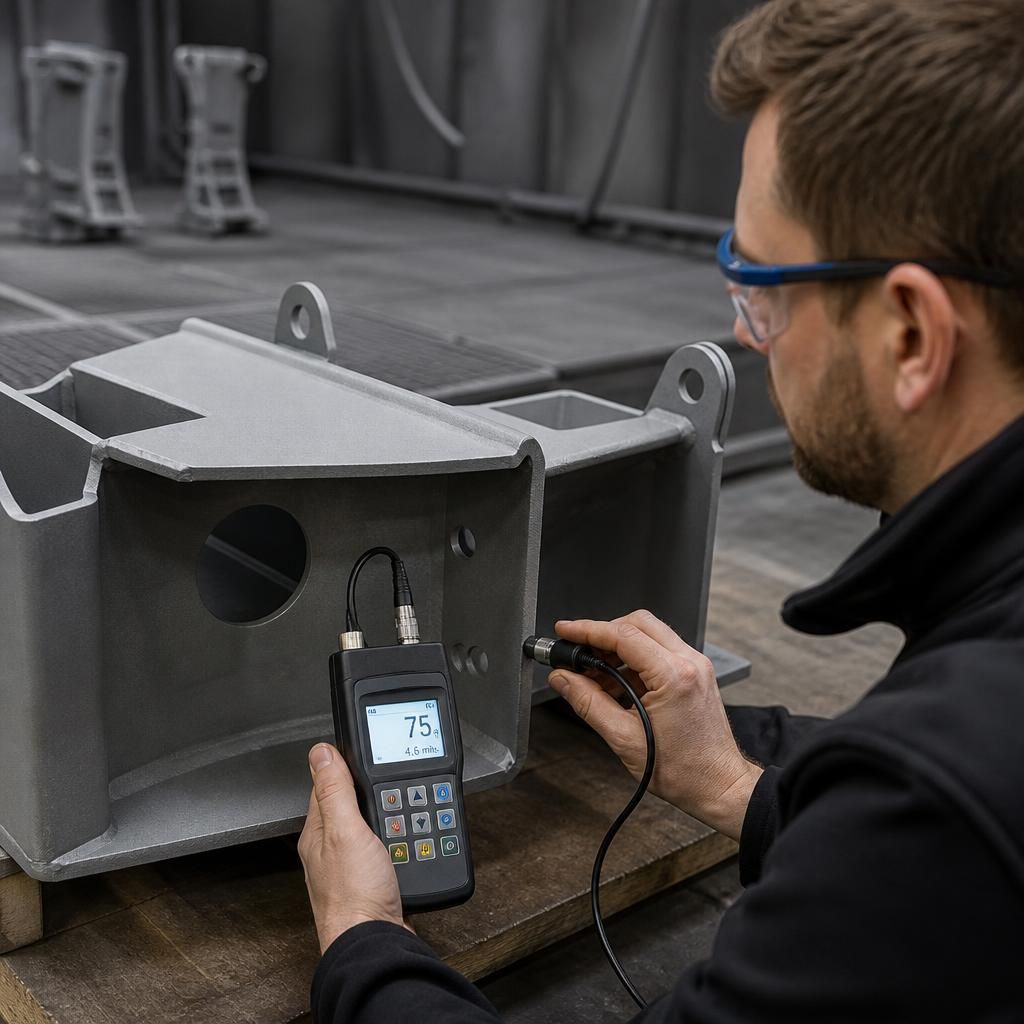
The surface profile created by shot blasting should be controlled rather than made as coarse as possible. It consists of the peaks and valleys formed in the metal, providing a keying surface for the powder coating. A profile that is too shallow may give the coating insufficient mechanical grip, while an excessively aggressive profile can remain visible through the finish, increase the amount of powder needed to cover the surface and leave sharp peaks with limited coating coverage.
Media selection should therefore reflect the coating thickness, finish requirements and service conditions of the component. The prepared surface should be checked using an appropriate profile assessment method, with readings taken across representative areas rather than relying only on appearance. Edges, welds, recesses and large flat faces can respond differently to blasting, so the profile needs to be reasonably consistent across the complete part. Trial work is particularly useful where the component has a thin coating specification or where appearance is important, as it confirms that the chosen media and settings produce sufficient adhesion without creating an unnecessarily coarse texture.