

What factors should I consider when choosing the appropriate shot blasting media for my powder coating project?
Choose shot blasting media according to the metal substrate, its thickness and hardness, the contamination or coating to be removed, and the surface profile required for powder coating adhesion. Also consider media size, shape and hardness, as these affect cleaning intensity, surface texture, dimensional accuracy and the risk of embedding particles or damaging the component.
The appropriate shot blasting media is selected by balancing the required cleaning action with the component’s geometry, the powder coating specification, the blasting equipment and the level of process control available. A suitable choice should prepare the surface consistently without removing detail, altering critical dimensions, trapping abrasive or creating a profile that the coating system cannot properly cover.
Consider the component’s geometry and access. Media must reach the areas that need preparation, including recesses, holes, internal corners and welded joints. A heavy or aggressive abrasive may work effectively on broad, accessible faces but prove unsuitable around fine features or thin edges. Where components have intricate shapes, assess whether the chosen media can circulate through the blasting system and contact the relevant surfaces without leaving untreated areas. The blasting nozzle angle, component orientation and method of movement are also important; media choice cannot compensate for poor coverage.
Match the media to the required cleaning action. Different abrasives remove mill scale, corrosion products, old coatings and fabrication residues in different ways. Angular media cuts into contamination and creates a more pronounced mechanical key, while rounded media provides a peening or impact action and may be more appropriate where a less aggressive treatment is required. Glass bead and fine mineral abrasives are generally associated with controlled cleaning and finishing, whereas steel grit and other sharper media are used when more forceful removal is necessary. The correct option depends on the condition of the component and the finish specified for the powder coating system.
Check the powder coating specification. The coating manufacturer’s technical requirements may define an acceptable surface condition, profile range or preparation method. These requirements should be treated as part of the media selection process rather than checked only after blasting. A profile that is too shallow may reduce the mechanical key available to the powder coating, while an unnecessarily deep or uneven profile can affect coverage, visual appearance and coating consumption. If the final finish is specified for appearance as well as protection, carry out a representative trial before committing a production batch.
Account for equipment compatibility. The same abrasive can behave differently in a wheel-blast cabinet, pressure pot or suction-blast system. Consider the equipment’s media recovery system, nozzle configuration, air supply, wheel speed and filtration arrangements. Media that is too heavy, too friable or incorrectly graded can reduce blasting efficiency, increase dust or place additional wear on components within the machine. The abrasive must also be suitable for the recovery system so that broken-down particles and debris can be removed rather than repeatedly circulated.
Evaluate media condition and contamination control. Reusable media gradually changes as it fractures, becomes rounded or collects removed material. A mixture of usable abrasive, fines and contaminants can produce an inconsistent surface even when the original media was appropriate. Effective sieving, separation and replenishment are therefore essential. Keep an eye on dust levels, spent abrasive and visible residue, particularly where the blasted parts will move directly to powder coating. Any remaining abrasive or contamination can interfere with coating adhesion and finish quality.
Protect critical dimensions and fine details. For machined faces, threaded sections, bearing seats, edges and close-fitting interfaces, specify areas that must be protected before blasting. Media selection should be considered alongside masking and racking arrangements. The objective is not simply to produce a visibly clean surface; it is to prepare the areas intended for coating while preserving features that affect assembly or function. Test pieces can reveal whether the process is rounding edges, enlarging openings or affecting a fine surface detail.
Consider health, environmental and handling requirements. Dust generation, waste classification, extraction performance and operator protection vary between media types. The abrasive should be supported by suitable ventilation, filtration, personal protective equipment and waste-handling procedures. Recyclable media may reduce replacement and disposal requirements, but only if the recovery system maintains its quality. A lower-cost abrasive is not necessarily the most economical choice if it breaks down quickly, contaminates components or requires frequent equipment cleaning.
Validate the choice before full production. A practical selection process should include:
- Inspecting representative components and identifying the residues to be removed.
- Confirming the powder coating and surface-preparation requirements.
- Checking compatibility with the available blasting and recovery equipment.
- Blasting a sample using controlled settings and inspecting cleanliness, texture, edges and critical features.
- Applying the intended coating system and checking the resulting appearance and adhesion.
- Recording the media type, condition, equipment settings and inspection results so the process can be repeated.
For batch work, consistency is as important as the initial choice. A media specification should include the type, grading, acceptable condition and replenishment method, with checks built into the preparation process. Where the component design, coating specification or production volume makes selection uncertain, a powder coating specialist can help assess trial results and establish a preparation method suited to the parts being processed.
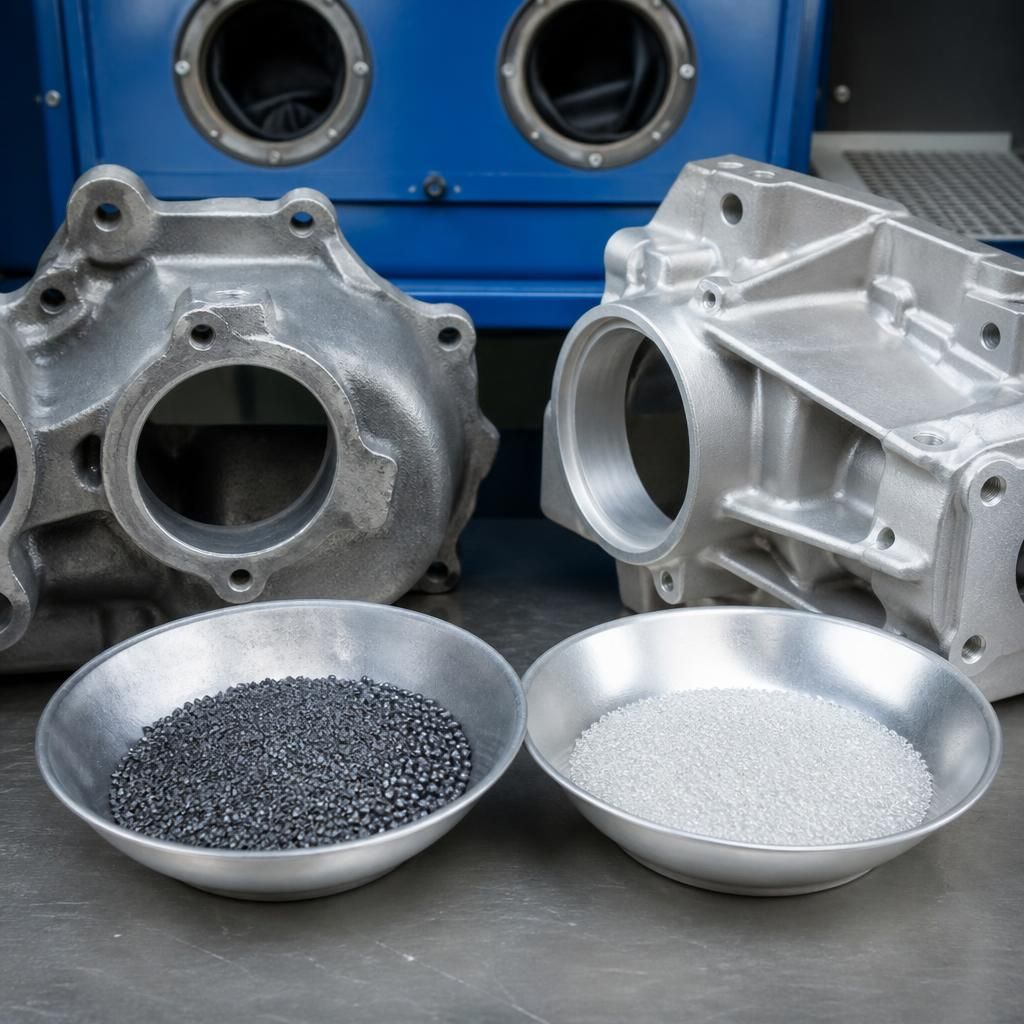
The metal substrate should influence the choice of shot blasting media because ferrous and non-ferrous components react differently to abrasive impact and contamination. Steel can generally tolerate more forceful preparation than aluminium, zinc or other softer alloys, where an overly aggressive medium may distort edges, remove excessive material or leave an unsuitable profile.
Prevent cross-contamination when preparing non-ferrous parts. Media previously used on steel can transfer ferrous particles to aluminium, galvanised or zinc-coated surfaces, potentially affecting appearance and the subsequent coating process. Use a suitable clean medium, dedicated equipment where necessary, and inspect the blasted surface for embedded particles or discolouration before powder coating.
Discuss Your Shot Blasting Media Requirements
Discuss your component requirements with the powder coating team before selecting a blasting media, including the substrate, part geometry, existing surface condition and required finish. This allows the preparation approach to be considered alongside the intended powder coating system.