

What specific cleaning methods are most effective for removing stubborn contaminants before powder coating?
The most effective approach combines a suitable degreaser or alkaline wash for oils and grease with abrasive blasting or mechanical abrasion for rust, mill scale and firmly bonded residues. Stubborn contamination may require staged cleaning, followed by thorough rinsing and drying so no chemical residue, moisture or loose material remains before powder coating.
The most effective way to remove a stubborn contaminant before powder coating is to identify its chemistry first, then use a method that dissolves, lifts or neutralises it without leaving a film on the metal. Water-soluble salts, silicone, wax, adhesive, carbon deposits and chemical residues each require different treatment; using a stronger cleaner indiscriminately can spread contamination or damage the substrate.
For soluble salts and ionic residues, a controlled aqueous rinse is generally more effective than a solvent. Pressure washing with clean water can remove residues left by handling, outdoor exposure or previous chemical treatment. Where the specification is demanding, a final rinse using low-contamination or deionised water can reduce the risk of deposits drying on the surface. The rinse water should drain freely rather than pool in joints, folds or hollow sections. A surface-water or conductivity check may be appropriate where soluble salt contamination is a known concern.
For silicone, wax and release-agent contamination, use a compatible solvent cleaner designed to dissolve the particular residue. Apply it to a clean, lint-free cloth rather than repeatedly wiping with a contaminated cloth. A two-cloth method is useful: one cloth applies and lifts the residue, while a second clean cloth removes the dissolved material. Cloths should be replaced frequently, otherwise the contaminant can be redistributed across the component. Silicone contamination deserves particular care because small quantities can interfere with coating wetting and may cause surface defects.
For adhesive and tape residues, allowing a suitable remover time to soften the deposit is often more effective than aggressive scraping. A plastic scraper or other non-marring tool can then lift the softened material from the surface. Heat may help with some adhesive types, but it should be controlled and used only where it will not distort the component, affect a previous treatment or increase the spread of the residue. The area must subsequently be cleaned again to remove both the adhesive and the remover itself.
For carbon, soot and combustion deposits, steam cleaning or a heated aqueous cleaning process can loosen the deposit before the component is rinsed. This is particularly useful where the contamination is greasy as well as particulate. The process should be followed by complete drainage and drying, because trapped moisture and loosened carbon in seams, recesses or tube ends can compromise the coating process.
For paint overspray, marker, sealant and other localised deposits, first test the proposed remover on an inconspicuous area. A chemical coating remover may be suitable for some residues, while others are better lifted with a controlled local treatment. The product instructions determine whether the remover needs neutralising or a further wash. Any softened residue, stripper film or pigment left in a joint or textured surface can become a source of adhesion problems if it is not removed completely.
Stubborn contamination may also be hidden rather than visibly present. Oil can remain in lap joints, drilled holes, threaded areas and porous weld residues, while salts can collect in crevices. Components should therefore be positioned so that cleaning fluid reaches these areas and can drain away afterwards. Hollow sections may require particular attention, and drainage holes should not be blocked by temporary masking or accumulated debris.
The cleaning method should also reflect the base metal:
- Steel: check for flash rust after water-based cleaning and avoid leaving the surface damp before coating.
- Galvanised or zinc-coated steel: use a cleaner and process that will not attack or unnecessarily remove the existing zinc layer.
- Aluminium: avoid strongly caustic products unless their effect on the alloy and finish is understood, as they can etch or darken the surface.
- Stainless steel: prevent transfer of ordinary steel particles from tools, benches or abrasive materials, since these can later produce localised corrosion.
Verification is as important as the cleaning operation. A clean white cloth can reveal remaining oil, pigment or carbon after wiping, while a water-break observation can indicate whether a continuous water film forms across the surface. These checks are useful screening methods, but they do not replace a process specification where salt levels, surface chemistry or coating performance are critical. The component should be inspected under suitable lighting, including recesses and edges, before it proceeds to the next preparation stage.
Cleaning products must be selected with their technical and safety information in mind. The product’s compatibility with the substrate, evaporation characteristics, residue potential, ventilation requirements and waste-disposal instructions all matter. Solvents that appear effective during application can leave an invisible film, and some cleaning agents can react with a later pretreatment. For industrial batch work, documenting the contaminant, cleaner, contact time, rinse method and inspection result helps maintain consistent preparation across different loads.
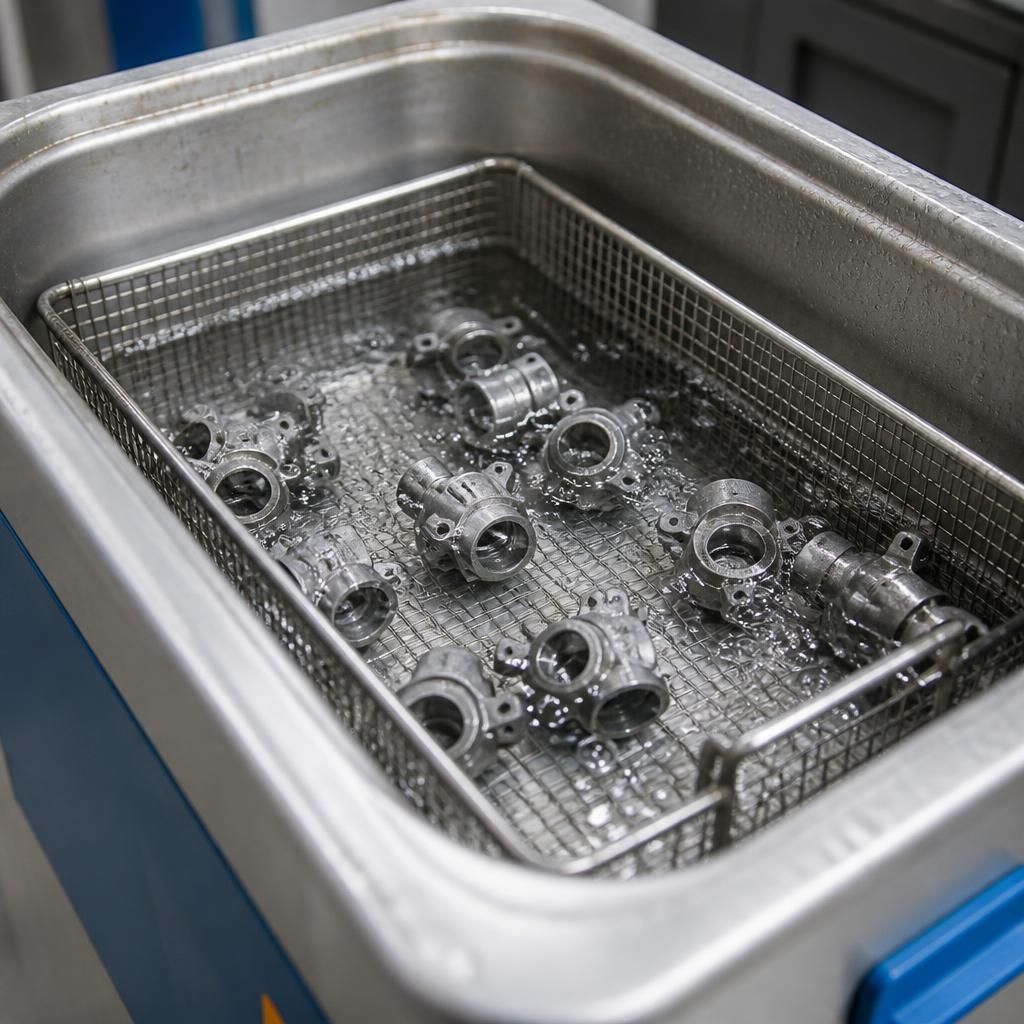
Ultrasonic cleaning can be particularly effective for small or intricately shaped metal components with contamination lodged around threads, fine recesses and detailed profiles. The component is immersed in a compatible cleaning solution while high-frequency sound waves create microscopic bubbles that collapse against the surface, helping dislodge oil, fine particulate and residues from areas that brushes or cloths may not reach. It is most suitable after heavy deposits have been removed, rather than as a replacement for bulk degreasing or corrosion removal. The solution must be compatible with the substrate and any existing treatment, and the parts require a clean rinse and complete drying before powder coating.