

What specific advantages does textured black powder coating offer over traditional painting methods for industrial applications?
Textured black powder coating generally provides a harder, more chip- and scratch-resistant finish than traditional liquid paint, making it better suited to industrial metalwork exposed to handling and wear. Its baked-on surface also offers consistent coverage, a distinctive textured appearance and lower routine maintenance requirements, while the texture can help disguise minor surface imperfections.
For industrial applications, textured black powder coating offers advantages over traditional liquid painting through its application efficiency, solvent-free powder formulation, repeatable finish and suitability for demanding metal components. Its value is not limited to appearance: when the metal is correctly prepared and the coating is properly cured, it can support a more controlled and durable finishing process.
More efficient material application
Powder coating is applied as a dry powder using an electrostatic charge, which attracts the particles to the earthed metal component before curing. Overspray can often be collected and reused, whereas liquid paint overspray is normally lost or requires controlled disposal. This can make powder coating a more efficient option for suitable production work, although the actual material usage depends on part geometry, coating specification and application equipment.
The dry application also avoids the runs, sags and solvent entrapment that can occur when liquid paint is applied too heavily or before the previous layer has properly dried. This is particularly useful for repeat batches, where controlled application settings can help produce a more uniform result from one component to the next.
Reduced reliance on solvents
Traditional paints commonly use liquid solvents to carry resins and pigments. Powder coating is supplied as a dry formulation, so the application stage does not involve the same solvent evaporation associated with many liquid painting systems. This can reduce solvent-related handling and workplace exposure considerations, subject to the product’s safety data and the controls used within the coating facility.
Powder coating still requires appropriate extraction, housekeeping and personal protective equipment. It should not be treated as risk-free simply because it is solvent-free, and different powders may have different handling requirements.
Reliable production and curing
Unlike liquid paint, which may need several coats and drying stages, powder coating can often achieve the specified finish in a more consolidated coating cycle. The coated component is heated so that the powder melts, flows and chemically cures into a continuous film. This gives manufacturers and fabricators a clearly defined process involving surface preparation, application and oven curing rather than a series of open drying stages.
That process can simplify production planning for compatible components. It is especially practical for batch work and repeatable metal parts, provided the parts can be handled safely, fit the available equipment and tolerate the required curing temperature. Complex assemblies containing heat-sensitive materials may require a different approach.
Improved resistance in service
A correctly specified textured powder system can provide useful resistance to moisture, light industrial chemicals and routine handling. The precise performance depends on the resin type, film thickness, pretreatment, curing conditions and the environment in which the component will be used. For outdoor or corrosive applications, the coating specification should therefore be matched to the exposure rather than selected solely by colour or texture.
Powder coating can also provide a continuous barrier between the metal and its surroundings. This is important for fabricated parts, brackets, frames, enclosures and other components where corrosion protection forms part of the finish requirement. It does not remove the need for sound welds, suitable design, drainage and thorough preparation of the substrate.
Consistent identification and finish specification
Black textured powder coating is widely used where a non-gloss, tactile finish is required without relying on decorative painting techniques. The texture can provide a practical visual distinction between coated and uncoated parts and can be specified alongside requirements such as gloss level, coating chemistry, film build and environmental resistance.
For industrial procurement, this makes the finish easier to define on drawings and purchase orders. A suitable specification should describe more than “textured black”: it may need to state the required performance, substrate preparation, pretreatment, acceptable appearance, curing requirements and inspection criteria.
Less dependence on ambient drying conditions
Liquid paint performance can be affected by temperature, humidity, dust and drying conditions during application and between coats. Powder coating is also sensitive to process control, but curing takes place in a controlled oven rather than relying primarily on air drying. This can reduce some of the variability associated with exposed wet-paint drying areas.
However, oven temperature alone does not confirm a successful cure. The metal must reach the required temperature for the specified time, and heavy or irregularly shaped components may heat differently from thin sections. Coating operators need to account for the component’s mass and geometry when setting and checking the process.
Important limitations when comparing the two methods
- Powder coating is not automatically suitable for every metal assembly. Components may need to withstand the curing cycle and be designed so that trapped air, moisture and contaminants can escape.
- Thorough degreasing, preparation and pretreatment remain essential. Powder applied over oil, rust, mill scale or contamination can fail regardless of the application method.
- On-site touch-ups and small repairs may be simpler with liquid paint, while powder-coated parts are normally repaired using a compatible system recommended for the service environment.
- The textured surface is not a substitute for corrosion engineering. Sharp edges, crevices, poor drainage and damaged areas can still become points of premature deterioration.
Overall, textured black powder coating is most advantageous where industrial metal parts require a repeatable factory-applied finish, efficient batch processing and protection suited to their operating environment. The strongest comparison with painting comes from treating the coating as part of a complete system: substrate preparation, pretreatment, powder selection, application control and correct curing all determine whether its technical advantages are achieved in practice.
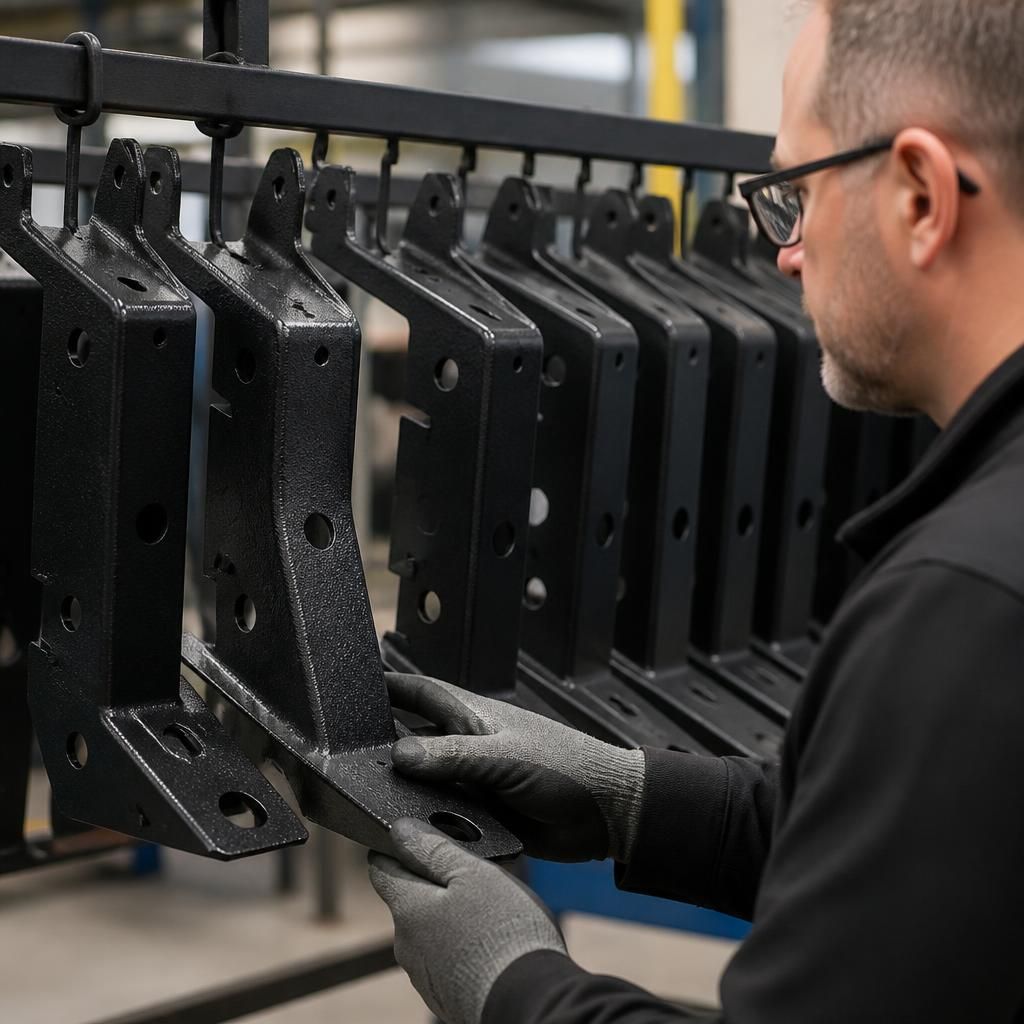
One practical advantage of textured black powder coating is that the finish can provide a more consistent visual standard across repeat industrial components. Once the required texture, gloss level and film build have been agreed, inspectors can assess parts against the same appearance criteria rather than relying on subjective comparisons between separate wet-paint applications.
This is useful for brackets, enclosures, frames and fabricated assemblies supplied in batches. The textured surface can also reduce the visual prominence of minor handling marks and variations in the underlying fabrication, while still requiring the metal to be properly prepared. It therefore supports a controlled specification without making surface preparation or inspection less important.
Discuss Your Textured Black Powder Coating Requirements
Discuss your textured black powder coating requirements with the team, providing details of the metal substrate, component dimensions and intended service environment so the appropriate finish can be assessed. Request a quote for your industrial components.