

What specific environmental conditions can black protective powder coatings withstand that traditional liquid paints cannot?
When correctly specified and cured, black protective powder coatings can withstand prolonged moisture, UV exposure, chemical contact, abrasion and repeated temperature changes with less risk of peeling, chipping or corrosion breakthrough than many traditional liquid paint systems. Their uniform, mechanically bonded film is particularly suited to metal components exposed to harsh industrial, construction and automotive environments.
Black protective powder coatings are most valuable where several environmental stresses occur together, particularly in coastal, industrial and high-use settings. However, no powder coating is automatically suitable for every condition. Resistance depends on the resin chemistry, film specification, substrate preparation, curing and the exposure expected in service. The meaningful comparison is therefore between a correctly specified powder system and a conventional liquid paint selected for the same duty.
Coastal and salt-laden atmospheres can be especially demanding. Salt deposits attract water and create a conductive surface that accelerates corrosion at defects, edges and poorly prepared areas. A suitable protective powder system, combined with appropriate pretreatment and edge coverage, can provide a more continuous barrier than many liquid paint applications. For coastal or marine-adjacent components, the coating specification should address cyclic salt exposure rather than relying only on a general-purpose decorative finish.
Industrial atmospheres containing airborne contaminants are another relevant condition. Manufacturing sites may expose metalwork to dust, process residues, acidic pollutants or alkaline deposits. These contaminants can settle on a paint film and attack weak points, particularly where the film is soft, porous or poorly adhered. A cured powder coating can offer a dense, resilient surface that is easier to clean and less vulnerable to damage from routine industrial contamination, provided its chemical resistance matches the substances present.
Repeated condensation and drying cycles can be more damaging than a single wet exposure. Water can collect beneath dirt, around fixings and in joints, then evaporate and leave concentrated residues behind. This cycle places stress on the coating and can expose preparation defects. Powder coating is often selected for these conditions because its cured film has consistent coverage across the main surfaces. Design details still matter: trapped water, unsealed joints and sharp edges can undermine any coating system.
Areas subject to impact from loose particles or handling equipment also favour a properly selected protective powder finish. Examples include fabricated guards, brackets, machine frames and components moved through busy production areas. The key benefit is not simply hardness; the film must balance hardness with enough flexibility to resist cracking when the substrate is knocked or flexed. A brittle or incorrectly cured coating may fail just as a liquid paint can.
Black finishes require an additional consideration. Dark surfaces absorb more solar energy than light finishes, so components exposed outdoors may experience greater surface heating. The coating, substrate and fixing method should be assessed together where there are significant differences in expansion between connected materials. The correct formulation can help the finish remain stable, but colour alone does not determine environmental performance.
Before specifying the coating, assess the actual exposure rather than treating “outdoor use” as a sufficient description. Relevant questions include:
- Will the component be exposed to salt deposits, industrial pollutants or repeated condensation?
- Will it be immersed, regularly washed or exposed to a particular fluid?
- Could impact, particle contamination or cleaning methods damage the film?
- Are there welds, joints, edges or recessed areas where corrosion could begin?
- Will the black finish experience strong solar heating or significant movement of the substrate?
Testing may include salt-spray or cyclic-corrosion assessment, humidity exposure, adhesion, impact, flexibility and chemical-resistance testing. These tests do not make powder coating universally superior to liquid paint; they help confirm whether the proposed system is suitable for the component’s actual environment. For industrial metalwork, specifying the exposure conditions in advance is the most reliable way to obtain durable protection rather than choosing a black finish by colour alone.
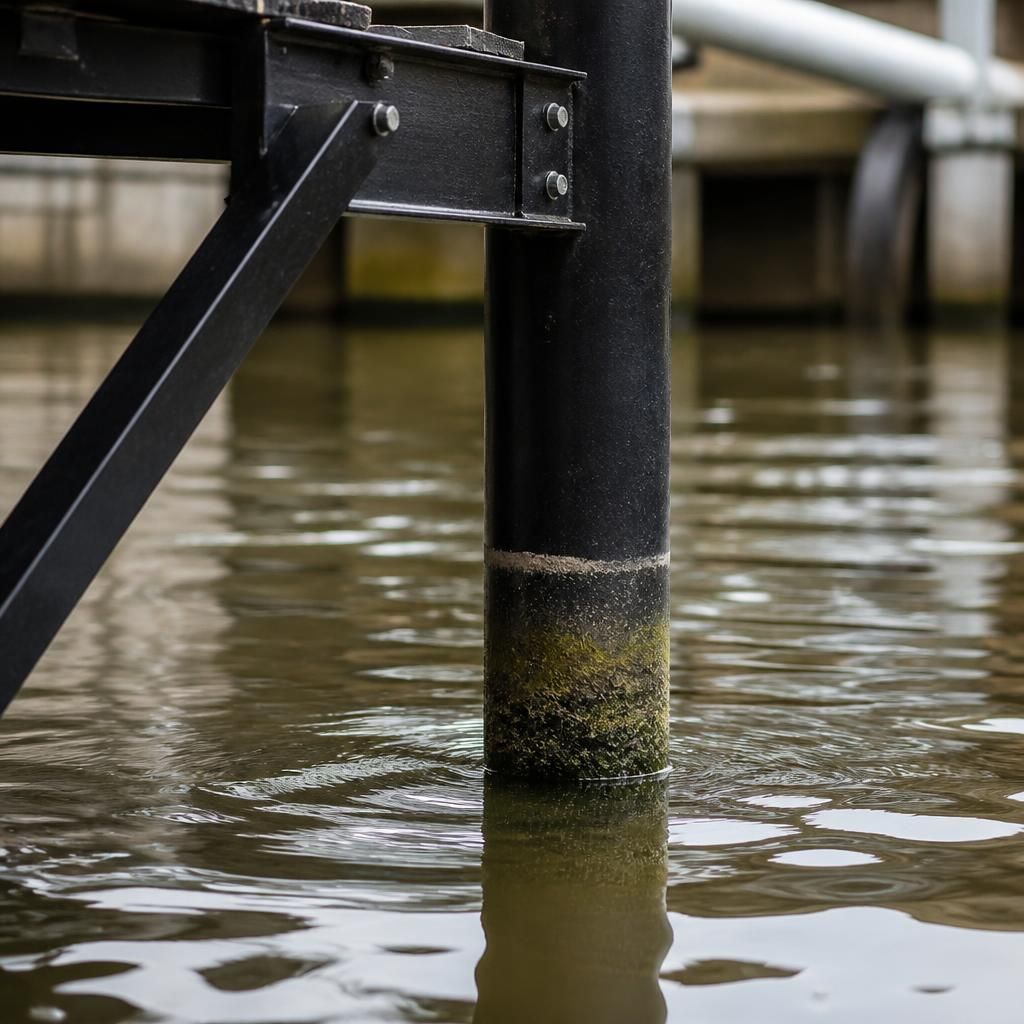
Continuous immersion is a specialist exposure, not a standard benefit of every black powder coating. Where metal components remain underwater or in contact with liquid for extended periods, the coating must be selected for that fluid and immersion duty. A correctly prepared and cured system can provide a stable barrier against water ingress and corrosion, whereas a general-purpose liquid paint may soften, blister or lose adhesion when moisture reaches weaknesses in the film.
Conditions around the liquid line can be particularly severe because the surface may be exposed to immersion, evaporation and renewed wetting at the same time. Coating selection should therefore consider the liquid’s composition, temperature and movement, as well as welds, joints and edges that may retain moisture. Continuous immersion should be confirmed as part of the specification rather than assumed from the coating’s black colour or general outdoor rating.