

What specific pre-treatment processes do you use to ensure optimal adhesion and finish quality for powder coated steel panels?
We pre-treat steel panels by removing oil, dirt, mill scale and other contaminants, then use suitable abrasion and chemical conversion treatment to create a clean, receptive surface. The panels are dried and checked before powder application, helping the coating bond consistently and supporting a smooth, corrosion-resistant finish.
For steel panels, pre-treatment is controlled as a complete process rather than a single operation. The treatment is selected and checked according to the panel’s condition, construction, intended service environment and powder coating specification, so that the surface presented for coating is chemically suitable, physically consistent and free from residues that could cause defects.
Assessment of the panel before treatment
Each panel is considered for features that can affect coating quality, including welds, folded edges, drilled holes, joints, recesses and areas where moisture or processing fluids may collect. Weld spatter, sharp projections and other surface irregularities are dealt with as part of preparation because pre-treatment cannot compensate for a poor underlying profile. Particular attention is given to edges and corners, where an inconsistent surface can contribute to uneven coverage or reduced protection.
The condition of the steel also influences the preparation route. Clean new material, previously handled components and panels showing heavier oxidation or residual scale may require different preparation intensity. This avoids treating every component identically when the substrate or its construction calls for a different approach.
Control of the treatment stages
- Cleaning stages are managed to prevent oils, handling marks and process residues being carried into later stages.
- Where a mechanical key is required, the surface profile is kept suitable for the specified powder system rather than being made unnecessarily coarse.
- Chemical conversion treatment is selected for compatibility with steel and the required level of corrosion protection. Its purpose is to improve the interface between the metal and the powder film, not to conceal surface defects.
- Rinsing between treatment stages helps remove loosened material and limits chemical carry-over, which could otherwise interfere with bonding or leave visible deposits.
- Drainage is considered for apertures, folds and enclosed sections so that treatment liquid does not remain trapped and later emerge during heating.
These controls are particularly important for panels with complex geometry. A flat face may appear ready while a folded return, underside or fixing hole still contains moisture or residue. Panels are therefore positioned and handled in a way that allows treatment fluids to drain and enables the relevant surfaces to be examined.
Drying and protection after treatment
After the final rinse and drying stage, panels are protected from recontamination before powder application. Clean handling methods and suitable support points help prevent fingerprints, dust, oil from equipment or contact with unprepared surfaces being transferred back onto the steel. Racks, hooks and contact areas are also managed so they do not introduce marks or untreated patches into visible faces.
Drying is checked in relation to the panel design, not only its exposed face. Water retained in seams, holes or folded sections can produce bubbling, pinholing or adhesion problems when the part enters the curing oven. A panel that is visually dry on its broad surfaces may therefore need further attention if its geometry creates concealed drainage points.
Final checks before powder coating
The prepared panel is examined for an even, clean surface with no visible residue, remaining scale, flash rust, trapped moisture or preparation damage. Edges, weld zones and less accessible faces receive the same attention as the main panel surface. If a defect is found, the panel is returned for correction rather than relying on the powder film to hide it.
Good pre-treatment also depends on keeping the interval between preparation and coating under control. Unprotected steel can pick up contamination or begin to oxidise again, particularly in humid conditions. Panels are therefore kept in a condition suitable for coating and inspected again if handling, storage or transport could have affected the prepared surface.
This combination of substrate assessment, controlled treatment stages, effective drainage, careful drying and final inspection gives the powder coating a more reliable foundation. It supports consistent adhesion and finish quality across batches while reducing the risk of defects that originate beneath the visible coating.
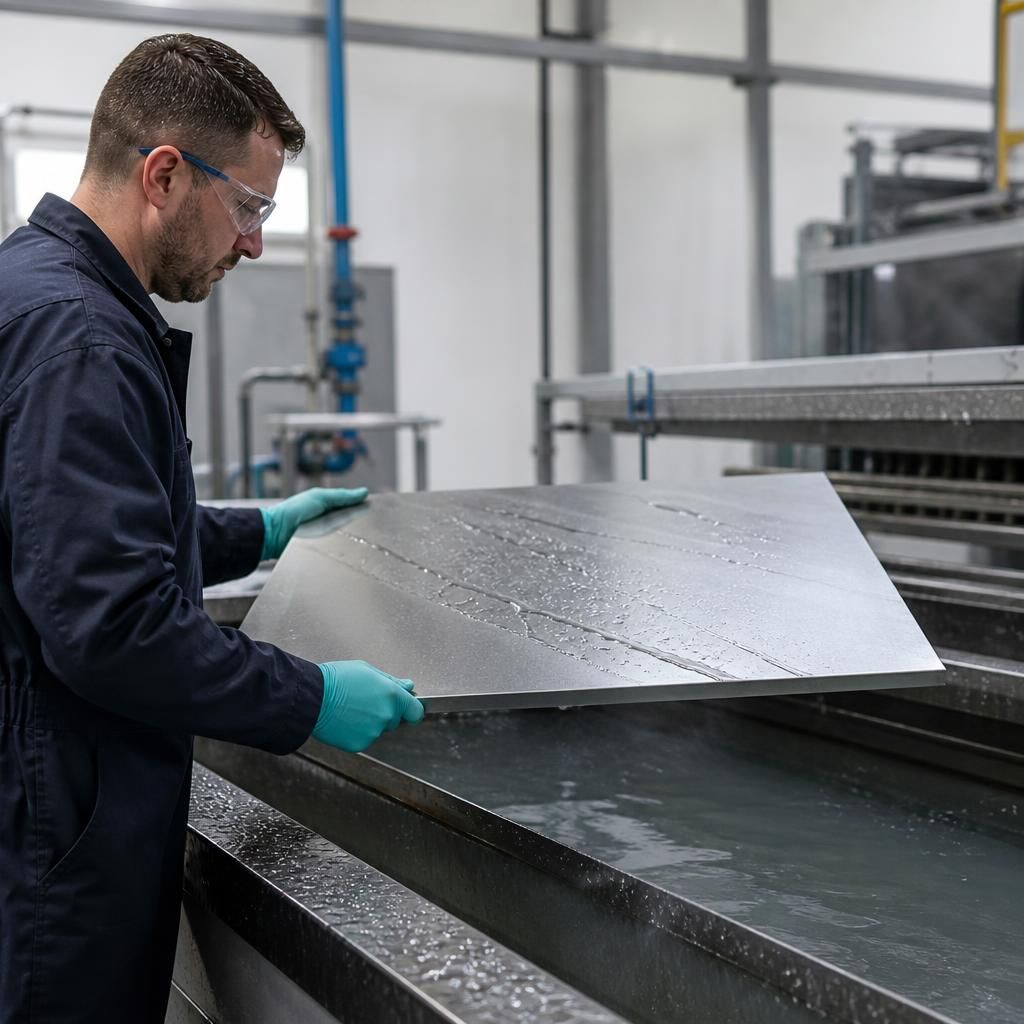
Pre-treatment is adapted when a steel panel has a zinc-coated or galvanised surface, because the process must promote powder adhesion without unnecessarily removing the protective metallic layer. In these cases, the cleaning and conversion stages are chosen for compatibility with the coating already present, rather than applying the same preparation used for untreated steel.
Surface cleanliness can also be assessed before coating by observing how the rinsed surface accepts water. Even wetting indicates that oils and similar contaminants have been removed, while persistent beading can identify an area requiring further cleaning. This type of check helps distinguish a genuinely prepared surface from one that merely appears clean under workshop lighting.
Discuss your steel panel pre-treatment requirements
Share your steel panel material, geometry, condition and intended coating requirements with our team so we can discuss a suitable pre-treatment approach. We can then advise on the preparation considerations for your components before powder coating.