

What are the specific advantages of using powder coating for chassis and frames compared to traditional liquid coatings?
Powder coating gives chassis and frames a tough, uniform cured finish that generally offers stronger resistance to abrasion, impact, corrosion and weathering than conventional liquid coatings. It also applies without liquid solvents and can produce consistent coverage across complex metalwork, supporting durable protection with less risk of runs or uneven finish.
Powder coating offers several practical advantages over traditional liquid coatings for chassis and frames, particularly where the component must withstand repeated handling, outdoor exposure and mechanical wear. The main differences relate to application efficiency, film formation, environmental control and the way a cured finish performs during the service life of the metalwork.
More efficient material use: Powder is applied as a dry coating and attracted to the electrically grounded metal before curing. Overspray that remains clean and uncontaminated may be recovered for reuse, whereas liquid-coating overspray generally becomes waste mixed with solvent or other coating materials. The actual material efficiency depends on the equipment, colour changes, component geometry and recovery system, but powder can reduce avoidable coating waste in a controlled production process.
Fewer application stages: A powder system can often achieve the required film build in a single application and then cure it in an oven. Liquid systems may require several coats, with flash-off or drying stages between them. For chassis and frames, reducing intermediate handling can simplify the process and limit the opportunities for dust, handling marks or variations between coats. Powder is also dry to the touch after curing, so the component does not need to be held while liquid solvents evaporate.
A chemically cross-linked finish: Thermosetting powder does not simply dry by losing liquid; it melts and chemically cross-links during curing. This creates a stable film with a different response to heat and solvents from many air-dried liquid coatings. Once correctly cured, it is less likely to soften under ordinary handling conditions. The coating must still be matched to the intended service temperature and chemical exposure, since excessive heat, aggressive chemicals or severe damage can affect any finish.
Better control in repeat production: Chassis and frames are often manufactured in batches, making repeatability important. Powder application can be monitored through variables such as powder type, electrostatic settings, oven temperature, curing time, grounding and film thickness. A defined process helps maintain the same coating specification across similar components. Liquid coatings can also produce repeatable results, but their performance is more affected by factors such as viscosity, solvent evaporation, spray consistency and wet-film drying conditions.
Reduced solvent handling: Powder contains no liquid solvent carrier, so the application process does not require the same solvent-management arrangements as a solvent-borne liquid system. This can simplify controls for flammable liquids and reduce solvent vapour generated during spraying. Powder application still requires suitable extraction, housekeeping, personal protective equipment and control of airborne dust; it should not be treated as risk-free or maintenance-free.
There are, however, important limitations when comparing the two methods. Powder curing requires the steel chassis or frame to tolerate oven temperatures, and components such as rubber bushes, plastic parts, bearings, seals or heat-sensitive assemblies may need removal or protection. Powder can also add measurable film thickness to mating faces, threads, bores and close-fitting interfaces. These areas should be identified before coating and masked or otherwise prepared where dimensional accuracy matters.
Liquid coating may remain more suitable for heat-sensitive assemblies, very thin decorative films, site-applied repairs or work that cannot be placed in an oven. Powder coating is therefore most advantageous when the chassis or frame is a suitable metal substrate, can be correctly prepared and masked, and benefits from efficient batch processing and a cured industrial finish. The specification should consider the metal, operating temperature, exposure conditions, required film thickness, masking requirements and whether the complete assembly can safely undergo curing.
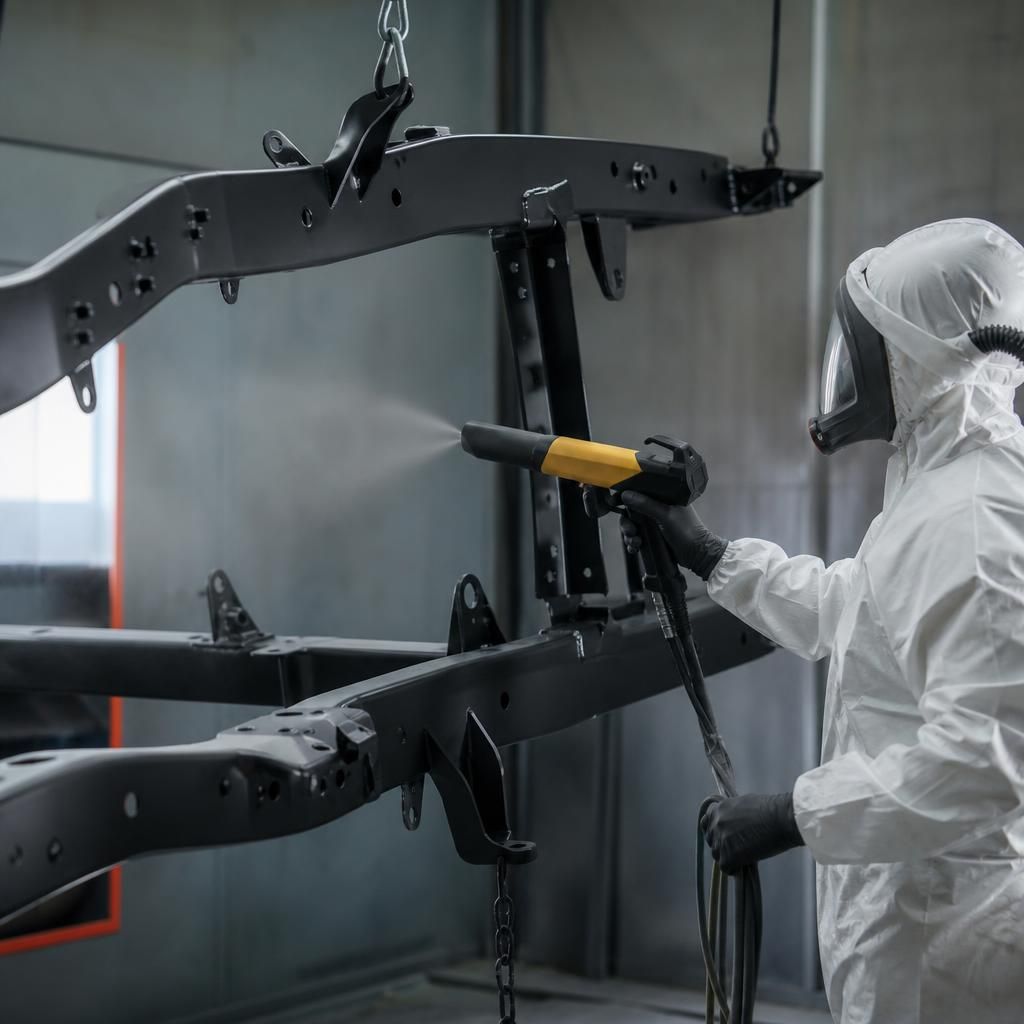
For two-pack liquid coating systems, powder coating can simplify material control because the dry powder does not require resin and hardener to be mixed in a precise ratio before application. This avoids errors caused by incorrect mixing, changes in pot life and leftover wet coating that can no longer be used. The powder specification must still be matched to the chassis material, service conditions and curing requirements, but the coating is supplied ready for controlled electrostatic application.
Discuss Powder Coating for Your Chassis or Frames
Discuss your chassis or frame requirements with the powder-coating.co.uk team to assess substrate suitability, masking needs and the coating specification for its intended use. Provide details of the component, operating conditions and batch requirements to receive practical guidance on the next steps.