

What specific surface preparation techniques are used for optimal powder coating on galvanised steel?
Surface preparation for powder coating galvanised steel typically combines alkaline cleaning or degreasing, controlled sweep blasting to key the zinc without stripping it, and a suitable conversion treatment such as phosphate. The steel is then thoroughly rinsed, dried and inspected to remove contaminants, surface salts, moisture and residues that could cause adhesion failure or coating defects.
Optimal preparation of galvanised steel requires more than removing visible dirt. The zinc surface must be assessed, cleaned without damaging its protective layer, given a suitable mechanical key, and treated so that the powder coating can bond consistently. Preparation should also address fabrication defects, white rust, trapped moisture and gases that may later cause blistering, pinholing or loss of adhesion.
Begin with a substrate assessment. Galvanised components can vary considerably depending on how they were manufactured and stored. Check whether the surface is newly galvanised, weathered, passivated, contaminated with storage oils or affected by white rust. Areas with heavy zinc build-up, runs, ash inclusions or uneven crystallisation may need local attention before the main preparation stage. The condition of the zinc matters because aggressive treatment can expose the underlying steel and create areas with different corrosion behaviour.
Deal with fabrication defects before coating. Weld spatter, sharp burrs, grinding marks, laminations and projecting edges can prevent an even powder film. These defects should be removed using methods that do not unnecessarily thin the zinc layer. Welded sections also require particular care: flux, heat scale and residues can remain around the joint, while weld porosity may release gases during oven curing. Where the design permits, drain and vent holes should be provided in hollow sections so that cleaning fluids do not become trapped and gases can escape during heating.
Remove white rust carefully. White rust is a powdery zinc corrosion product that develops when galvanised steel remains damp or is stored without adequate ventilation. Light deposits may be removed with controlled brushing or a suitable chemical treatment. Heavier deposits require a process selected to remove the corrosion product without unnecessarily attacking sound zinc. Simply coating over white rust is unreliable because the loose material forms a weak layer between the substrate and the powder film.
Use controlled abrasion to create a uniform key. Sweep blasting is commonly used where the zinc needs light profiling rather than wholesale removal. The abrasive, pressure, nozzle distance and travel speed must be selected for galvanised steel; excessive impact can strip the coating, expose steel or leave an uneven surface. A fine, clean, non-metallic abrasive is often preferred where it provides the required profile without embedding iron or other contaminants. Blasting should produce a consistently dull surface, not deep scoring or isolated bright patches.
Mechanical preparation may be supplemented by light abrasion in localised areas, particularly around welds, edges or repairs. The objective is to provide consistent surface energy and remove weak deposits, not to make the zinc resemble blasted untreated steel. Overworking corners and edges can create thin spots that are difficult for the powder film to protect.
Check for passivation and chemical residues. Some galvanised products leave the galvanising line with a passivation or storage treatment. These films can interfere with adhesion and may need to be removed or chemically conditioned before powder coating. The selected pre-treatment must be compatible with zinc and with the powder system. A process designed for bare mild steel is not automatically suitable for galvanised surfaces, as it may attack the zinc, leave residues or provide an unsuitable conversion layer.
Control rinsing, drying and handling. After chemical preparation, all recesses, joints and hollow sections need particular attention because retained liquid can later cause blistering or corrosion staining. Components should be dried fully before coating and protected from renewed contamination. Clean gloves, suitable racks and non-contaminating contact points help prevent fingerprints, oil transfer and handling marks from undoing the preparation work. Parts should not be left exposed to damp conditions after treatment, as the prepared surface can deteriorate before powder application.
Manage outgassing risks. Zinc-coated steel and fabricated assemblies may contain moisture, oils or gases within pores, overlaps and welds. When the component is heated for curing, these can migrate through the powder film and create pinholes or bubbles. A controlled preheat or outgassing cycle may be appropriate for the component and coating system. The timing and temperature must be established through the coating specification, because excessive heating can affect the substrate, pretreatment or final finish. Where appearance is critical, a trial component can reveal whether outgassing or trapped contamination remains a concern.
Use a process check before production coating. A prepared sample or test area can be used to confirm that the chosen treatment gives acceptable wetting, appearance and adhesion. The check should include difficult areas such as welds, corners, recesses and previously affected zinc. If the result is inconsistent, changing the powder alone will not correct poor preparation; the cleaning, abrasion, chemical treatment or handling stage needs to be reviewed.
For industrial batches, the most reliable approach is a documented preparation sequence with controls for abrasive condition, chemical concentration, rinse quality, drying and part handling. The exact method should reflect the galvanising condition, component design, required appearance and intended service environment. This prevents the common mistake of treating every galvanised component identically and helps produce a sound base for a durable powder-coated finish.
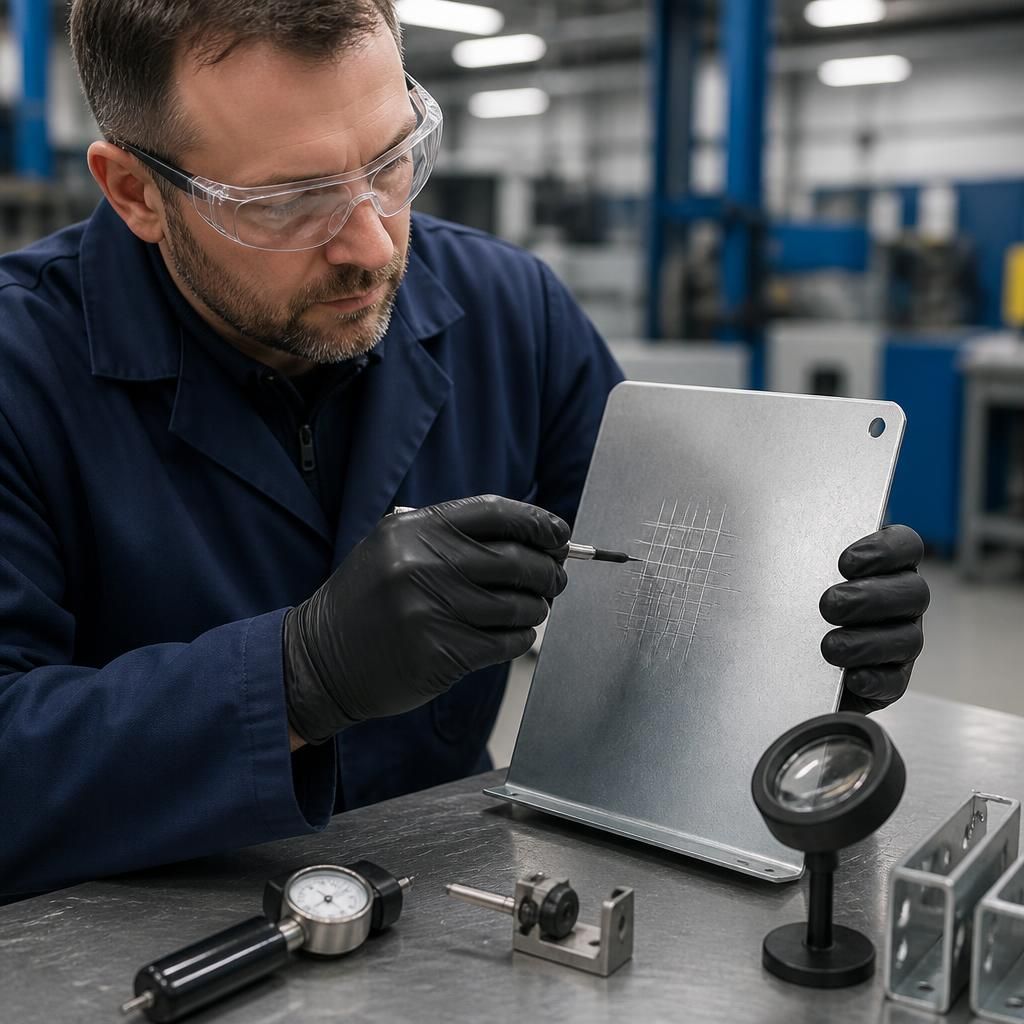
Preparation should be verified on a representative galvanised sample before a production batch is coated. After the powder has been cured, a cross-hatch adhesion test can show whether the coating has bonded properly to the prepared zinc surface. Visual inspection should also check for craters, pinholes, bubbles, thin edges and areas where the finish has receded from corners or recesses.
The sample should include the same galvanising condition, weld details, edges and difficult geometries as the finished components. Testing a simple flat panel alone may not reveal problems caused by fabrication or part design. Any failure should be traced back to the preparation sequence and corrected before production coating proceeds.
Discuss Surface Preparation for Powder Coating Galvanised Steel
Discuss your galvanised steel components with a powder-coating specialist to establish a preparation sequence suited to their condition, design and service environment. Providing details of the substrate and finish requirements helps determine whether additional testing or treatment is appropriate before coating.