

What specific environmental conditions should be considered when selecting a powder coating for steel railings?
When selecting powder coating for steel railings, consider exposure to moisture, rain, condensation, sunlight and ultraviolet radiation, as well as salt, pollution, chemicals and physical abrasion. The coating system should match the railing’s location and expected exposure so it provides suitable resistance to corrosion, colour fading, chalking and wear.
The coating system for steel railings should be selected against the complete service environment, not simply whether the railings are indoors or outdoors. The assessment should cover atmospheric corrosivity, temperature, wetting patterns, contamination, exposure direction, contact with other materials and the consequences of any coating failure. These factors determine the suitable powder chemistry, pretreatment, film build and colour or gloss specification.
Assess the location’s corrosivity
Atmospheric exposure is commonly considered using corrosivity categories, such as those in BS EN ISO 12944. A relatively clean, dry indoor setting places different demands on a coating from an exposed urban, industrial, coastal or heavily polluted site. The classification should reflect the actual position of the railing. A sheltered canopy, an open external stairway and a railing beside a road may all require different levels of protection even when they are within the same building project.
Pay particular attention to sites where contaminants can remain on the surface rather than being washed away. Road spray, airborne deposits and residues from nearby processes may collect on lower rails, joints and horizontal surfaces. The selected system must be suitable for the expected contaminant and for the cleaning regime that can reasonably be applied.
Consider how the railing gets wet
Average rainfall is less informative than the pattern of wetting and drying. Railings may be affected by condensation, wind-driven rain, water retained beneath brackets or repeated dampness at connections to floors and walls. Areas that stay wet for long periods place greater demands on pretreatment, edge coverage and the continuity of the coating.
Design details are therefore part of the environmental assessment. Hollow sections need suitable drainage and ventilation, while joints, welds, cut ends and sharp edges need careful preparation. Water traps can undermine an otherwise appropriate powder specification. If a railing will be washed frequently or exposed to spray, the coating should also be checked for resistance to the proposed detergents and for compatibility with the cleaning method.
Allow for temperature and thermal movement
External steel railings experience changes in temperature caused by weather and direct solar heating. Dark colours can become particularly warm in sunlight, while exposed metal can cool rapidly at night. The specification should take account of the expected temperature range, thermal cycling and any movement between the steel, fixings and adjacent materials.
Freeze-and-thaw conditions can be relevant where moisture enters joints, porous interfaces or poorly drained details. The powder coating does not remove the need to prevent water from being retained in the construction. Where railings are close to heat sources or industrial equipment, the coating should be selected using the actual operating temperature rather than the normal ambient temperature.
Check chemical contact rather than relying on a general exterior grade
Different chemicals can affect a coating in different ways. Occasional airborne exposure is not equivalent to regular splashing, cleaning, or immersion. Identify the substances involved, their concentration, temperature, contact time and whether they are acidic, alkaline, solvent-based or contain oils. This information is needed to confirm whether a standard architectural powder coating is suitable or whether a more specialised protective system is required.
Also consider indirect chemical exposure. Cleaning products, de-icing materials, process residues and contaminants transferred from gloves or equipment may be more significant than the general atmosphere. A coating that is suitable for a dry industrial environment may not be appropriate where liquids collect at the base of the railing or around fixings.
Examine interfaces and dissimilar materials
Steel railings are often attached to concrete, masonry, aluminium, stainless steel or galvanised components. Moisture held between dissimilar metals can create conditions for galvanic corrosion, particularly where the coating is damaged or the joint is poorly sealed. The specification should consider the full assembly, including fixings, welds, washers, base plates and areas concealed after installation.
Where galvanised steel or previously treated steel is being coated, the preparation and pretreatment must be compatible with the substrate. A powder finish cannot compensate for unsuitable surface condition, contamination or corrosion beneath the coating. The project specification should state how exposed edges, repaired areas and site damage will be treated.
Match appearance requirements to exposure
Colour and gloss affect how environmental change is seen. Some finishes show chalking, fading, dirt or surface marking more readily than others. For prominent railings, specify the required colour retention and appearance for the exposure rather than selecting solely on initial appearance. Texture can also influence how easily deposits are removed and how visible local damage becomes.
Where colour consistency matters, use the same coating system and agreed colour standard across all batches. Sample panels can help assess the expected appearance on the actual steel profile, especially where the railing combines flat sections, tubes, welds and different orientations.
Use the site assessment to define the whole system
- Record whether the railing is sheltered, partially exposed or fully exposed.
- Identify condensation, persistent damp areas, spray, immersion risk and drainage problems.
- List chemicals, cleaning agents, de-icing products and industrial contaminants that may contact the surface.
- Consider temperature extremes, solar heating and movement at joints or interfaces.
- Specify suitable steel preparation, pretreatment, edge treatment and coating thickness alongside the powder type.
- Confirm the required colour retention, gloss level, cleanability and repair procedure.
For most projects, the correct decision is a tested coating system matched to the site category and construction details, rather than a powder colour chosen in isolation. Providing the coater with drawings, substrate information, location details and details of any chemical or cleaning exposure allows the specification to be assessed before production.
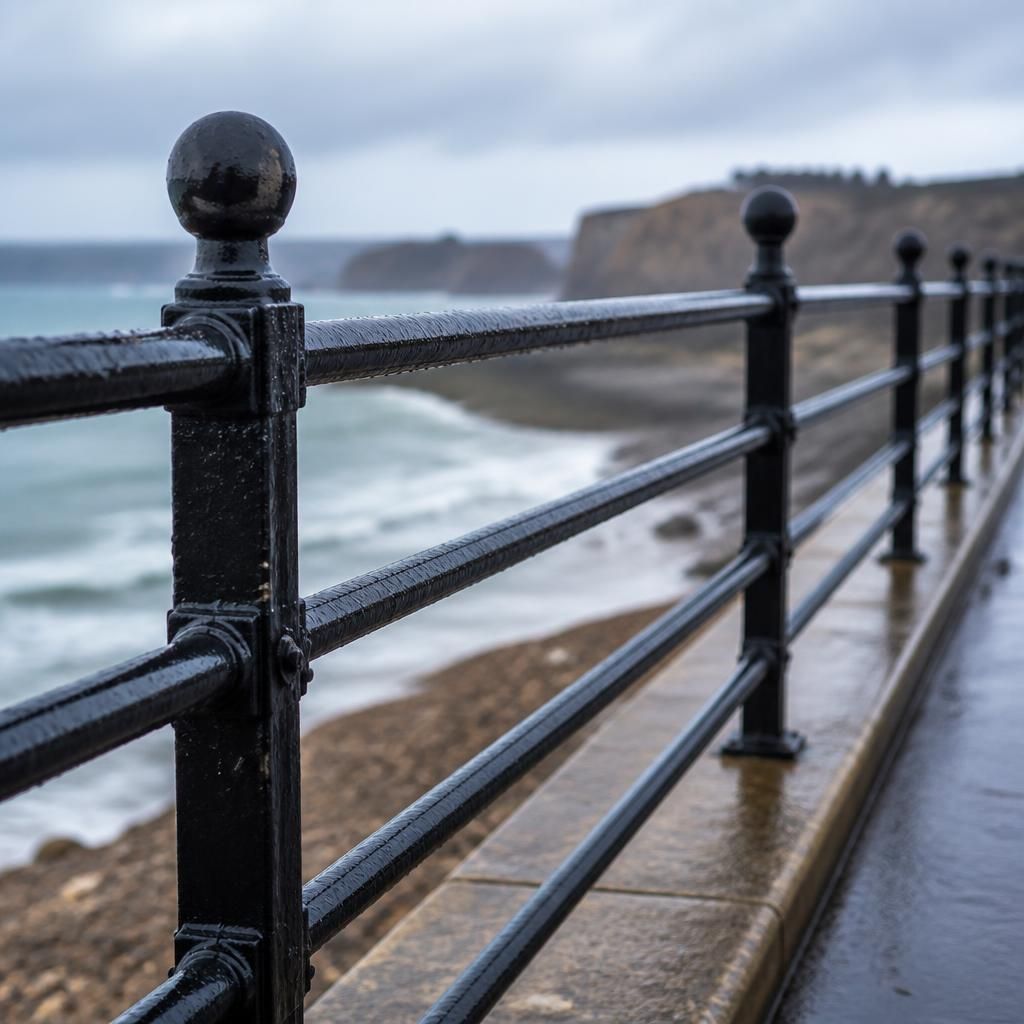
The consequences of coating failure should also influence the specification. A railing that is difficult to access for inspection or repair, or one positioned above areas that must remain protected from corrosion debris, may justify a more robust coating system than a similar railing in an easily maintained location. Consider the cost and practicality of removing the railing, preparing damaged areas and controlling overspray or debris during future repairs.
This risk-based assessment should be considered alongside the site exposure. Where repair access is restricted, specify the substrate preparation, pretreatment and powder system carefully at the outset, and ensure that edges, fixings and concealed interfaces are included in the inspection plan.
Discuss Your Steel Railings’ Environmental Requirements
Discuss your steel railings’ environmental requirements with our coating specialists, providing site conditions, substrate details and any chemical or cleaning exposure. This information can be used to assess a suitable powder coating system before production.