

What are the key benefits of powder coating rusted steel over traditional paint methods?
Powder coating can give properly prepared rusted steel a tougher, more uniform and more durable finish than traditional liquid paint. Its bonded coating provides strong resistance to impact, moisture and corrosion, while typically requiring less maintenance and delivering a consistent quality appearance.
Powder coating offers several practical advantages over traditional liquid paint for properly prepared rusted steel, particularly where the component must withstand regular handling, repeated use or demanding service conditions. The main differences arise from the application method: powder is electrostatically applied as a dry coating and then cured under controlled heat, whereas liquid paint relies on wet film application and solvent or water evaporation.
More controlled film formation
Powder coating produces a consistent layer across the prepared steel surface, with fewer risks of runs, sags, brush marks or visible variation between application areas. This is especially useful for manufactured parts and batch work, where repeatable appearance and coating thickness are important. Corners, edges and profiles still require suitable preparation and coating selection, but the cured finish is not dependent on the same wet-flow behaviour as liquid paint.
Fewer solvent-related concerns
Powder is supplied as a dry material rather than a solvent-based liquid. This avoids the solvent odour and wet-film handling associated with many traditional paint systems, while also reducing the need to manage solvent evaporation during application. Any environmental assessment must still consider the powder chemistry, pretreatment, curing energy and waste handling, but the absence of liquid carrier solvents is a significant process distinction.
Efficient application for repeatable production
For batches of steel components, powder coating can simplify a controlled finishing process. Parts can be prepared, coated and cured using defined stages, making it easier to maintain consistent results across a production run. Overspray can also be collected in suitable systems, although its recovery and reuse depend on the equipment and powder formulation. Liquid paint overspray and contaminated materials generally require different waste controls.
A hard, fully cured finish
Unlike paint that may remain vulnerable while drying or curing, powder coating is heat-cured to form a continuous finish before the component is handled or returned to service. This can reduce problems caused by handling semi-dry parts, provided the steel has been correctly prepared and the coating has reached its specified cure. The result is particularly suited to fabricated metalwork and components that need a robust factory-applied finish.
Greater choice of finish and specification
Powder coatings are available in different colours, gloss levels, textures and formulations. This allows the finish to be selected according to appearance, cleaning requirements, exposure conditions and the intended use of the steel component. A suitable primer or multi-layer system may also be specified where additional corrosion protection is required, rather than treating every rusted item with a single decorative topcoat.
Preparation remains decisive
These benefits do not mean powder should be applied over loose or active rust. Corrosion, mill scale, grease and other contaminants must be removed, and the surface may need abrasive blasting or chemical pretreatment to create a clean, suitable profile. Rust trapped in pits can continue to affect the substrate, while moisture or trapped gases in porous areas can cause defects during curing. Traditional paint may appear more forgiving in some local repair situations, but it does not remove the need to deal with the underlying corrosion.
Powder coating is therefore most advantageous when the rusted steel can be removed from service and processed in a controlled facility. It is less suitable for large fixed structures, heat-sensitive items or repairs that cannot be transported, where a correctly specified liquid coating may be more practical. For manufacturers, fabricators, construction firms and automotive businesses across the Midlands, the appropriate comparison should consider surface condition, component size, production quantity, exposure and the required finish—not simply the coating material alone.
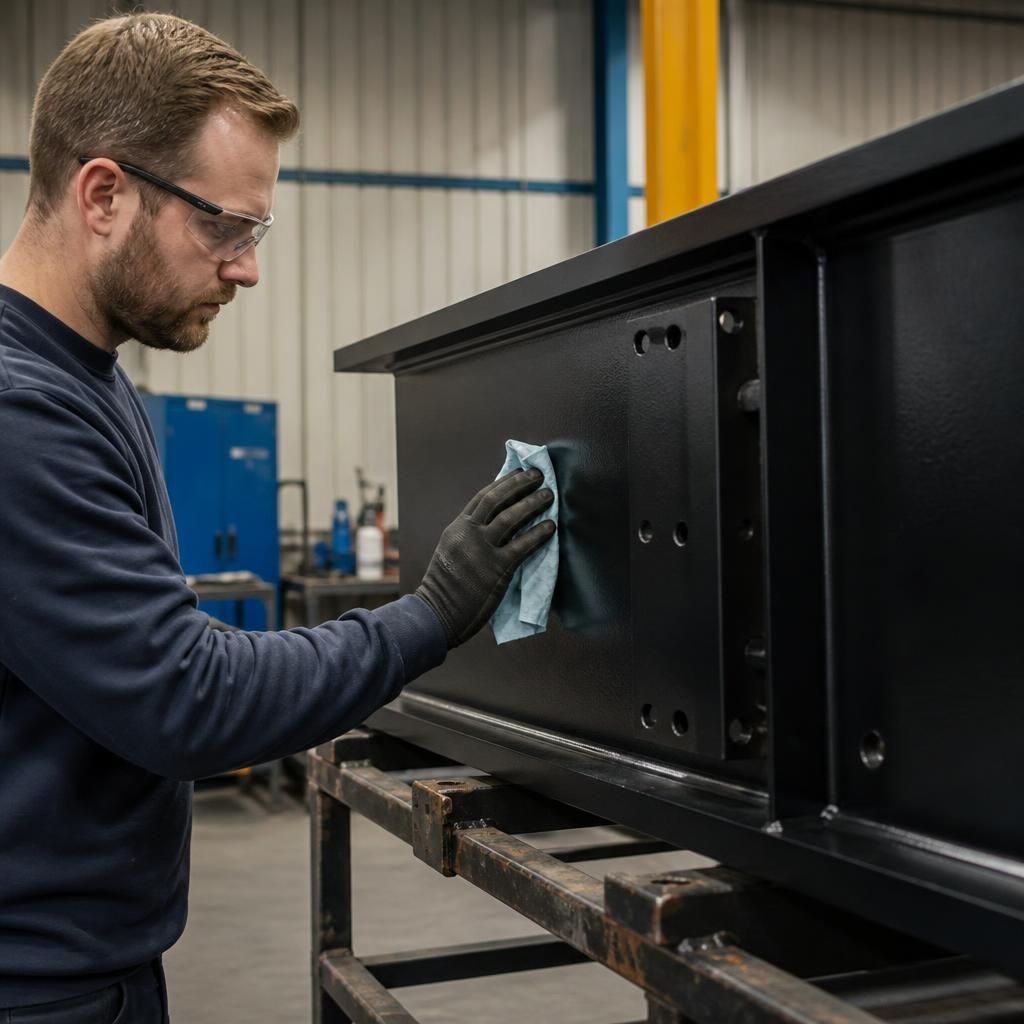
A key benefit of powder coating rusted steel is the comparatively simple routine care required after the finish has been correctly applied. The cured film forms a continuous surface that does not absorb moisture like a porous or deteriorating paint layer, so dirt and surface contaminants can usually be removed with suitable washing rather than frequent recoating.
This does not make the steel maintenance-free. Coated components should still be inspected for chips, deep scratches, exposed edges and areas where corrosion may be developing beneath the film. Prompt attention to local damage helps prevent moisture reaching the steel and preserves the protective value of the coating. Compared with traditional paint systems that may need more frequent touch-ups as the film weathers, a correctly specified powder finish can reduce routine intervention while retaining a clean, consistent appearance.