

What factors should be considered when selecting the appropriate anti-corrosion coating for specific steel applications?
Selecting an anti-corrosion coating for steel depends on the exposure environment, expected moisture and chemical contact, temperature, abrasion or impact, required service life, and the condition and preparation of the steel surface. The coating system should also suit the component’s size and geometry, application method, finish requirements, maintenance arrangements, and any relevant project or industry standards.
The appropriate anti-corrosion coating is selected by matching the complete coating system to the steel substrate, the component’s intended duty, the required performance, and the practical limits of manufacture and maintenance. The correct choice is rarely determined by colour or coating type alone; it depends on how the steel is prepared, which pretreatment is compatible, how the coating will be applied and cured, and how the finished part will be inspected and repaired.
Start with the steel substrate and existing finish
Steel chemistry, surface condition and any existing treatment affect adhesion and corrosion protection. Mild steel, high-strength steel, galvanised steel and previously coated components may require different preparation and pretreatment. A system suitable for bare steel is not automatically suitable for zinc-coated steel or a part carrying residues from fabrication.
Consider whether the component has been welded, laser-cut, drilled, bent or exposed to oils, marking fluids or weld spatter. These features can influence cleaning, edge coverage and the risk of local coating failure. Where a component has been previously painted or treated, the old layer should be identified and assessed for compatibility rather than simply coated over.
Specify the performance requirement, not just the coating name
Anti-corrosion performance should be considered alongside the other properties the finished surface must provide. Depending on the application, these may include:
- adhesion to the prepared steel and resistance to delamination;
- resistance to scratching, chipping and handling damage;
- flexibility where the part may be formed or subject to movement;
- resistance to particular oils, solvents, cleaning agents or process chemicals;
- electrical insulation or conductivity requirements;
- slip, friction or release characteristics; and
- the required appearance, texture, gloss level and colour consistency.
These requirements can point towards different resin chemistries, film builds or multi-layer systems. A coating that provides strong general protection may not be suitable where frequent cleaning, chemical contact or repeated mechanical handling is central to the component’s use.
Assess the whole system, including pretreatment
Corrosion protection is a system rather than an isolated layer. The specification may include degreasing, abrasive preparation, chemical pretreatment, a primer, a topcoat or another combination selected for the substrate and duty. Each stage should be compatible with the next, because poor bonding between layers can become the point at which corrosion develops.
For powder coating, the specification should account for the powder chemistry, target film thickness and curing requirements. The part must be able to reach the required curing conditions without distortion or damage to heat-sensitive sections. Masking may also be needed for earth points, bearing seats, threaded holes, machined faces and areas where dimensional accuracy is critical.
Check the component design before choosing the process
Coating selection should be reviewed against the part’s design and production sequence. Deep recesses, narrow channels, overlapping sections and enclosed areas can affect cleaning, powder coverage and drainage. Poor drainage can leave cleaning chemicals or moisture trapped in the component, while sharp edges may receive less effective coverage than broad faces.
Welds, joints and contact points deserve particular attention. Crevices can retain contaminants and may need design changes, additional sealing or a specified preparation method. Parts that will be assembled after coating should be checked for tolerances, masking requirements and the possibility of damage during assembly.
Consider whether powder coating is technically suitable
Powder coating can provide a hard, consistent finish for many steel components, but the process must suit the part. The component needs to tolerate the curing cycle, and its size, mass and construction must allow the coating to be applied and cured consistently. A powder system may be less suitable where the substrate cannot withstand the process conditions, where very precise local film control is needed, or where the part will be exposed to a combination of conditions outside the coating’s tested capability.
Where a specialist performance is required, the specification may call for a particular powder formulation or a layered system rather than a standard decorative finish. Nylon and other specialist coatings, for example, may be considered where the component needs a different balance of toughness, friction, impact resistance or chemical protection. The selection should be based on documented suitability for the application rather than the finish being described as specialist in general terms.
Use standards and test requirements to define acceptance
A coating specification should state how conformity will be assessed. Depending on the project, this may include checks on surface preparation, coating thickness, cure, adhesion, visual uniformity and the absence of defects such as pinholes, runs, inclusions or areas of missed coverage. Where corrosion testing is relevant, the test method and acceptance criteria should be agreed in advance.
It is also important to distinguish between a laboratory test result and the performance of a finished component. Test panels may not reproduce welds, edges, recesses or assembled joints. For critical applications, representative samples or trial pieces can help confirm that the chosen system works with the actual steel, preparation method and production process.
Allow for transport, installation and future repairs
The coating must remain suitable after the part leaves the applicator. Consider how it will be lifted, stacked, transported and installed, and whether contact with tools, fixings or adjacent materials could damage the surface. If the coating is likely to be cut, drilled or welded after application, the specification should explain how exposed steel will be protected and how local repairs will be made.
Repair materials should be compatible with the original system and should provide a practical method for restoring protection at damaged areas. If replacement or recoating is difficult once the component is installed, a more robust system or additional protection at vulnerable locations may be justified.
Compare options on whole-life suitability
The lowest initial coating cost is not necessarily the most appropriate choice. Compare the expected service requirements with preparation, application, inspection, transport, installation and future repair needs. A coating that is easier to inspect, more compatible with the manufacturing process or less vulnerable to handling damage may offer better whole-life value even if its initial specification is more involved.
A clear coating brief should therefore record the steel type, preparation requirements, coating system, performance properties, finish, areas to be masked, inspection checks and repair approach. For complex or high-value steelwork, discussing the component drawings and production sequence with an experienced powder-coating specialist before manufacture can identify compatibility issues early and prevent an unsuitable system being selected.
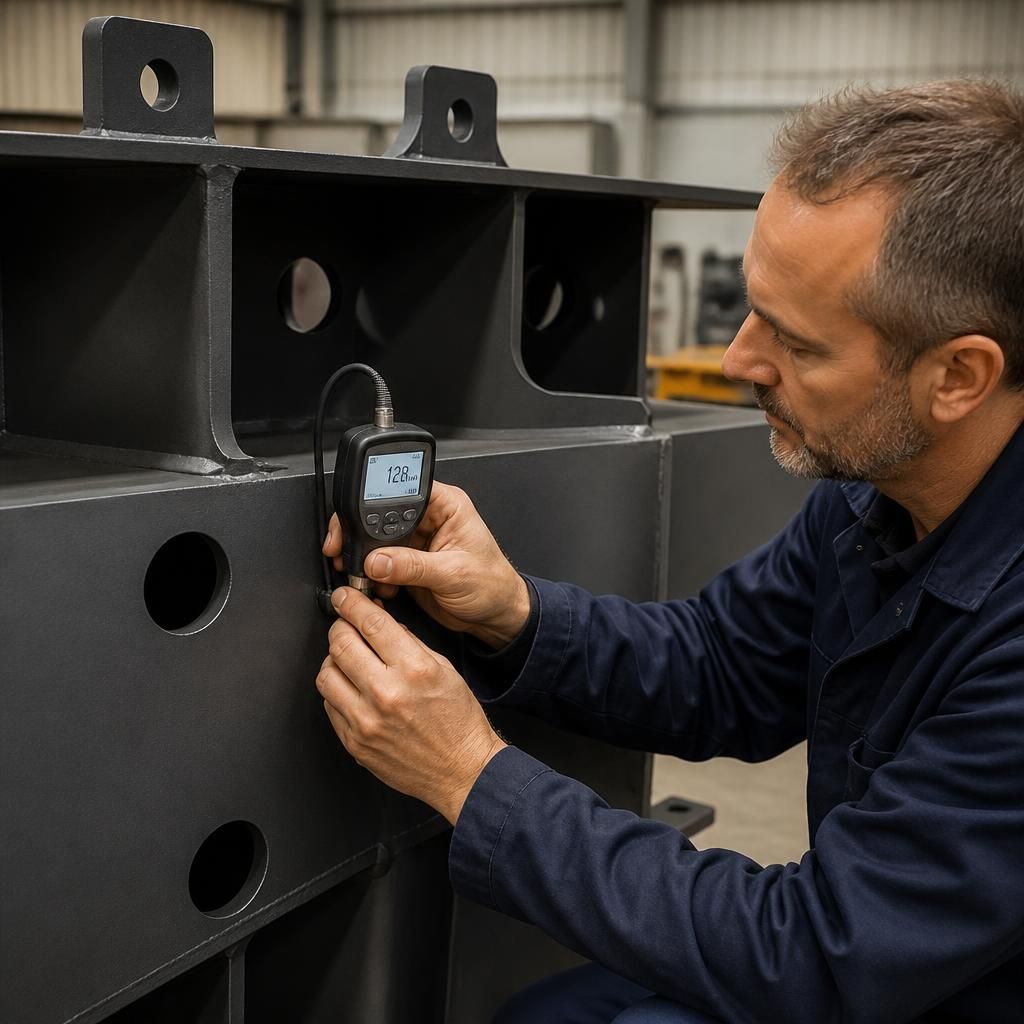
Film thickness should be treated as a controlled design requirement when selecting an anti-corrosion coating for steel. Increasing the coating build does not automatically improve protection: excessive thickness can affect curing, dimensional tolerances, threaded connections and assembly, while insufficient coverage may leave vulnerable areas exposed. The selected system should therefore provide a practical thickness range for the component’s geometry, with particular attention to edges, welds, recesses and areas that must remain dimensionally accurate.
Discuss the right coating for your steel application
Discuss your steel component, service conditions and coating requirements with a powder-coating specialist before finalising the specification. Sharing drawings and details of the intended application can help identify a suitable anti-corrosion coating system and preparation method.