

What specific conditions should be considered when selecting nylon coatings for metal components?
When selecting a nylon coating for metal components, assess the operating conditions first: expected wear, impact, friction, chemical exposure, temperature variation, moisture and contact with other materials. Also consider the component’s geometry, substrate preparation, required coating thickness, surface finish, dimensional tolerances and the demands of its intended application.
The most important selection conditions are the component’s required function, the nylon formulation and application method, compliance requirements, dimensional restrictions and the practical demands of production. A suitable coating must perform as part of the complete component design rather than being chosen solely because nylon is generally tough or abrasion resistant.
Define the primary purpose of the coating. Nylon may be selected to provide a low-friction contact surface, reduce noise, prevent marking between mating parts, add electrical insulation or create a resilient barrier between a metal component and the surrounding equipment. These objectives can require different coating characteristics. For example, a surface intended to support sliding contact may need a different balance of friction and hardness from one intended mainly to cushion impact or isolate components electrically.
Assess the contact conditions. Consider the material touching the coated surface, the contact pressure, the frequency of movement and whether the contact is continuous or intermittent. Nylon can work effectively against some metals, plastics and elastomers, but the pairing should be assessed as a system. A coating that performs well against one counter-surface may not be appropriate where the mating material is abrasive, sharp-edged or likely to transfer debris.
Choose the nylon grade and coating system carefully. Different nylon systems can vary in hardness, flexibility, friction behaviour, impact performance, colour range and resistance to the intended environment. The specification should identify the required grade, application technique and target properties rather than simply stating “nylon coating”. The coating provider may also need to confirm whether the component is suitable for a thermoplastic application and whether the proposed system can achieve the required coverage consistently.
Check dimensional and assembly consequences. Even where the component’s general dimensions have already been established, the coating must be considered in relation to mating parts, press fits, threads, holes, bearing seats and moving clearances. Areas that must remain uncoated may need defined masking, while edges and transitions should be reviewed to prevent interference during assembly. Drawings should show functional surfaces, exclusion zones and any limits for coating build-up.
Account for moisture-related material behaviour. Nylon is not completely dimensionally inert. Its properties can change with moisture uptake, so this matters where the component has close fits, relies on a precise electrical characteristic or operates in a damp environment. The specification should consider the expected moisture state of the finished part and whether dimensional checks need to be made under representative conditions.
Identify exposure beyond the main duty cycle. Ultraviolet light, outdoor weathering, cleaning regimes, disinfectants, oils, fuels and occasional contamination may affect the choice, even when they are not part of the component’s primary function. The relevant exposure should be described in terms of concentration, frequency and contact method where possible. Compatibility should be confirmed for the actual nylon system rather than assumed from the general reputation of nylon as a material.
Include regulatory and sector requirements. Components used in food-processing, medical, electrical, transport or safety-related equipment may need specific evidence concerning chemical constituents, traceability, hygiene, flame behaviour or electrical performance. A coating should not be selected on technical performance alone if the finished part must satisfy a customer specification, industry standard or statutory requirement. Any required declaration or test documentation should be agreed before production.
Consider appearance and identification as functional requirements. Colour may be used to distinguish components, identify inspection status or make damage easier to detect. The specification should state whether colour consistency, gloss, texture or visible surface uniformity is important. Where appearance is secondary, accepting a broader visual range may simplify selection, but this should still be recorded so that cosmetic expectations do not conflict with the engineering requirement.
Plan inspection and acceptance criteria. A clear specification should define the checks that determine whether the coating is acceptable. Depending on the component, these may include coverage, adhesion, coating build, masking accuracy, surface continuity and visual condition. Representative sample parts or test panels can help establish an agreed standard before a larger batch is processed, particularly when the component has several functional surfaces.
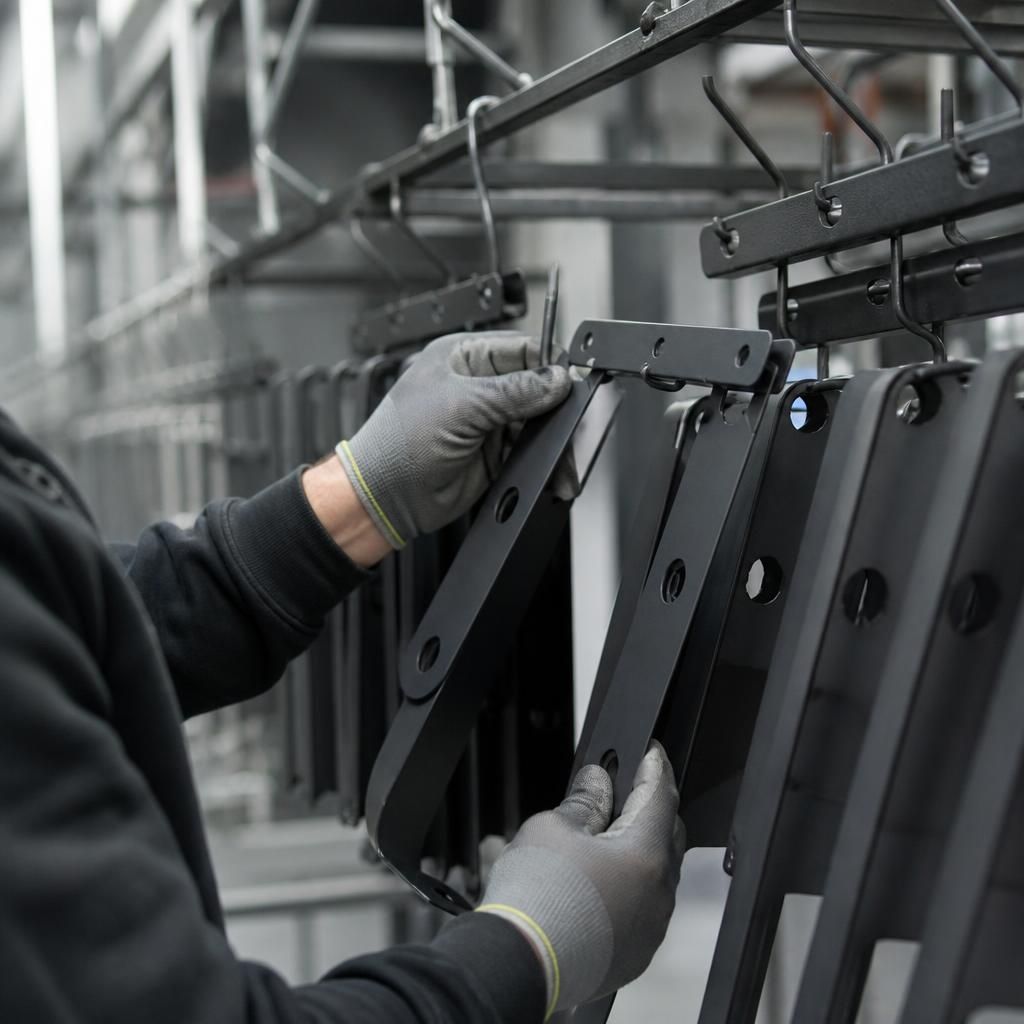
Review production and handling constraints. Part size, weight, quantity, racking points and the ability to handle the component without damaging the coating can influence the practical choice of process. Components should be presented with information about lifting points, protected surfaces and any areas that cannot tolerate contact during processing. For manufacturers and fabricators across the Midlands, discussing drawings, batch requirements and collection or delivery arrangements with a specialist can help establish whether the proposed nylon system is suitable before work is scheduled.
In practice, the selection decision should bring together the operating specification, material compatibility, compliance needs, assembly requirements and inspection method. Providing complete drawings and describing the component’s actual duty allows the coating system to be assessed against measurable requirements instead of relying on a generic nylon specification.
Thermal cycling should be assessed separately from the component’s maximum operating temperature. Nylon and the underlying metal can expand and contract at different rates as the part moves between hot and cold conditions. Repeated cycling may place stress on the coating, particularly around sharp transitions, thin edges, holes and changes in section.
Where this condition applies, selection should consider the full temperature range, the frequency of cycling and the time spent at each temperature. The proposed coating system should then be reviewed against the component’s geometry and bond requirements, with representative testing used where failure at the interface could affect safety, fit or service life.