

What are the primary advantages of using electrostatic epoxy powder coating over traditional liquid coatings for industrial applications?
Electrostatic epoxy powder coating provides a tough, uniform finish with strong resistance to corrosion, chemicals and impact, making it well suited to demanding industrial components. Compared with traditional liquid coatings, the electrostatic process can improve powder transfer, minimise material waste and avoid solvent-based application, while producing a durable coating after heat curing.
For industrial applications, the main advantages of electrostatic epoxy powder coating over traditional liquid coating are more consistent application, efficient film formation, reduced handling of liquid materials and a repeatable production process. Powder is given an electrostatic charge and attracted to an earthed metal component before being cured, allowing the coating system to be controlled as part of a defined manufacturing operation rather than relying solely on wet-film application and evaporation.
More consistent coating thickness
Electrostatic application can produce a controlled, even layer across suitably prepared metalwork. This is particularly useful where appearance, fit or functional performance depends on consistent film build. Liquid coatings can be affected by runs, sags, solvent evaporation and variations in application technique. Powder application reduces these variables when the component geometry, grounding, gun settings and curing conditions are properly managed.
Consistency is valuable for batches of brackets, enclosures, frames, panels and fabricated parts. Components can be assessed against the same preparation and curing requirements, helping manufacturers maintain a repeatable specification between production runs.
Efficient use of coating material
Powder coating is applied as a dry material rather than as a liquid mixture containing a carrier. Overspray can often be collected within a suitable application system, subject to colour, material and contamination controls. This can make material usage easier to manage than a liquid process in which unused mixed coating may become waste once its working life has expired.
The process also avoids the need to manage liquid viscosity in the same way as wet painting. Liquid coatings may require adjustment for temperature, application method or solvent balance, whereas powder is generally specified and applied using equipment settings suited to the product and component. This supports more predictable production control, although the powder type and application parameters must still be matched to the job.
Fewer drying stages before handling
Liquid coatings normally need time for solvents or water to leave the film before the component can be handled, stacked or moved through the next production stage. Epoxy powder coating forms its finished film during a controlled curing cycle. Once the coating has cured and the part has reached a suitable handling condition, the separate air-drying period associated with many liquid systems is avoided.
This can simplify material flow through a factory. It may reduce the need for drying space, protect freshly coated surfaces from accidental contact and make batch scheduling more straightforward. The part must still remain within the required curing conditions; powder coating is not a substitute for correct oven control or adequate heat transfer.
Improved process repeatability
Industrial powder coating can be incorporated into a documented sequence covering cleaning, surface preparation, masking, application, curing and inspection. Key variables include the condition of the metal, powder choice, electrical grounding, spray settings, component temperature and oven performance. Controlling these factors helps reduce variation that might otherwise arise from different operators or changing liquid-coating conditions.
Repeatability is especially important where coated components are supplied in batches or assembled into products made to a common specification. It also makes investigation more practical if a defect occurs, because the coating process can be reviewed stage by stage.
Practical advantages for production environments
- Dry powder is easier to store and handle than open containers of liquid coating and solvent, provided it is kept in the conditions specified by the coating manufacturer.
- There is no wet film to collect dust or suffer certain forms of liquid-flow defect before curing.
- Masking can be used to keep powder away from threads, electrical contact points, bearing seats and other areas that must remain uncoated.
- Automated or semi-automated application can support repeatable coverage on suitable component ranges.
- Colour and finish changes can be planned through equipment cleaning and material-control procedures, although frequent changes can add preparation time.
Potential environmental and workplace benefits
Because powder is a dry coating material rather than a solvent-borne liquid, the process can reduce reliance on solvent storage and handling. It also avoids the routine evaporation of liquid carriers during application and drying. These characteristics can simplify some aspects of workplace control and waste management, but they do not remove the need for suitable extraction, personal protective equipment, housekeeping and safe handling procedures.
The environmental benefit depends on the complete process. Energy used by the curing oven, rejected parts, cleaning materials and powder disposal all need to be considered. A well-controlled application and curing process is therefore more important than simply selecting powder coating in isolation.
Important limitations when making the comparison
Epoxy powder coating is not automatically the best option for every industrial component. The substrate must tolerate the curing temperature, and the part must be suitable for a process involving an electrically conductive surface and oven curing. Large assembled structures, heat-sensitive materials or components that cannot be moved through the application and curing stages may require a different coating approach.
Epoxy systems are also selected primarily for their adhesion, chemical resistance and protective performance rather than for long-term direct exposure to ultraviolet light. Where a component will be used outdoors or exposed to sunlight, the specification should consider whether an epoxy system, a different powder chemistry or a compatible topcoat is appropriate. The intended environment, substrate, required appearance, service temperature and preparation standard should all be agreed before coating.
Overall, electrostatic epoxy powder coating offers its greatest advantage where metal components can be prepared consistently, coated under controlled conditions and cured correctly. Compared with traditional liquid coatings, it provides a more structured and repeatable route to production coating, with practical benefits in material handling, film control and post-application workflow. The correct choice still depends on the component design and the conditions in which the finished part will operate.
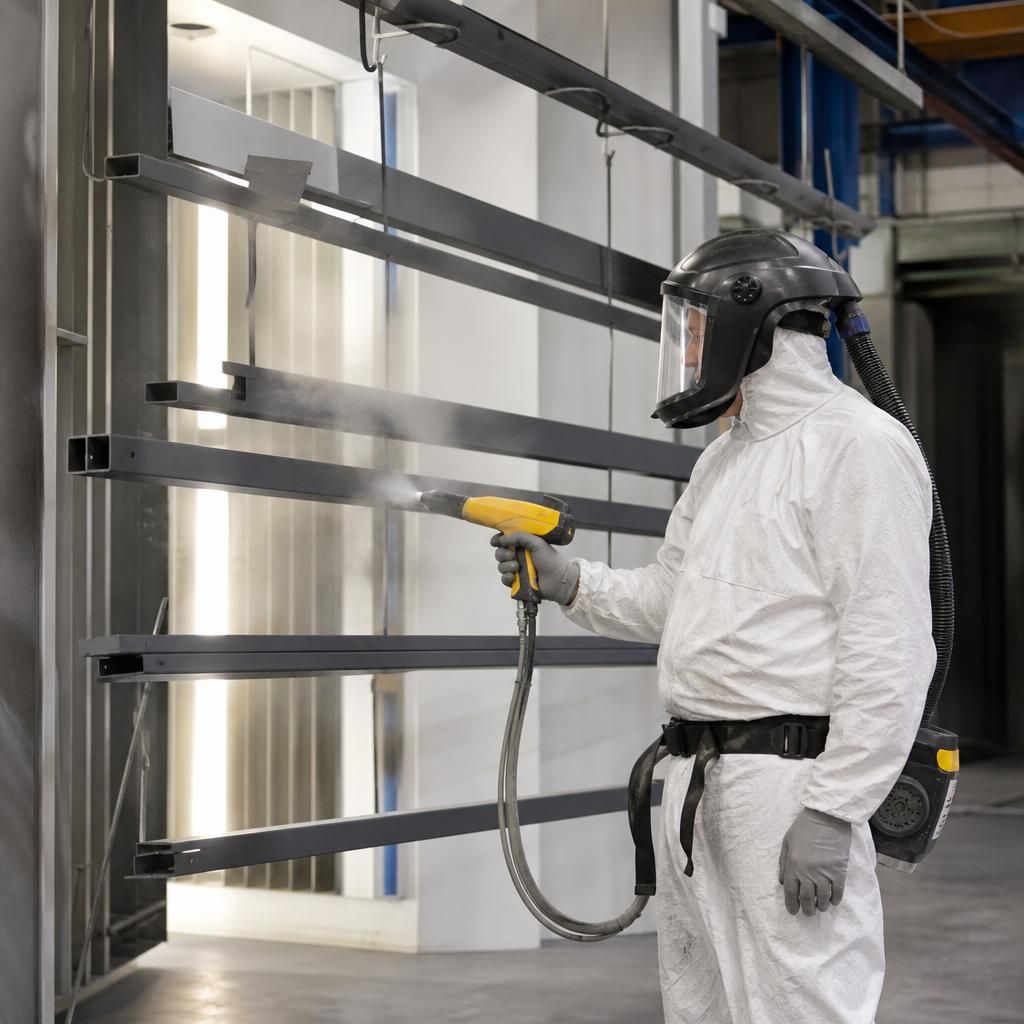
A further advantage of electrostatic epoxy powder coating is that the cured film is a thermoset layer: once the resin has cross-linked in the oven, it does not soften and flow again under normal service conditions. This gives the finished coating a stable film structure and avoids defects associated with solvent release from a wet coating, such as solvent entrapment, bubbling or lingering odour.
This characteristic is particularly relevant to enclosed metalwork, fabricated assemblies and components that need a clean, fully cured surface before handling or installation. The benefit depends on correct powder selection, substrate preparation and oven curing; under-cured powder will not deliver the intended film performance.
Discuss your electrostatic epoxy powder coating requirements
Discuss your electrostatic epoxy powder coating requirements with the team, including the substrate, component dimensions, operating environment and required finish. This information helps establish whether the process is suitable and what preparation and curing specification the parts require.