

What specific benefits does powder coating provide over traditional painting methods for aluminium frames and parts?
Powder coating provides aluminium frames and parts with a tougher, more consistent finish than traditional liquid paint, improving resistance to corrosion, impact, abrasion and weathering. Its durable surface generally requires less maintenance and helps retain the component’s appearance for longer.
For aluminium frames and parts, powder coating offers more controlled application, more uniform coverage and a lower-solvent finishing method than traditional liquid painting. The coating is applied as a dry powder, electrically attracted to the prepared aluminium and then cured under heat, creating a continuous film that is firmly bonded to the surface.
A key advantage is consistency across repeated components. Liquid paint can be affected by brush marks, spray overlap, runs, sags and changes in solvent evaporation. Powder application is better suited to controlled production because the coating can be applied to a specified film build and cured under defined conditions. This helps produce a repeatable finish across batches of frames, brackets, panels and other aluminium parts, provided the components are correctly prepared and the curing requirements are matched to the powder system.
Powder coating can also cover profiles and formed parts more evenly than many manual painting methods. The electrostatic process helps powder adhere to exposed surfaces before curing, including sections that may be difficult to coat consistently by brush or conventional spray. Design details still matter: deep recesses, sharp internal corners, Faraday-cage areas and areas that must remain uncoated may require specialist application techniques and masking.
The dry application method changes how the coating behaves during production. Unlike liquid paint, powder does not rely on a solvent evaporating from the wet film, so there is no wet coating to drip or flow while the part is being moved into the curing stage. Correctly applied powder can therefore reduce handling-related surface defects. Excess powder may also be collected in suitable systems, although recovery and reuse depend on the equipment, powder type and colour-management requirements.
Powder coating is often practical for batch production because the process combines application and curing into a defined finishing cycle. It can reduce the number of separate paint coats needed for some specifications, while avoiding the drying intervals associated with multiple liquid layers. The exact result depends on the powder formulation, pretreatment, specified coating thickness, component design and oven capabilities.
- Uniform appearance: controlled spraying and curing help maintain an even finish across repeat components.
- Strong substrate preparation: aluminium can be chemically or mechanically pretreated before coating, improving the foundation for the finish.
- Reduced solvent use: powder is applied without the liquid solvents used in conventional wet paint systems, although the full environmental profile also depends on pretreatment, curing energy and waste handling.
- Efficient production handling: the coating is cured as a dry film rather than being moved as a wet surface, reducing the risk of some wet-paint application defects.
- Specification flexibility: powder systems are available for different performance requirements, surface effects and operating conditions, subject to compatibility with the aluminium component and its intended use.
Traditional painting can still be preferable for components that cannot tolerate the heat of a curing oven, for on-site repairs or for very small isolated areas. Powder coating also requires careful control of pretreatment, masking, grounding and cure temperature; a high-quality result is not achieved simply by applying powder to untreated aluminium. The comparison should therefore consider the part geometry, batch size, required specification, repair method and service conditions, rather than treating powder coating as a universal replacement for liquid paint.
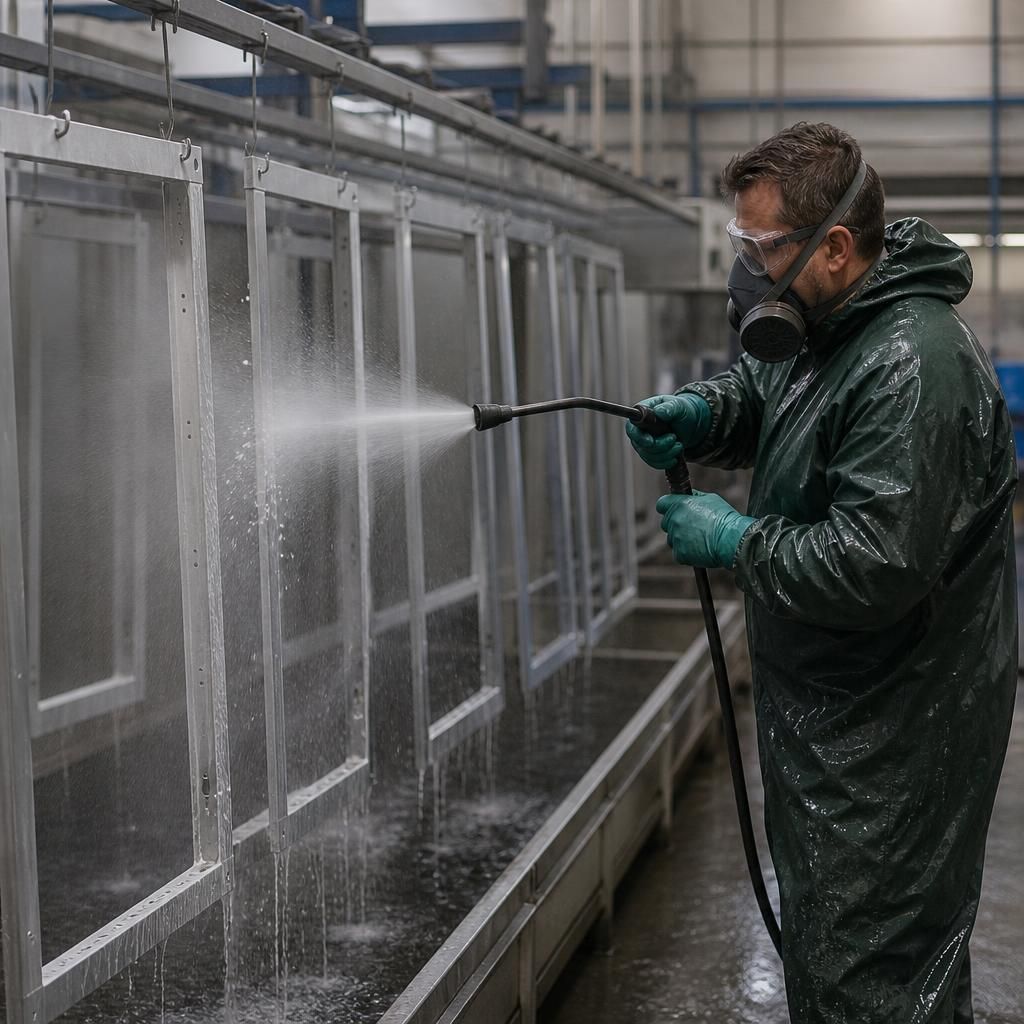
A further benefit of powder coating is that the system can be selected for the chemical conditions around the aluminium frame or part. Where components may encounter oils, detergents, moisture or other industrial contaminants, a suitable powder formulation can provide better resistance than a general-purpose decorative paint. This helps the finish remain serviceable during routine cleaning and handling, provided the coating specification matches the exposure.
This advantage depends on more than the powder itself. Aluminium pretreatment, correct film thickness, complete curing and compatibility with the cleaning products or chemicals must all be considered. A coating specialist can therefore assess the part’s operating environment rather than treating every aluminium component as suitable for the same paint system.