

What are the specific coating options available for aluminium sheets and coils to meet both aesthetic and functional requirements?
Aluminium sheets and coils can be finished with exterior-grade polyester powder coating, epoxy or epoxy-polyester systems for more specialised functional performance, and protective nylon coatings where enhanced wear or chemical resistance is required. Aesthetic choices include a wide range of colours, gloss levels and textures, while the coating specification should reflect the expected exposure, durability and end use.
The appropriate coating for aluminium sheets and coils depends on the balance between appearance, weathering, chemical exposure, wear, forming and fabrication requirements. The main options are differentiated by resin chemistry, primer or pre-treatment, surface effect and the level of protection required, rather than by colour alone.
Exterior polyester systems are commonly specified where the aluminium will face sunlight, rain and changing temperatures. They are available in standard and enhanced-durability grades, allowing the specification to reflect the expected exposure and the required retention of colour and finish. These systems are suitable for many architectural panels, fascia components, enclosures and fabricated parts, provided the preparation and application process are appropriate for the intended environment.
Epoxy-based coatings are selected primarily for functional protection. They can provide useful resistance to oils, solvents, moisture and many industrial chemicals, making them relevant to interior components, plant equipment and parts exposed to demanding service conditions. Epoxy is not normally the first choice for prolonged direct sunlight because its appearance can chalk or lose colour more readily than an exterior-grade polyester system. It is therefore important to distinguish between chemical resistance and long-term UV performance when choosing the specification.
Epoxy-polyester hybrids combine characteristics from both resin types. They can offer a practical balance of hardness, adhesion and general chemical resistance for indoor applications, while providing a broad choice of decorative finishes. They are often considered for equipment housings, shelving, cabinets and fabricated components that are not subject to severe outdoor exposure.
Nylon coatings are used where resistance to friction, impact, abrasion or repeated handling is more important than a purely decorative finish. Nylon can be suitable for components that slide, rub or come into contact with other parts. The correct grade still depends on the load, operating temperature, chemicals and type of contact involved; a coating described as wear-resistant should not automatically be treated as suitable for every high-abrasion application.
Specialist primers and pre-treatment layers may be included where additional adhesion or corrosion protection is needed. Aluminium requires preparation that removes contamination and creates a suitable surface for the coating system. A primer can support adhesion and provide an additional barrier, particularly where the finished component will be exposed to moisture, salts or aggressive service conditions. It should be specified as part of a compatible system rather than added without checking the relationship between pre-treatment, primer and topcoat.
Finish selection can be divided into several separate choices:
- Colour: standard colours are available alongside closer colour matches for projects with defined design or corporate requirements. The selected colour should be assessed for its suitability to the exposure, as darker finishes can absorb more solar heat.
- Gloss level: gloss, satin and matt surfaces produce different visual effects and differ in how readily they show handling marks, surface irregularities and accumulated dirt.
- Texture: fine textures, coarse textures and wrinkle effects can alter the appearance and tactile feel of the aluminium. Textured finishes may also help disguise minor visual variation in the underlying sheet.
- Metallic and special-effect finishes: these can create a distinctive appearance, but application and touch-up requirements may be more demanding than for a plain colour. Batch consistency and viewing direction should be considered where adjacent panels must appear uniform.
- Clear finishes: a clear topcoat can be considered where the appearance of the substrate or an underlying effect needs to remain visible, although the complete system must still be assessed for UV, chemical and handling resistance.
The aluminium’s end use also affects whether the coating should be applied before or after forming. Coating flat sheet first can be appropriate where the finished item has simple folds and the process will not excessively stretch or damage the film. Fabricating first and coating afterwards can protect cut edges, drilled areas and formed surfaces more consistently, although the part must be suitable for the coating line and any masking requirements.
For coils, the specification should take account of how the material will be unwound, processed, cut and handled. A coating that performs well on a static sheet may not be appropriate if the coil will be slit, roll-formed or subjected to tight bending. The required flexibility, hardness and resistance to marking should therefore be agreed alongside the forming process. Coating thickness also needs to be controlled consistently: excessive build can affect bends, edges, dimensions and the appearance of assembled components, while insufficient build may reduce protection.
When comparing options, provide the coater with the intended location, forming method, cleaning regime, likely chemical exposure, contact with other materials and the required appearance. A practical specification should identify the aluminium alloy and condition, pre-treatment, coating chemistry, colour, gloss, texture, acceptable surface variation and any testing or sample approval requirements. This prevents an attractive finish being selected that is unsuitable for fabrication or service conditions.
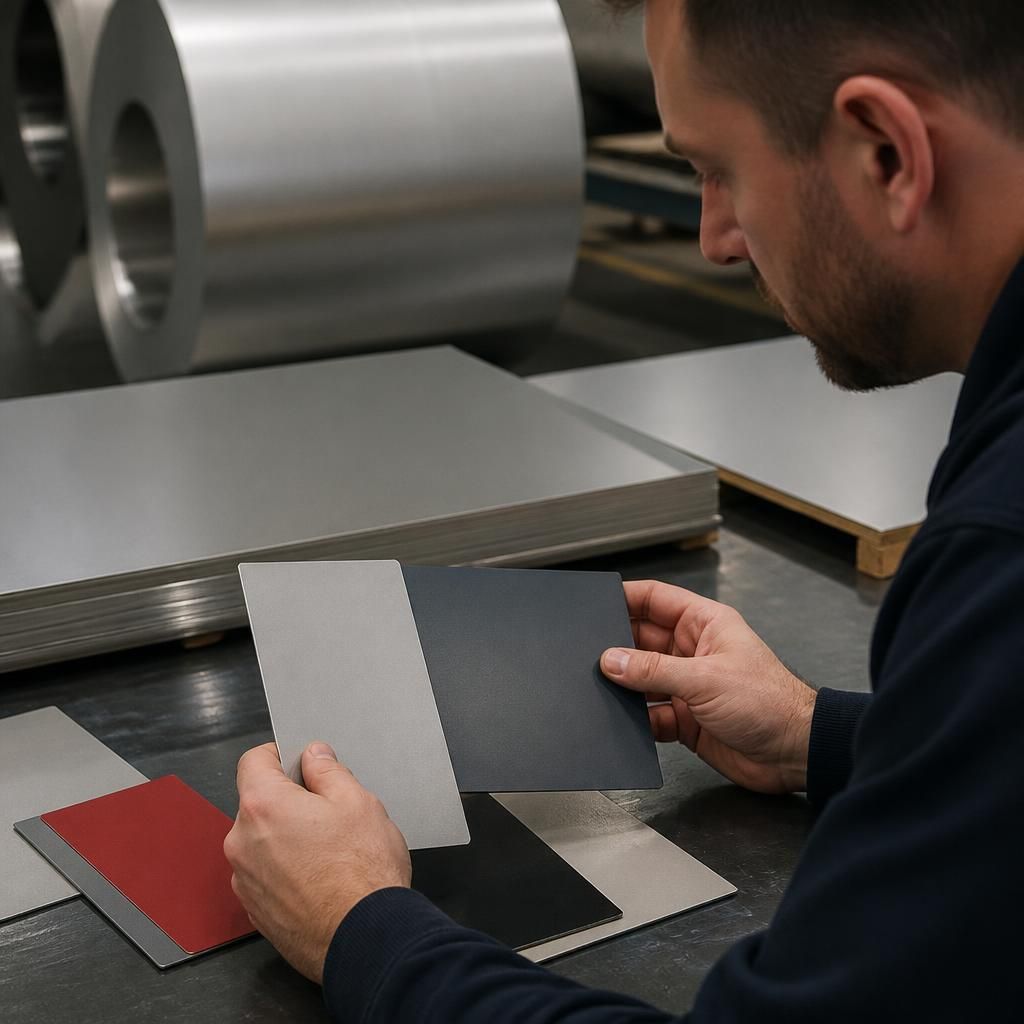
A representative sample panel should be used to approve an aluminium coating before production. Colour charts cannot show how the chosen resin, gloss level or texture will appear on the actual alloy and surface preparation.
- Assess the colour and finish under the lighting in which the finished component will be viewed.
- Inspect the coating after the planned bending, cutting or forming process for cracking, marking or visible variation.
- Check whether the surface effect remains consistent across adjacent sheets or coil-processed sections.
- Where functional resistance is important, agree suitable checks for the expected cleaning agents, chemicals, handling or contact conditions.
Documenting the approved sample, including acceptable visual variation and the intended processing route, gives the coater a clear reference for subsequent batches. This is particularly useful for metallic, textured or special-effect finishes, where appearance can be more sensitive to application and viewing conditions.