

What factors should be considered when selecting the ideal finish for powder coated aluminium profiles in industrial applications?
Selecting the ideal finish for powder coated aluminium profiles depends on the service environment, required resistance to corrosion, chemicals, abrasion and UV exposure, as well as the desired colour, gloss and texture. The specification should also account for profile preparation, application conditions, dimensional requirements and any project standards or compliance obligations.
The ideal finish for powder coated aluminium profiles is the one that meets the profile’s functional, dimensional, visual and production requirements without compromising assembly or long-term serviceability. Selection should therefore be based on the complete component design, not on the coating colour or resin type alone.
Start with the profile’s geometry and intended use. Long extrusions, hollow sections, deep channels, sharp internal corners and closely spaced features can affect powder deposition and coating uniformity. Consider which faces will remain visible, which areas will be enclosed, and where the profile will be cut, drilled, joined or handled. A finish that is suitable for a simple flat section may be less appropriate for a complex extrusion unless the application method and racking arrangement can provide consistent coverage.
Check dimensional and assembly tolerances. Powder coating adds a measurable layer to the profile, which can influence sliding fits, press fits, telescopic sections, threaded features and close-fitting joints. Allowances may also be needed around apertures, mating faces and areas that must remain electrically conductive. Masking requirements should be identified on the drawing, including threads, bearing surfaces, earth points and locations where adhesives or seals will be applied.
Assess interaction with other components. The finish must work with the rest of the assembly. Review compatibility with rubber seals, gaskets, tapes, adhesives, lubricants and cleaning products used during manufacture or service. Where aluminium profiles meet steel or other dissimilar metals, the design should also consider electrical contact, moisture retention and the possibility of corrosion at the joint. In some applications, a fully coated surface is not the correct solution; controlled masking or a defined contact area may be required.
Define the appearance in a way that can be inspected. A general description such as “standard finish” is rarely precise enough for a multi-part industrial project. Specify the approved colour reference, surface character, acceptable variation and the viewing conditions under which the finish will be assessed. Where profiles are supplied in separate batches or installed beside existing components, an approved sample panel can provide a more useful reference than a catalogue image. The specification should also state how visible rack marks, minor surface variation and repaired areas will be treated.
Consider production repeatability. The selected finish should be achievable across the required profile length, batch size and component mix. Ask how the coater will manage:
- racking and contact points;
- masking of critical features;
- consistent coverage on internal and external surfaces;
- separation of different components within a batch; and
- identification and traceability of completed work.
These points are particularly important where profiles form a visible group, because small differences between batches can be more noticeable after installation than during isolated inspection.
Match the finish to the profile’s maintenance and repair strategy. Some components can be removed and recoated, while others are permanently built into a larger structure. For fixed installations, establish how minor damage will be identified and repaired, whether replacement sections can be matched later, and which repair materials are acceptable. The original coating specification, approved sample and batch records should be retained so that future work can be compared with the installed finish.
Use a clear technical specification. The purchase information should identify the aluminium profile, coated surfaces, masking zones, required coating system, thickness requirement, appearance reference, inspection method and acceptance criteria. Drawings should show areas that must remain free from coating and any surfaces requiring special handling. If the profile is safety-critical, forms part of a tested assembly or must meet a project-specific standard, those requirements should be agreed before production rather than left to interpretation.
For unusual sections or high-value production runs, a representative trial or sample approval can confirm coverage, fit and appearance before the full batch is processed. A coating specialist can review the profile drawings and intended assembly to identify areas where geometry, tolerances or component compatibility could affect the choice of finish.
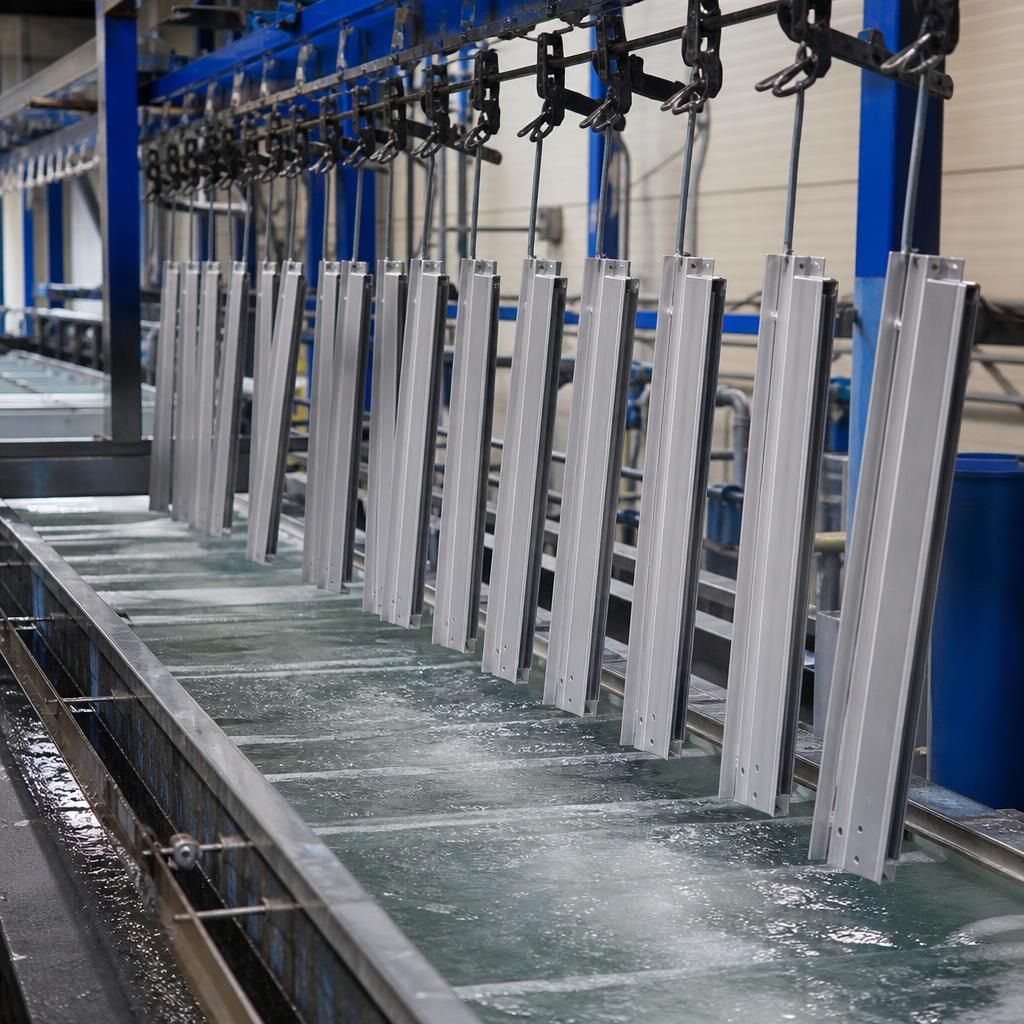
For powder coated aluminium profiles, substrate preparation and pretreatment beneath the powder are as important as the visible topcoat when selecting a finish. Aluminium can carry oils, extrusion residues and surface oxides that affect adhesion if they are not removed or controlled before coating.
The specification should therefore identify a pretreatment suitable for the aluminium alloy, profile condition and intended service environment. It should also take account of handling between preparation and coating, because contamination after cleaning can undermine an otherwise suitable finish. Where profiles will face condensation, pollutants or frequent cleaning, the preparation stage deserves particular attention rather than relying on the powder formulation alone.
Ask the coater to explain how preparation, rinsing, drying and coating will be controlled for the profile design and batch requirements. A finish should be assessed as a complete system—aluminium substrate, pretreatment and powder—not as an isolated colour or resin choice. This approach helps distinguish a specification that is technically suitable from one that only appears suitable on paper.
Discuss Your Aluminium Profile Finish Requirements
Discuss your aluminium profile finish requirements with a powder coating specialist and provide the relevant drawings, service conditions and project standards for review. This can help confirm that the proposed finish is suitable for the intended industrial application.