

What are the key factors that ensure the longevity and quality of polyester powder coated aluminium?
The longevity and quality of polyester powder coated aluminium depend on suitable alloy selection, thorough surface preparation, correct powder application and controlled curing. Environmental exposure, coating specification, edge and joint treatment, inspection and appropriate maintenance also determine how well the finish performs over time.
Long-term performance depends on treating the coating as part of the component’s design and supply chain, rather than as an isolated decorative layer. In addition to the core coating process, the most important influences are component geometry, compatibility between adjoining materials, powder chemistry, batch control, dimensional requirements, handling and installation.
Component design and drainage: Aluminium parts should be designed so that water, dirt and contaminants cannot remain trapped against the coated surface. Enclosed sections, overlapping joints, narrow gaps and poorly positioned holes can create localised deterioration even where the visible faces remain sound. Drainage and ventilation provisions also help prevent moisture being retained during storage, transport and service. Designers should consider how the coating will behave around folded corners, recesses, apertures and fixing points, rather than assessing only the largest flat face.
Compatibility with adjoining materials: Polyester-coated aluminium is often assembled with fasteners, brackets, seals, plastics or other metals. These materials should be selected so they do not damage the finish chemically or mechanically. Particular care is needed where dissimilar metals may remain in contact in the presence of moisture, as this can encourage galvanic corrosion at interfaces. Washers, isolating components and compatible sealants can help protect joints, provided they are suitable for the intended service conditions.
Powder chemistry and appearance requirements: The polyester system needs to match the component’s intended use and the required appearance. Resin selection influences flexibility, hardness, weathering behaviour and resistance to chemicals, while pigments affect colour stability and visual consistency. Gloss level, texture and colour should be defined before production because these characteristics can alter the perceived uniformity of a finished assembly. A textured coating may disguise minor surface variation but can also make colour comparison more difficult than with a smooth finish.
Colour and batch consistency: When a project includes numerous parts or deliveries, consistency is affected by powder batch, substrate condition, component orientation and production settings. Parts that will be viewed together should be planned as a coordinated group. Retaining an agreed reference sample and recording the relevant powder identification helps reduce avoidable variation between production runs. This is especially important where replacement parts may be required later, since a nominally identical colour can appear different if its gloss or texture changes.
Racking, masking and dimensional control: The way a part is supported during coating affects contact marks, concealed areas and the position of uncoated points. Masking may be required for threads, bearing seats, earth points, precision bores and mating surfaces. These details should be identified on drawings before manufacture, including acceptable coating build and clearance tolerances. A finish that looks uniform on an external face may still prevent correct assembly if coating is allowed to enter a tight-tolerance interface.
Control of the complete production batch: Quality is more reliable when parts are grouped according to compatible dimensions, colours, textures and processing requirements. Mixing components with substantially different mass or geometry can make it harder to maintain a consistent result across the whole load. Clear part identification, agreed acceptance criteria and production records provide traceability if a question arises about a particular batch. For repeat work, retaining approved samples and process information supports closer comparison between orders.
Handling and packaging: A sound coating can be damaged after production by metal-to-metal contact, abrasive packing materials, straps, forklift handling or premature stacking. Components should be allowed to reach a suitable handling condition before they are packed, and packaging should separate faces that may rub together. Corners, holes and projecting features deserve particular protection because they are common points of impact during transport. Packaging should also prevent contamination without trapping moisture against the finished aluminium.
Installation and later fabrication: Drilling, cutting, grinding and welding after coating create exposed areas and can introduce heat or debris to nearby surfaces. Wherever possible, operations that alter the component should be completed before coating. If site modification is unavoidable, the resulting exposed areas need a compatible repair approach agreed with the coating specialist; ordinary paint is not automatically an equivalent repair. Installers should use clean, non-abrasive equipment and avoid dragging coated parts across one another.
Evidence of conformity: For industrial projects, the coating requirement should be supported by clear documentation covering the specified system, colour or texture, component identification and agreed acceptance criteria. This information helps the coater, fabricator and installer work to the same definition of quality. It also makes future replacement, investigation or refurbishment more straightforward without relying solely on visual memory.
In practice, the strongest results come from coordinating design, material interfaces, appearance control and post-coating handling at the quotation and drawing stage. Polyester powder coating can then be assessed not only by how it looks when it leaves production, but by whether the finished component remains compatible, serviceable and consistent throughout its intended use.
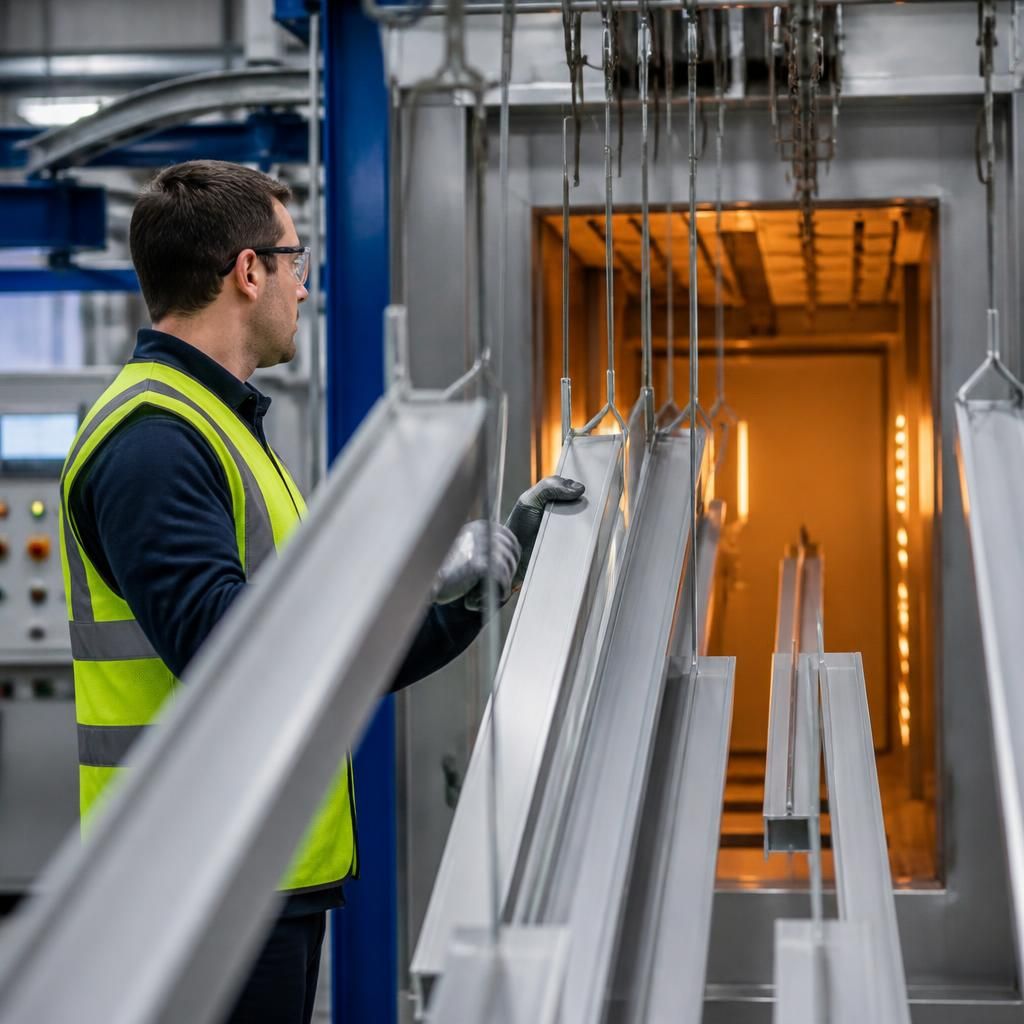
Surface preparation and curing are two process controls that directly affect the longevity of polyester powder coated aluminium. Before powder is applied, the aluminium must be free from oil, dirt, oxidation and other contaminants. A suitable chemical pre-treatment can create a stable surface for the powder to bond to, helping reduce the risk of adhesion failure and corrosion developing beneath the coating.
Curing must then be controlled according to the powder manufacturer’s requirements, with the aluminium reaching the required temperature for the specified period. Oven air temperature alone does not confirm that the component has cured correctly, particularly where sections vary in thickness or mass. Insufficient curing can leave the film vulnerable to damage, while excessive heat may affect colour or finish. Monitoring the process on representative parts helps confirm that the coating has developed the intended hardness, adhesion and resistance.
Discuss your polyester powder coated aluminium requirements
If you are specifying polyester powder coated aluminium, discuss your component details, service environment and finish requirements with a coating specialist before production. This allows the coating system and acceptance criteria to be considered alongside the part’s intended use.