

How does the pretreatment process affect the longevity and quality of aluminium powder coatings?
Pretreatment determines how well powder coating bonds to aluminium and how effectively the finished surface resists corrosion and service-related damage. Cleaning, deoxidising and applying a suitable conversion coating create a stable surface for the powder, improving adhesion, finish consistency and long-term coating performance.
Pretreatment affects aluminium powder coating by controlling the condition, chemistry and cleanliness of the metal immediately before powder application. A correctly specified and controlled process reduces coating defects, supports consistent film formation and helps the finished component withstand moisture, handling and service exposure for longer.
The required treatment depends on the aluminium alloy, the component’s previous use, its geometry and the environment in which it will be installed. Extrusions, castings and fabricated assemblies can present different levels of oxide, lubricant, marking ink, weld residue and embedded dirt. A process suitable for one type of aluminium may be unsuitable for another, so pretreatment should be selected against the substrate and the intended service conditions rather than treated as a standard wash applied to every part.
Surface preparation also affects the uniformity of the coating. Residues left in recesses, around joints or inside hollow sections can cause localised defects that may not be visible until the part is in service. Sharp edges, drilled holes, welds and overlapping joints require particular attention because they can retain contamination or allow moisture to reach beneath the coating. Components should therefore be designed, presented and processed so that all relevant surfaces can be reached, rinsed and dried effectively.
- Degreasing: removes oils, lubricants and handling residues that can interfere with the powder film.
- Etching or deoxidising: treats the natural aluminium oxide layer and helps provide a more consistent surface condition.
- Conversion treatment: modifies the surface to improve resistance at the coating interface and reduce the risk of under-film deterioration.
- Rinsing: removes spent chemicals and soluble residues that could otherwise cause staining, blistering or loss of coating performance.
- Drying: prevents trapped water or process chemicals from affecting powder application and curing.
Rinsing quality is particularly important. If chemical residues remain on the metal, they can contribute to discolouration, surface deposits or osmotic effects beneath the coating. Water quality, rinse stages, drainage and the time between treatment and powder application all influence the result. Components should leave the pretreatment line free from visible residue and should not be handled in a way that reintroduces grease, dust or moisture.
Process control matters as much as the treatment type. Concentration, temperature, contact time and solution condition need to remain within the operating range specified for the process. If treatment is too mild, contaminants or unstable oxide may remain. If it is too aggressive, the aluminium can become excessively etched, dimensions can be affected on precision parts, and the resulting surface may be uneven. Regular checks and documented control of the stages help maintain repeatable results across production batches.
The condition of the incoming component should also be assessed before coating. Heavy oxidation, corrosion, silicone contamination, adhesive residue or transport damage may require additional preparation before the normal pretreatment sequence. Pretreatment cannot reliably correct poor fabrication practices, inaccessible surfaces or contamination that has penetrated into porous castings. Early inspection allows unsuitable parts or required preparation work to be identified before they reach the coating stage.
Its effect on quality can be seen in several ways:
- More consistent appearance across a batch, including fewer dull patches, stains and visible surface variations.
- Lower risk of pinholes, craters, blistering and other defects caused by contamination or retained moisture.
- Better edge and recess performance where poor preparation would otherwise create vulnerable areas.
- More reliable resistance to corrosion, abrasion and repeated handling during the component’s working life.
- Fewer failures at inspection or during service, reducing the likelihood that parts will need stripping and recoating.
After pretreatment, the aluminium should be inspected before powder is applied. Checks may include visual examination for stains, water breaks, residues and missed areas, together with confirmation that the component is dry and suitable for the next stage. Where a project has defined performance requirements, representative testing can assess the complete system rather than relying on appearance alone. Useful checks may include cross-cut adhesion, coating thickness, impact resistance and exposure testing, selected according to the component’s use and specification.
Pretreatment does not compensate for an unsuitable powder, incorrect film thickness or inadequate curing; coating performance depends on the complete system. However, even a correctly applied powder can fail prematurely if the aluminium beneath it has been poorly prepared. For durable, consistent aluminium powder coatings, the pretreatment specification should therefore cover the alloy, component design, contamination risk, chemical stages, rinsing, drying, inspection and any required performance tests.
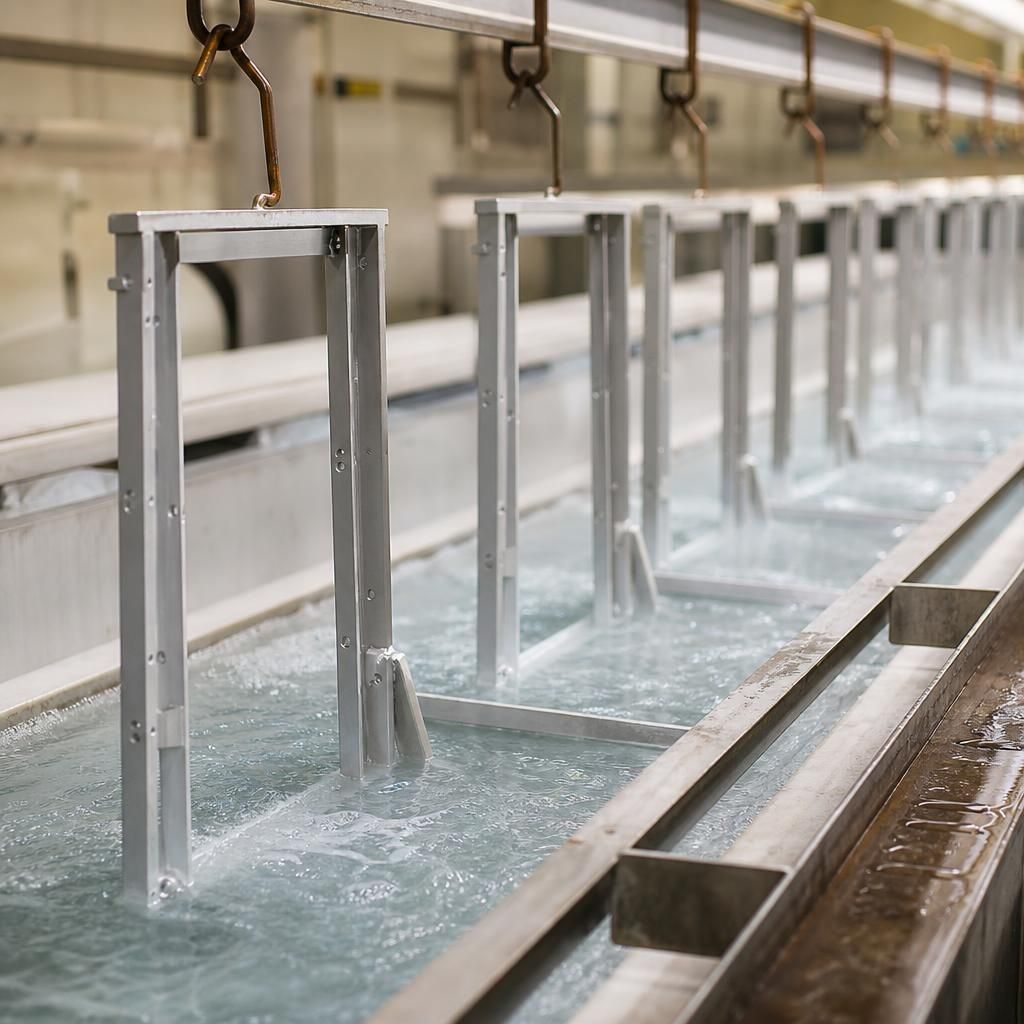
The conversion stage is important because it creates the interface between the aluminium and the powder film. Rather than relying solely on the coating to grip the metal, the treatment changes the surface chemistry so the first layer of powder can form a more stable bond during curing. This is particularly significant where components are exposed to condensation, outdoor moisture or repeated cleaning.
A conversion layer must be continuous and compatible with the chosen coating system. Bare patches, excessive build-up or poor coverage can create local differences in adhesion and corrosion resistance, even when the finished colour and gloss appear consistent. For this reason, pretreatment selection should be confirmed against the aluminium grade, the powder specification and the component’s intended environment before full production.
Discuss Your Aluminium Pretreatment Requirements
If you are planning aluminium powder coating, discuss the alloy, component design and intended service environment with our team before production. We can help identify the pretreatment considerations and inspection requirements relevant to your coating specification.