

What are the most common environmental conditions that could lead to powder coating failures, and how can they be controlled during the application process?
Powder coating failures can result from excessive humidity, airborne dust, inadequate ventilation, temperature variation and contamination in the application area. Control these conditions by keeping the workspace clean and dry, monitoring ambient and substrate temperature, maintaining suitable airflow, and preventing moisture or contaminants from reaching the prepared metal and uncured powder.
Environmental powder coating failures occur when moisture, temperature, airborne particles, airflow, compressed air quality or surrounding contamination interferes with powder deposition, melt flow, curing or adhesion. Effective control therefore involves more than measuring room humidity: the metal, powder, application equipment and curing environment must all remain within conditions that allow a consistent film to form.
Condensation is a particular risk. A component can appear dry while its surface temperature is close to the dew point, allowing a microscopic film of moisture to form during handling or spraying. This can cause poor adhesion, pinholing, blistering or localised corrosion beneath the coating. The substrate temperature should be assessed as well as the general room temperature, especially where parts have been stored in a cold area, brought in from outside or placed near doors and unheated surfaces. Coating should be postponed until the metal is dry and safely above the dew point, with the condition checked again if the environment changes.
Relative humidity readings should be interpreted alongside substrate temperature and the condition of the prepared surface. A single reading taken away from the workpiece may not represent the conditions at the spray position. Monitoring at relevant points in the process helps identify changes caused by incoming materials, open doors, washing operations or changes in the building environment. Records are useful when investigating defects because they can show whether a problem occurred during preparation, application or curing.
Air movement must be stable rather than simply strong. The extraction system should remove overspray without disturbing the powder cloud around the component. Excessive or uneven airflow can pull powder away from edges, create differences in film build and introduce particles from adjacent areas. Insufficiently controlled airflow can allow overspray to settle on the workpiece or leave powder suspended in the booth. The booth layout, extraction balance, part position and hanging method should be assessed together, particularly for deep recesses, large panels and complex fabrications.
The application area should also be separated from activities that generate unwanted material. Grinding, welding, shot blasting, cutting and sanding can release dust, fibres or hot particles that settle on prepared metal or become trapped in uncured powder. Physical separation, suitable cleaning between processes and controlled movement of people and components reduce this transfer. Floors, ledges, booth surfaces, racks and conveyor parts should be cleaned using methods that do not simply redistribute dust into the spray zone.
Compressed air is an often-overlooked environmental input. Water, oil or particles carried through the air line can reach the powder or coated surface and create craters, fisheyes, pinholes or adhesion defects. Filters, separators and drains must be appropriate for the equipment and maintained so that collected moisture and oil cannot be carried downstream. Air quality should be checked at the point of use rather than assumed from the condition of the compressor, since pipework and storage vessels can introduce additional contamination.
Temperature affects the powder and the metal in different ways. Cold components can alter powder charging and deposition, while warmer components may change how powder begins to flow before entering the oven. Excessively warm surrounding surfaces, direct sunlight or heat from nearby equipment can create local variations in film behaviour. Components should be allowed to reach a stable, suitable condition before spraying, and the route from preparation to application should avoid unnecessary exposure to changing environments.
Electrostatic application is also affected by the condition of the workpiece and its connection to earth. A clean, reliable earth path helps powder transfer consistently to the metal. Paint build-up on hooks, racks or contact points can interrupt that path, producing uneven deposition, back-ionisation or poor coverage in particular areas. These issues may appear to be environmental because they vary with booth conditions, but they should be checked alongside humidity, airflow and contamination controls.
Powder itself must be protected from environmental exposure before it reaches the gun. Damp storage or repeated temperature changes can cause agglomeration and alter how the material feeds, charges and fluidises. Keep powder in its original sealed packaging until required, protect it from moisture, and avoid using material that has formed lumps or shows other signs of contamination. Reclaim systems need similar control: recovered powder should not be allowed to collect dirt, mixed colours or unsuitable material from another process.
The curing oven introduces a further environmental control point. Clean air circulation, stable heat distribution and a correctly operating extraction system are necessary for the coating to reach its specified cure condition across the whole component. Residues, fumes or combustion-related contamination in the oven can affect the finish, while blocked airflow or poorly positioned loads can create differences between exposed and sheltered areas. Oven performance should be verified with suitable temperature checks on representative parts rather than relying only on the controller display.
A practical environmental-control procedure should include:
- checking the ambient and substrate conditions before coating, with particular attention to condensation risk;
- keeping prepared components protected from moisture, dust and contact contamination between stages;
- maintaining balanced booth extraction and preventing disruptive draughts;
- checking compressed-air cleanliness at the application equipment;
- maintaining clean earth contacts, hooks, racks and conveyor points;
- storing virgin and reclaim powder in controlled conditions and keeping incompatible materials separate; and
- checking oven airflow and heat distribution when defects suggest uneven curing.
If a failure is found, examine where it is concentrated. Defects on upward-facing areas may indicate airborne settlement, defects around contact points may indicate earthing or rack contamination, and defects on colder sections may point to condensation or uneven heat transfer. Comparing the defect pattern with environmental records, cleaning activities and equipment checks can identify the controlling factor more reliably than changing the powder or curing settings without investigation.
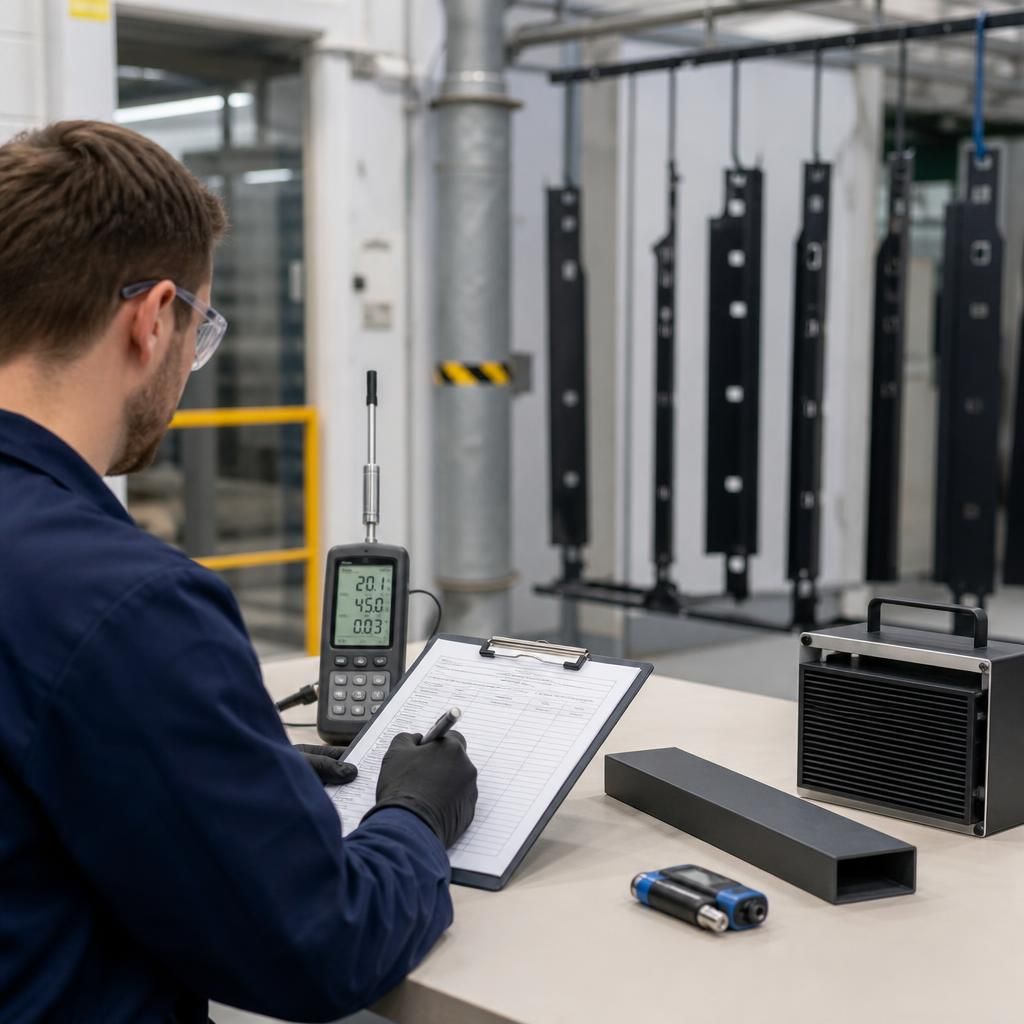
Environmental control is most effective when it is linked to defined acceptance limits and corrective actions. The coating specification or powder manufacturer’s technical data should establish the permitted application conditions, rather than relying on a universal temperature or humidity value. A documented check sheet can record the relevant readings, the operator responsible and whether the batch is released for coating.
If conditions fall outside the agreed limits, the affected work should be placed on hold until the cause has been corrected and the conditions have returned to an acceptable range. Any parts already coated during the deviation should be identified for inspection or testing. This approach prevents operators from attempting to correct an environmentally caused defect by changing gun settings or applying additional powder.
Discuss Environmental Control Requirements for Your Powder Coating Project
Discuss your project with the powder-coating team to confirm the environmental controls, handling requirements and inspection checks needed for your components. Share the component material, dimensions, finish specification and expected service conditions so the application can be assessed against the relevant coating requirements.