

What specific techniques are used in powder coating repair to ensure compatibility with existing coatings?
Powder coating repair is matched to the existing finish through coating identification, colour, gloss and texture comparison, followed by controlled surface preparation and a small test area where needed. Technicians also feather damaged edges, select a compatible repair powder and verify adhesion and curing conditions so the new coating bonds without creating a visible or performance-related mismatch.
Powder coating repair achieves compatibility by treating the existing finish as part of the repair system, rather than applying a new material over it without assessment. The key techniques are resin-family selection, evaluation of the original coating’s condition, controlled interface preparation, suitable repair geometry, and a curing method that does not damage or distort the retained finish.
Confirm the coating system before selecting the repair material. Powder coatings may be based on different resin chemistries, including polyester, epoxy, hybrid and thermoplastic systems. Their resistance to heat, chemicals, ultraviolet exposure and solvents varies. A repair material is therefore chosen according to the original coating’s likely chemistry and the conditions the component will face. For example, an exterior component generally requires a repair system with suitable weathering performance, while an indoor industrial part may have different requirements.
Where the original specification or coating batch information is available, it can provide useful evidence about the resin type, recommended film build and curing range. If documentation is unavailable, technicians assess the coating’s behaviour and condition using appropriate inspection methods. This helps prevent a repair from being chemically or physically unsuitable even when its appearance is close to the surrounding finish.
Separate sound coating from unstable coating. Compatibility depends on what remains attached to the metal. A sound surrounding film can provide a stable boundary, but blistered, under-cured, flaking or chemically degraded material may continue to fail beneath a repair. Technicians remove or isolate unsound areas and avoid sealing active corrosion, trapped contamination or moisture beneath the new layer. If the original coating failure extends beyond a local defect, a larger-area treatment or complete stripping and recoating may be more appropriate than a small repair.
Control the repair boundary. The transition between retained and new coating is designed to reduce a hard step that could remain visible or create a weak edge. The repair may be tapered into the surrounding coating, with the boundary kept away from sharp corners, drainage points, fastener interfaces and areas subject to repeated abrasion where practicable. This is particularly important on fabricated parts with folds, welds or complex profiles, because these features can concentrate coating thickness and affect how the repair cures.
Manage film thickness at the interface. Excessive build-up can produce a ridge, interfere with assembly tolerances or cure differently from the surrounding film. Insufficient build can leave the metal under-protected. Application is therefore controlled so that the repaired area provides the required barrier without creating an abrupt change in thickness. Critical dimensions, mating faces, threads and grounding points may be masked or protected from overspray where the coating could affect fit or electrical contact.
Use an appropriate curing strategy. Powder normally needs a defined combination of part temperature and dwell time to develop its intended properties. During repair, the curing cycle must be considered alongside the existing coating. Too little heat may leave the repair under-cured; excessive heat may discolour the retained finish, alter its texture, damage heat-sensitive components or cause further defects. For local repairs, technicians may use a carefully controlled heat source or process the component as a whole when the part and existing coating can tolerate it. The component’s mass, geometry and metal type also affect how evenly heat reaches the repair.
Account for thermal history. A previously coated component has already experienced a curing cycle, and additional heating can affect both the old and new layers. Repair planning considers whether the retained coating is likely to soften, yellow, lose gloss or release trapped gases when reheated. Where repeated heating presents a risk, an alternative repair route may be selected, such as a compatible coating system designed for lower-temperature application or a wider-area recoating process.
Check the interface rather than relying on appearance alone. A compatible repair should remain stable at the boundary during handling and service. Inspection can include visual examination under suitable lighting, dimensional checks on mating areas, and appropriate tests for coating continuity and mechanical integrity. For production work, the repair method may be recorded against the component specification so that the same powder type, boundary treatment and curing conditions can be repeated consistently across a batch.
Compatibility is ultimately a balance between chemistry, substrate condition, heat exposure, film build and service demands. A repair is not automatically suitable because it looks similar immediately after application. Where the existing finish is unknown, extensively degraded or based on a coating type that cannot safely tolerate further heat, the technically sound option may be to remove the affected system and establish a new coating system across the relevant component.
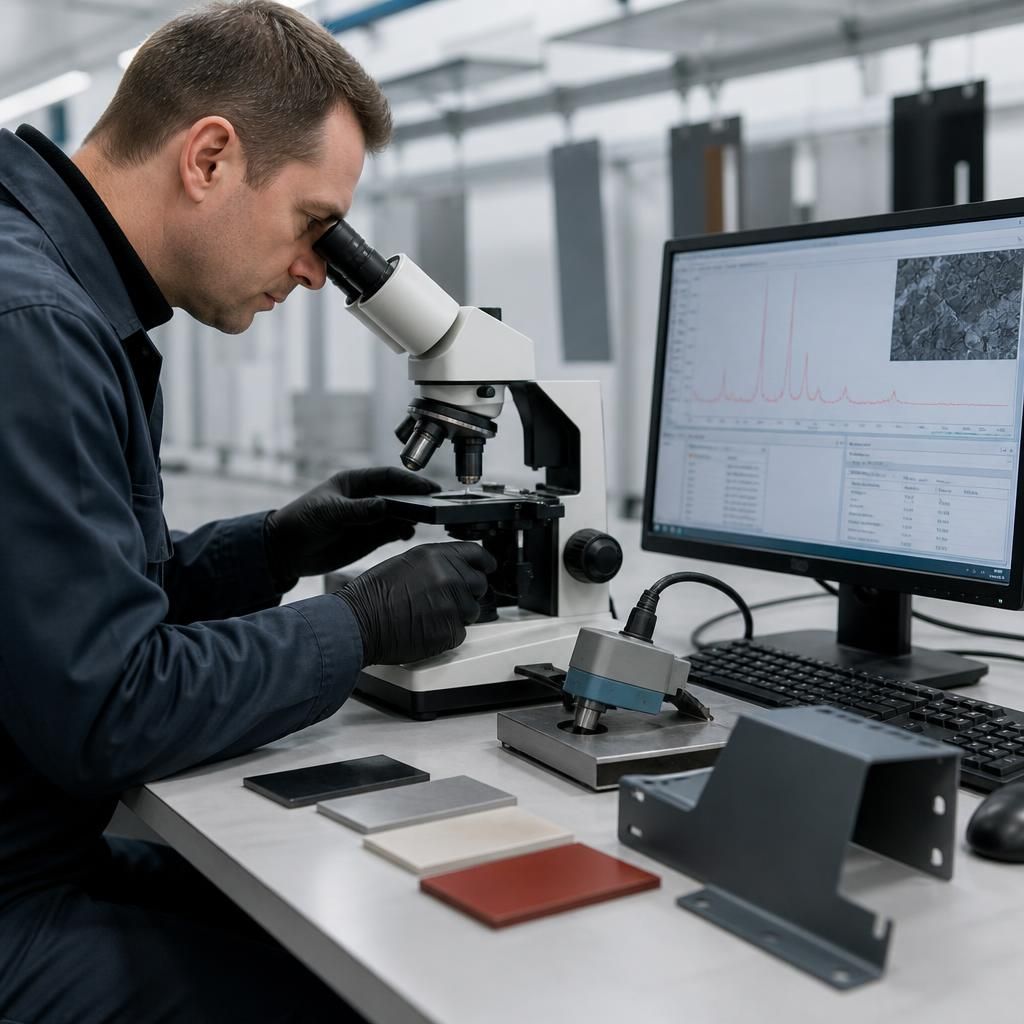
When the original powder specification is unavailable, analytical checks can improve compatibility decisions. A coating sample may be examined by microscopy to identify layer structure, while infrared analysis can help distinguish resin families such as polyester, epoxy or thermoplastic coatings. A dry-film thickness measurement also shows how much existing material remains and whether a local repair could create excessive build-up. These checks are particularly useful where the finish is visually similar to another coating but may respond differently to heat, solvents or mechanical preparation.
The results are used alongside the component’s service conditions and the condition of the retained coating. This helps determine whether the repair should use a matching powder, a compatible alternative or a wider recoating approach. It also reduces the risk of treating an unidentified coating as though it had the same curing and performance characteristics as the new repair material.
Discuss Your Powder Coating Repair Requirements
Discuss your powder coating repair requirements with the team, including the component’s condition, service environment and any available information about the existing coating. This will help establish whether a local repair or wider recoating approach is technically appropriate.